


Turkish Prime Minister Recep Tayyip Erdogan said yesterday Kurdish militants would “drown in their own blood” as he led political and army chiefs in paying respects to troops killed in a clash with the rebels.
The fighting on Saturday, which marked a fresh escalation in the 26-year-old insurgency, killed 11 soldiers and 12 Kurdistan Workers Party (PKK) guerrillas in the southeastern province of Hakkari, near the border with Iraq.
The soldiers’ coffins, draped in red-and-white Turkish flags, were laid out on tables for a ceremony at a military base in the city of Van where Erdogan and armed forces chief General Ilker Basbug listened to a Muslim prayer with other leaders.
“Today we will not make the traitors happy,” Erdogan said. “We will defend this ground heroically. Resolute against enemies, resolute against terrorism.”
“I say here very clearly, they will not win. They will gain nothing. They will melt away in their own darkness ... they will drown in their own blood,” he said.
The death toll in Saturday’s clash was one of the highest in recent years in a conflict that has killed more than 40,000 people since the PKK took up arms against the state in 1984 with the aim of creating an ethnic homeland in the southeast.
After Saturday’s battle, the Turkish air force struck PKK targets in the mountains of northern Iraq, where several thousand of the rebels are based.
Military sources said yesterday one Turkish soldier was killed and one injured overnight in a Kurdish rebel attack on a military outpost in the southeastern province of Elazig.
They said the militants threw a hand grenade at the base before opening fire with rifles in the Palu district of Elazig.
Turkish troops entered northern Iraq overnight, penetrating 10km, after the deadly attacks, a security official said yesterday.
Three people were killed in the incursion into the Qandil mountains, where the PKK maintains rear bases for its campaign, he said.
The official did not specify whether the dead were civilians or PKK fighters, but he said that the incursion happened in the Shamarsha district of Arbil province north of the town of Sidikan.
It was the second time in five days that Turkish ground forces had crossed the border.
On Wednesday, Turkish troops crossed from Sirnak Province into Dohuk Province farther west, in their first ground operation across the border in two years.
“Two of our men were killed in the clashes that took place on Wednesday,” PKK spokesman Ahmed Denis said in the Iraqi Kurdistan regional capital of Arbil on Friday.
The intensifying clashes between the PKK and Turkish troops prompted Denis to warn on Saturday that the rebels would take their armed campaign to cities across Turkey if the army pressed on with a policy of military confrontation.
A local official said Turkish air raids in Iraq’s Kurdish north killed a teenage girl — the first reported civilian death from shelling that began last week.
Karmang Ezzat, mayor of the Soran border town, said yesterday that the girl’s mother and three-year-old brother were also wounded in the previous night’s attack.

‘NO SECURITY RISK’: The Railway Bureau reassured the public that the technicians’ activities were limited to technical guidance and did not involve sensitive systems The Railway Bureau yesterday said it had invited eight Chinese technicians to assist with an airport MRT construction project. The bureau issued the confirmation after an Internet user said Chinese nationals had entered the construction zone of Taiwan Taoyuan International Airport’s Terminal 3 project. They asked why “individuals from an enemy state” were allowed access to such a major national infrastructure project, which raised serious concerns over Taiwan’s industrial safety, sensitive systems and information security. The bureau’s Northern Region Engineering Branch Office said subcontractor Taiwan Handle Industrial Co (台灣手把工業) of the Taoyuan airport MRT’s “Contract No. CU05 Project A14 Station Civil, MEP &

The National Chungshan Institute of Science and Technology yesterday showcased its locally developed variants of the Vision 60 robotic patrol dog, which it plans to deploy on the nation’s outlying territories in the South China Sea. The variants were produced under the Joint Lab project — created by the institute and domestic companies — and assembled with domestically produced motors, lenses and artificial intelligence (AI) systems alongside licensed tech from the US, Missile and Rocket Systems Research Division deputy director Jen Kuo-kang (任國光) told the media event at a military base in Taipei’s Dazhi (大直) area. Taiwan has built up its strengths
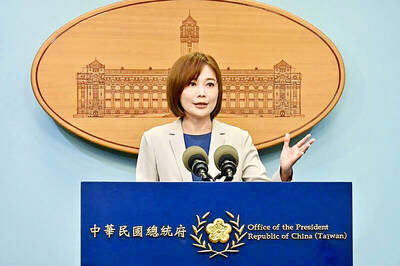
TIT-FOR-TAT: The US allegedly revoked the visa of a Chinese national working at Xinhua News Agency in the US in response to Beijing’s expulsion of Vivian Wang The Presidential Office yesterday condemned China for expelling a New York Times correspondent from Beijing following the newspaper’s interview with President William Lai (賴清德), saying the move highlighted Beijing’s suppression of press freedom and its threat to international news media. Taiwan has noted a series of recent incidents in which Beijing used similar tactics to “threaten and pressure international media outlets and journalists,” Presidential Office spokeswoman Karen Kuo (郭雅慧) said in a statement. “This concerns not only press freedom and freedom of expression, but also the safety of journalists, and Taiwan and relevant partners are paying close attention to the situation,” she

NOT IMMEDIATE: Taiwan has a chance to appeal the proposed 10 percent tariff before it starts, while other countries face a 12.5 percent tariff from the trade office Taiwan is among 60 economies determined by the US to have failed to impose or enforce a ban on the importation of goods produced with forced labor, according to a notice released on Tuesday by the Office of the US Trade Representative (USTR), which proposed imposing an additional 10 percent or more tariff on them. The USTR in a statement said that following an investigation, it had determined under Section 301 of the Trade Act of 1974 that the failure of the 60 economies to impose and effectively enforce a prohibition on the importation of goods produced with forced labor is


 RSS
RSS