


Au Revoir, Taipei, (一頁台北), a romantic comedy set in Taipei City, won the Best Asian Film Award from the Network for the Promotion of Asian Cinema (NETPAC) at the Berlin International Film Festival on Saturday, beating 11 other Asian entries.
The love story, which takes place over the course of one evening in Taipei City, was produced by German director Wim Wenders and directed by Arvin Chen (陳駿霖).
Chen is no stranger to the Berlin film festival. He won a Silver Berlin Bear-Jury Grand Prix for Short Films for a short he made titled May in 2007.

PHOTO: CNA
Starring singer Amber Kuo (郭采潔), Jack Yao (姚淳耀) and Joseph Chang (張孝全), Au Revoir, Taipei screened to packed audiences and won loud applause in Berlin.
Frank Chen (陳志寬), director of the Government Information Office’s (GIO) Motion Picture Affairs Department, conveyed the government’s congratulations to Chen on Saturday over the honor.
By winning the top award at NETPAC, which is an alliance of the Berlin film festival organizers, Au Revoir, Taipei now has the opportunity of winning a prize of NT$1.5 million (US$47,000) awarded by the GIO.
Another Taiwanese movie, Monga (艋舺), which has enjoyed huge box office success in Taiwan, was also screened at the festival, but did not win a prize.
Upon learning of the victory in Berlin, Taipei Mayor Hau Lung-bin (郝龍斌) said the performance of the two movies filmed in Taipei was a successful marketing campaign for the city.
Various aspects of Taipei, including the MRT system, night markets and the round-the-clock Eslite bookstore, all feature in the film.
“From Monga to Au Revoir Taipei, the Taipei Film Commission has worked closely with film production teams during the filming process and turned the movies into successful campaign for the city,” Hau told reporters while inspecting a construction site in the city yesterday. “Our cooperation with film crews not only increases publicity and visibility of Taipei worldwide, but also made many movie scenes new destinations for visitors to the city.”
In the making of the movie Monga, the city government closed streets to facilitate the filming, while for Au Revoir Taipei, the city government closed off an MRT station, allowing the crew to use an MRT train for filming and even dispatched real police officers to play police in the movie.
The city government cooperated with 15 countries in the production of 25 motion pictures last year, Hau said.
Outgoing GIO Minister Su Jun-pin (蘇俊賓) sent a message to the Au Revoir, Taipei team in Berlin to congratulate them for winning the award.
Au Revoir, Taipei and Monga will both receive GIO money.
“As it won an award at an international film festival, the production team of Au Revoir, Taipei will be awarded NT$1.5 million for their achievement,” GIO Motion Picture Affairs Department Director Joanne Tien (田又安) told the Taipei Times by telephone.
“Monga will receive a NT$200,000 prize for being nominated,” she said.
The Berlin International Film Festival concluded yesterday.
ADDITIONAL REPORTING BY LOA IOK-SIN
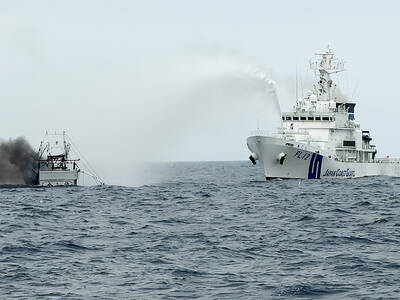
CREDIT-GRABBER: China said its coast guard rescued the crew of a fishing vessel that caught fire, who were actually rescued by a nearby Taiwanese boat and the CGA Maritime search and rescue operations do not have borders, and China should not use a shipwreck to infringe upon Taiwanese sovereignty, the Coast Guard Administration (CGA) said yesterday. The coast guard made the statement in response to the China Coast Guard (CCG) saying it saved a Taiwanese fishing boat. The Chuan Yu No. 6 (全漁6號), a fishing vessel registered in Keelung, on Thursday caught fire and sank in waters northeast of Diaoyutai Islands (釣魚台). The vessel left Keelung’s Badouzih Fishing Harbor (八斗子漁港) at 3:35pm on Sunday last week, with seven people on board — a 62-year-old Taiwanese captain surnamed Chang (張) and six

RISKY BUSINESS: The ‘incentives’ include initiatives that get suspended for no reason, creating uncertainty and resulting in considerable losses for Taiwanese, the MAC said China’s “incentives” failed to sway sentiment in Taiwan, as willingness to work in China hit a record low of 1.6 percent, a Ministry of Labor survey showed. The Directorate-General of Budget, Accounting and Statistics (DGBAS) also reported that the number of Taiwanese workers in China has nearly halved from a peak of 430,000 in 2012 to an estimated 231,000 in 2024. That marked a new low in the proportion of Taiwanese going abroad to work. The ministry’s annual survey on “Labor Life and Employment Status” includes questions respondents’ willingness to seek employment overseas. Willingness to work in China has steadily declined from

The number of pet cats in Taiwan surpassed that of pet dogs for the first time last year, reaching 1,742,033, a 32.8 percent increase from 2023, the Ministry of Agriculture said yesterday, citing a survey. By contrast, the number of pet dogs declined slightly by 1.2 percent over the same period to 1,462,528, the ministry said. Despite the shift, households with dogs still slightly outnumber those with cats by 1.2 percent. However, while the number of households with multiple dogs has remained relatively stable, households keeping more than two cats have increased, contributing to the overall rise in the feline population. The trend

LEVERAGE: China did not ‘need to fire a shot’ to deny Taiwan airspace over Africa when it owns ‘half the continent’s debt,’ a US official said, calling it economic warfare The EU has raised concerns about overflight rights following the delay of President William Lai’s (賴清德) planned state visit to the Kingdom of Eswatini after three African nations denied overflight clearance for his charter at the last minute. Taiwanese allies Paraguay and Saint Kitts and Nevis, as well as several US lawmakers and the Inter-Parliamentary Alliance on China (IPAC) condemned China for allegedly pressuring the countries. Lai was scheduled to fly directly to Taiwan’s only African ally from yesterday to Sunday to celebrate the 40th anniversary of King Mswati III’s accession and his 58th birthday, but Seychelles, Mauritius and Madagascar suddenly revoked


 RSS
RSS