


The Chinese Nationalist Party (KMT) yesterday announced that a former top aide to President Ma Ying-jeou (馬英九) would take over as party secretary-general.
The party confirmed that Ma had invited his former top aide and deputy city mayor, King Pu-tsung (金溥聰), to assist him with party affairs. King, currently a visiting scholar at the Brookings Institution in Washington, is expected to return to Taiwan later this month.
“We expect Mr King to bring more energy to the KMT and initiate bold and creative moves to help with party reform,” KMT spokesman Lee Chien-jung (李建榮) said after the party’s Central Standing Committee (CSC) meeting.
KMT Secretary-General Chan Chun-po (詹春柏), who also doubles as KMT vice chairman, will continue to serve as vice chairman while assisting King with party affairs, Lee said.
King, 54, played a major role in Ma’s previous campaigns, helping him win the Taipei City mayoral elections in 1998 and 2001, and the presidential election last year.
King’s first major task would be the campaign for the special municipality elections next year.
Before the KMT confirmed King’s new position, King had dismissed a report by the Chinese-language United Daily News earlier yesterday that he would return to “save” Ma from plummeting popularity by taking on the position of Presidential Office secretary-general.
King said he would not be taking any position in the Presidential Office, when asked for comment in a phone interview with ETTV.
APOLOGY
Earlier yesterday, Ma apologized for the party’s poor performance in Saturday’s local government elections and promised to continue party reform and improve the overall environment.
“A large number of pan-blue supporters did not vote in the elections this year. This means we did not work hard enough and our performance had disappointed them. I want to apologize to our supporters as the party chairman,” Ma told the CSC meeting.
Ma also apologized for the behavior of the party’s candidate for Huwei Township, Yunlin County, Chen Chen-hui (陳振輝) who, inebriated and armed with a handgun, wounded the sister of his Democratic Progressive Party (DPP) rival after losing the election.
The KMT took 12 of the 17 mayor and commissioner seats, while the DPP won four, and one went to an independent — a former KMT member.
The DPP increased its share of the overall vote to 45.9 percent, up from 38.2 percent four years ago, while taking back control of the hotly contested Yilan County after losing it to the KMT four years ago.
ECONOMY
Ma blamed the party’s disappointing performance on the “overall environment” and defended the Cabinet’s efforts to revive the economy and lower the unemployment rate.
“The Cabinet’s goal to establish policies in line with public expectations is correct, and we will strengthen our efforts in this direction,” he said.
Ma congratulated the DPP for its better-than-expected performance in the elections, saying he expected the two parties to resume normal relations and have a dialogue soon.
Several CSC members blamed the party’s worse-than-expected election performance on an ineffective Cabinet and called on Ma and the government to improve administrative performance.
“Apology is not the best way to solve the problem. I personally think that in order to attract public support, the government must improve administrative effectiveness,” CSC member Sean Lien (連勝文), son of former KMT chairman Lien Chan (連戰) said.
“I am very disappointed at some government officials’ slow response, and I can imagine how disappointed the public was in the government,” he said.
KMT Legislator Huang Chao-shun (黃昭順) said the party should reflect on its performance and warned that voters would give the KMT another lesson in the next election if it failed to acknowledge its mistakes.

A signaling system malfunction disrupted high-speed rail (HSR) services beginning at 8am today, with trains temporarily reduced to three northbound and three southbound trains per hour as authorities conduct inspections. The malfunction occurred on a section of track in Miaoli County during pre-operation checks early this morning, forcing northbound and southbound trains to use a single track, the HSR operator said. The regular schedule has been replaced with three hourly trains offering only nonreserved seating in each direction, stopping at every station, it said, adding that business class cars would still have reserved seating. Departures from terminal stations are scheduled at the top

DRONE CENTRAL: Taiwan aims to become Asia’s democratic hub for drones, with most exports focused on high-quality military-grade models, an official said Taiwan’s drone industry is expected to expand significantly by 2030, producing 100,000 units per month and exporting half of them, the Ministry of Economic Affairs said yesterday. Current drone production capacity is about 15,000 units per month, but the industry can quickly scale up as demand increases, Industrial Development Administration Director-General Chiou Chyou-huey (邱求慧) told a news conference in Taipei. Taiwan’s drone output grew 2.5-fold last year to NT$12.9 billion (US$408.3 million) under a government program to develop the uncrewed vehicle sector, he said. The Executive Yuan in October last year approved plans to invest NT$44.2 billion into domestic production of uncrewed aerial

VERBOSE VESSELS: A CGA cutter and a China Coast Guard exchanged verbal barbs for more than a day in Taiwanese-controlled waters before the Chinese vessel left The Taiwanese and Chinese coast guards had a standoff near the strategically located Pratas Islands (Dongsha Islands, 東沙群島) in the north of the South China Sea, the Coast Guard Administration (CGA) said yesterday. The two sides engaged in intense radio exchanges over sovereignty claims during the 33-hour standoff. China Coast Guard vessel 3501 eventually left the restricted waters, 26.6 nautical miles (49.2km) west of the Pratas Islands, at 5pm yesterday, the CGA said. Lying approximately between southern Taiwan and Hong Kong, the Taiwan-controlled Pratas are seen by some security experts as vulnerable to Chinese attack due to their distance — more than
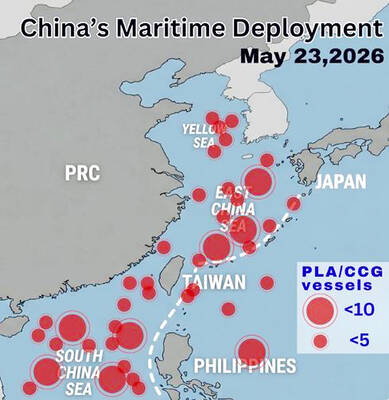
WARNING: China should stop engaging in actions that undermine regional peace and stability, as it would only build resentment among people across the Strait, the CGA said China has deployed more than 100 navy, coast guard and other vessels in waters from the Yellow Sea to the South China Sea and the western Pacific since US President Donald Trump and Chinese President Xi Jinping (習近平) met in Beijing, National Security Council Secretary-General Joseph Wu (吳釗燮) said yesterday. “In this part of the world, #China is the one & only PROBLEM wrecking the #StatusQuo & threatening regional peace & stability,” Wu wrote on X. In a separate post, he said Beijing was coercing Taiwan’s maritime domain, calling it illegal and provocative, after the Coast Guard Administration (CGA) expelled a


 RSS
RSS