


A government report found at least 146 military officials involved in 34 cases of alleged promotion-buying and 21 procurement scandals, with 114 of the suspects in the highest tier of the country’s three-tier enlisted force structure.
Ministry of National Defense (MND) Minister Chen Chao-min (陳肇敏) and Minister of Justice Wang Ching-feng (王清峰) jointly presented the report yesterday, the deadline set by President Ma Ying-jeou (馬英九) in April for the MND to report on corruption in the military. Ma’s action came in the wake of a spate of scandals involving the defense ministry.
Among the cases listed in the report, seven involve officers who are already under investigation while the other 48 cases involving 142 military officers had recently been referred by the MND to military prosecuters.
The 142 military officers include 40 lieutenant generals, 74 major generals, seven colonels, 10 lieutenant colonels, seven majors, one captain and one sergeant, the report showed.
“There have been concerns that our investigation was only aimed at low-level officers, but it was not,” Chen said. “The percentage of high-ranking officers was substantial, showing that the ministry is determined to impartially investigate suspects regardless of rank.”
During the past three months, Chen said the ministry had launched a comprehensive probe that included 910 promotion cases since 1998, 3,220 cases involving construction projects, 16,857 cases involving procurements, 21,402 cases concerning public spending and 5,087 cases that allegedly involved promotion-buying.
When asked why the ministry sent just 48 cases out of the 47,476 cases investigated to military prosecutors for further investigation, Chen said these particular cases were highly suspect.
The ministry will refer other cases for further investigation if any more evidence is found, Chen said.
“[The investigation into irregularities] was just the beginning. It will not stop until all corruption is swept away and the military is clean. We have to ferret out the dishonest and restore discipline in the military so that the army can use its strength to protect the nation,” Chen said.
To complete the report, the MND and the Ministry of Justice (MOJ) formed a joint task force, with Chen and Wang both agreeing to turn the mechanism into a standing agency.
The MOJ yesterday also presented a set of measures to clean up politics.
Wang said her ministry had drawn up a list of problems that impede investigation and proposed suggestions to address flaws in the judicial system as well as in rules and regulations.
“Integrity is the one and only way to enhance the country’s competitiveness,” Wang said.
The set of suggestions proposed by the MOJ came from its review of 12 scandals, which included the alleged corruption cases involving former president Chen Shui-bian (陳水扁) and his family members, the case involving Ma’s mayoral fund during his stint as Taipei mayor and the case of alleged money laundering involving the former president’s family physician, Huang Fang-yen (黃芳彥).
When asked why the report did not address the problem of judicial personnel integrity, Wang mentioned Huang’s alleged disappearance.
“I thought you were referring to why Huang was able to flee to the US after some people put the blame on State Public Prosecutor-General Chen Tsung-ming (陳聰明). I was very much concerned about this, but as it is still under investigation by the Special Prosecutors Panel, I have no comment on that,” Wang said.
At a separate setting yesterday, Chinese Nationalist Party (KMT) legislators expressed dissatisfaction with the report.
“President Ma should reject the report,” KMT Legislator Chiu Yi (邱毅) told reporters at the legislature. “The report is simply a list of corruption cases that have been investigated recently. Is there any major anti-corruption breakthrough in the report?” Chiu asked.
Chiu said the MND and the MOJ were attempting to fool the president with the report.
KMT Legislator Lo Shu-lei (羅淑蕾) wanted the ministers of justice and national defense to take responsibility for failing to demonstrate the government’s anti-corruption achievements in the report.
“If they don’t take responsibility for the report, how can the public tell whether the Ma administration really meant it when Ma vowed to combat corruption?” she said.
Democratic Progressive Party (DPP) lawmakers were also critical of the report. DPP Legislator Wang Sing-nan (王幸男) said it mostly listed corruption cases involving pan-green figures but few KMT politicians.
“Which goes to prove the Ma government only probed green politicians and officials, but covered up for blue individuals,” Wang said.
The report also listed Ma’s mayoral allowance case in 2007, in which he was later found not guilty.
“The Ministry of Justice only listed the case to stress Ma’s ‘cleanness’ and ‘innocence,’” Wang said.
“The ministry is flattering Ma,” he said.
Saying that most of the cases listed on the report are old, DPP Legislator Chen Ting-fei (陳亭妃) said DPP lawmakers had filed a number of corruption cases against officials who are KMT members but none of those cases were listed in the report.
Meanwhile, on the MOJ’s proposed measure suggesting that rules be drafted to regulate the behavior of political commentators, National Communications Commission (NCC) spokesperson Lee Ta-sung (李大嵩) said yesterday that he had not read the report and needed to see it before commenting.
Currently, the Satellite Broadcasting Act (衛星廣播電視法) has no article regulating the behavior of the political commentators.
Lee said the NCC has completed the proposed amendment to the act and was ready to submit it to the Executive Yuan for final approval.
“We have asked news programs to establish a fact-checking mechanism in the amendment,” Lee said. “But that requirement only applies to television news programs and does not extend to political talk shows.”
“If news reporters want to quote political commentators, the reporters must be responsible for checking the facts that political commentators give,” he said.
The fact-checking requirement in the proposed amendment to the act was interpreted earlier by some media as a way to muzzle political commentators.
ADDITIONAL REPORTING BY RICH CHANG, FLORA WANG AND SHELLEY SHAN


RESILIENCE: Taiwan plays a key role in semiconductors, energy, information infrastructure and advanced manufacturing, AIT Director Raymond Greene said Taiwan’s continued investment in deterrence and resilience remains vital, especially in uncrewed systems and other emerging technologies, American Institute in Taiwan (AIT) Director Raymond Greene said yesterday. Greene made the remarks at the annual National Strategic Summit on Supply Chain Resilience held by the Research Institute for Democracy, Society and Emerging Technology (DSET), a government-backed think tank. As Taiwan last year became the US’ fourth-largest trading partner and supply chain security is becoming more important, cooperation in emerging technologies continues to deepen between the two countries, he said. The US is committed to accelerating innovation, building key infrastructure, strengthening cooperation

The National Chungshan Institute of Science and Technology yesterday showcased its locally developed variants of the Vision 60 robotic patrol dog, which it plans to deploy on the nation’s outlying territories in the South China Sea. The variants were produced under the Joint Lab project — created by the institute and domestic companies — and assembled with domestically produced motors, lenses and artificial intelligence (AI) systems alongside licensed tech from the US, Missile and Rocket Systems Research Division deputy director Jen Kuo-kang (任國光) told the media event at a military base in Taipei’s Dazhi (大直) area. Taiwan has built up its strengths
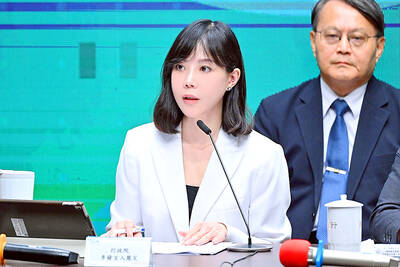
RIGHT DIRECTION: Taiwan’s efforts to prevent forced labor include a proposal to ‘fully prohibit’ employers from withholding workers’ documents, an official said Taiwan is to establish a mechanism to restrict imports of goods linked to forced labor, the Executive Yuan said yesterday, after the US proposed imposing additional tariffs on Taiwanese goods over labor concerns. “The Ministry of Labor and the Ministry of Economic Affairs are to establish an interministerial review procedure,” Executive Yuan spokesperson Michelle Lee (李慧芝) said at a news briefing in Taipei. “The government is to use the Foreign Trade Act [貿易法] as the legal basis to restrict imports of goods produced with forced labor” and bring its supply chain governance more in line with international standards on human rights, resilience
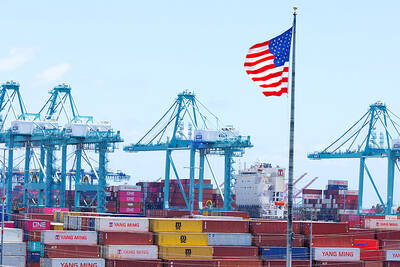
NOT IMMEDIATE: Taiwan has a chance to appeal the proposed 10 percent tariff before it starts, while other countries face a 12.5 percent tariff from the trade office Taiwan is among 60 economies determined by the US to have failed to impose or enforce a ban on the importation of goods produced with forced labor, according to a notice released on Tuesday by the Office of the US Trade Representative (USTR), which proposed imposing an additional 10 percent or more tariff on them. The USTR in a statement said that following an investigation, it had determined under Section 301 of the Trade Act of 1974 that the failure of the 60 economies to impose and effectively enforce a prohibition on the importation of goods produced with forced labor is


 RSS
RSS