


The Presidential Office official yesterday denied that an upcoming personnel reshuffle at the Taiwan Foundation for Democracy (TFD) was politically motivated.
“The board of directors’ term is about to finish and according to the TFD’s own charter, the number of seats should be allocated according to the percentage of each political party’s seats in the legislature,” the Presidential Office public relations director Eddy Tsai (蔡仲禮) told the Taipei Times by telephone. “We’re only acting according to the rules.”
Tsai made the remarks in response to a report published by the Chinese-language United Daily News yesterday that said President Ma Ying-jeou (馬英九) was planning a personnel reshuffle at the foundation because he was unhappy about the organization providing financial support to Tibetan and Chinese democracy activists.
The TFD, modeled on the National Endowment for Democracy (NED) in the US, was founded in 2003 under the then-Democratic Progressive Party administration with government funds with the aim of promoting human rights and democracy around the world.
The United Daily News story quoted an unnamed senior government official as saying that Ma was not happy with some of the foundation’s activities and was especially displeased with executive director Lin Wen-cheng (林文程), and deputy executive directors Maysing Yang (楊黃美幸) and Tung Li-wen (董立文).
The official said leading policy decision-makers in the government were nervous about Yang providing financial support to Chinese democracy activists, Tibetan independence organizations and Cuban democracy activists.
“If we don’t deal with it now, we’ll have problems in our relations with the US and China,” the official was quoted as saying in the story.
The official also accused the TFD of asking the US-based human rights watchdog group Freedom House to criticize the Chinese Nationalist Party (KMT) government.
Taiwan’s ranking on press freedom dropped 11 places in a Freedom House report released earlier this year.
“[The TFD] gets money from the government and attacks the government — how can we not do anything about it?” the official was quoted as saying.
In an interview with the Taipei Times yesterday, a TFD board member, who spoke on condition of anonymity, slammed the unnamed official in the United Daily News story as being “ignorant, without common sense and unsuitable to serve as an official in a democracy.”
The board member said that while the TFD is supposed to operate independently despite receiving government funding, officials in Ma’s administration often intervene.
“For example, when we were organizing an event to commemorate the 20th anniversary of the Tiananmen Square Massacre, we were told which speakers to invite and which to not invite,” the board member said. “Our democracy is deteriorating.”
Meanwhile, Yang said the TFD has done nothing wrong.
“These ‘top officials’ don’t understand what the TFD’s objective is,” Yang was quoted by Central News Agency (CNA) as saying yesterday. “If we don’t give support to organizations promoting human rights and democracy, what do we need the TFD for?”
All the money that went to Tibetan, Chinese, or Cuban human rights and democracy organization groups was reviewed and approved by the TFD board of directors, as well as the Ministry of Foreign Affairs and the Ministry of Audit, CNA quoted Yang as saying.
She said there were different groups offering support to Chinese and Tibetan activists in most democratic countries with diplomatic ties with China.
“I don’t see how the relationship between China and those countries would be affected by the groups’ efforts to support Chinese and Tibetan activists,” Yang said.
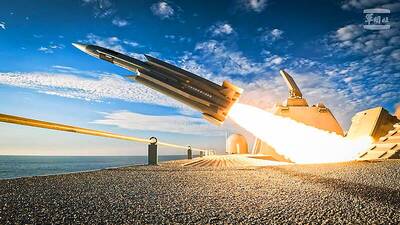
DETERRENCE: With 1,000 indigenous Hsiung Feng II and III missiles and 400 Harpoon missiles, the nation would boast the highest anti-ship missile density in the world With Taiwan wrapping up mass production of Hsiung Feng II and III missiles by December and an influx of Harpoon missiles from the US, Taiwan would have the highest density of anti-ship missiles in the world, a source said yesterday. Taiwan is to wrap up mass production of the indigenous anti-ship missiles by the end of year, as the Chungshan Institute of Science and Technology has been meeting production targets ahead of schedule, a defense official with knowledge of the matter said. Combined with the 400 Harpoon anti-ship missiles Taiwan expects to receive from the US by 2028, the nation would have

POSSIBILITIES EMERGE: With Taiwan’s victory and Japan’s narrow win over Australia, Taiwan now have a chance to advance if South Korea also beat the Aussies Taiwan has high hopes that the national baseball team would advance to the World Baseball Classic (WBC) quarter-finals after clinching a crucial 5-4 victory over South Korea in a nail-biting extra-inning game at the Tokyo Dome yesterday. Boosted by three home runs — two solo shots by Yu Chang (張育成) and Cheng Tsung-che (鄭宗哲) and a two-run homer by Stuart Fairchild — the triumph gave Taiwan a much-needed second victory in the five-team Pool C, where only the top two finishers would advance to the knockout stage in Miami, Florida. Entering extra innings with the game tied at four apiece, Taiwan scored
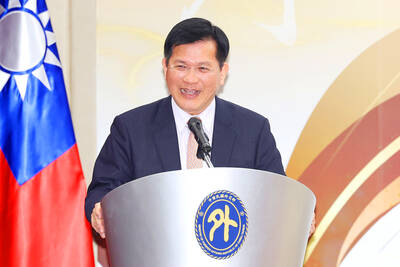
MISSION OF PEACE: The foreign minister urged Beijing to respect Taiwan’s existence as an independent nation, and work together to ensure peace and stability in the region Minister of Foreign Affairs Lin Chia-lung (林佳龍) yesterday rejected Chinese Minister of Foreign Affairs Wang Yi’s (王毅) comments about Taiwan, criticizing China as a “troublemaker” in the international community and a disruptor of cross-strait peace. Speaking at a news conference on the sidelines of the Chinese National People’s Congress, Wang said that Taiwan has always been a territory of China and that it would be impossible for it to become its own country. The “return” of Taiwan to China was the natural outcome of the Chinese people’s resistance against Japan in World War II, and that any pursuit of independence was “doomed

‘UNWAVERING FRIENDSHIP’: A representative of a Japanese group that co-organized a memorial, said he hopes Japanese never forget Taiwan’s kindness President William Lai (賴清德) yesterday marked the 15th anniversary of the Tohoku earthquake and tsunami, urging continued cooperation between Taiwan and Japan on disaster prevention and humanitarian assistance. Lai wrote on social media that Taiwan and Japan have always helped each other in the aftermath of major disasters. The magnitude 9 earthquake struck northeastern Japan on March 11, 2011, triggering a massive tsunami that claimed more than 19,000 lives, according to data from Japanese authorities. Following the disaster, Taiwan donated more than US$240 million in aid, making it one of the largest contributors of financial assistance to Japan. In addition to cash donations and


 RSS
RSS