


President Ma Ying-jeou (馬英九) yesterday met with Premier Liu Chao-shiuan (劉兆玄) and finance officials to discuss ways of dealing with the economic recession and asked that the Cabinet present practical strategies within three months on increasing exports and developing major industries.
The strategies will focus on diversifying export products, encouraging local industries to establish their own brands and acquiring key technologies, while pushing for the development of emerging industries, such as tourism, medical care, biotechnology and modern agriculture, the meeting concluded.
The signing of a Comprehensive Economic Cooperation Agreement (CECA) with China was also among the topics discussed at the meeting.
Ma said signing a CECA with China was part of his election platform and that his administration would push for the implementation of an agreement, Presidential Office Spokesman Wang Yu-chi (王郁琦) told reporters after the three-hour closed-door meeting yesterday.
Wang said Ma told the meeting that as to the title, content and form of the agreement, he would seek opinions from the public. The opposition party and the public were welcome to share their thoughts on the issues, Ma said, adding that normalizing cross-strait economic and trade relations remained a major aim of his administration and that the government would continue pushing for more cross-strait exchanges, while seeking public consensus.
Ma asked Liu and the Cabinet to report on the current economic situation and possible solutions to the downturn after the latest data released by the Directorate-General of Budget, Accounting and Statistics (DGBAS) published on Wednesday showed the nation’s economy was officially in recession. The data showed that GDP shrank by 8.36 percent in the fourth quarter of last year after a bigger-than-expected decline in exports that prompted the private sector to halt or delay investment.
Council for Economic Planning and Development Chairman Chen Tain-jy (陳添枝) yesterday presented a report on the nation’s overall economic situation and possible solutions to the financial crisis.
Ma and the Cabinet focused their discussion on the long-term development of local industries amid the global financial crisis. Specific policies were not included in the discussion, Wang said.
Ma called on the Cabinet to invite public bids for public construction works and to implement the projects as quickly as possible. He said he expected the legislature to pass a NT$500 billion (US$14.3 billion) budget so that the government could improve the economic situation.
Wang dismissed talk of a possible Cabinet reshuffle because of the financial crisis and stressed that the meeting was held simply to discuss solutions to the recession.
“The Cabinet’s strategies to revive the economy are no different from those presented by other nations’ governments. However, the president suggested that the Cabinet should pay particular attention to their effectiveness and the public’s expectations,” Wang said.
Ma will preside over another meeting this morning to discuss major social issues, including the possible renaming of Taiwan Democracy Memorial Hall.
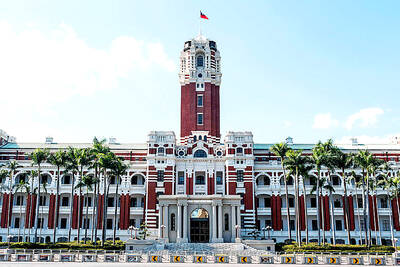
SECURITY: Taipei presses the US for arms supplies, saying the arms sales are not only a reflection of the US security commitment to Taiwan but also serve as a mutual deterrent against regional threats Taiwan is committed to preserving the cross-strait “status quo” and contributing to regional peace and stability, the Presidential Office said yesterday. “It is an undeniable fact that the Republic of China is a sovereign and independent democratic nation,” Presidential Office spokeswoman Karen Kuo (郭雅慧) reiterated, adding that Beijing has no right to claim sovereignty over Taiwan. The statements came after US President Donald Trump warned against Taiwanese independence. Trump wrapped up a state visit to Beijing on Friday, during which Chinese President Xi Jinping (習近平) had pressed him not to support Taiwan. Taiwan depends heavily on US security backing to deter China from carrying
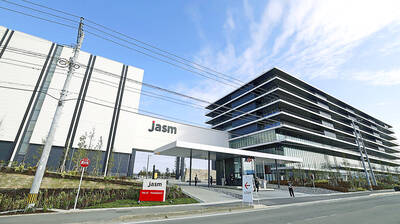
The subsidiary of Taiwan Semiconductor Manufacturing Co (TSMC, 台積電) in Kumamoto, Japan, turned a profit in the first quarter of this year, marking the first time the first fab of the unit has become profitable since mass production started at the end of 2024. According to the contract chipmaker’s financial statement released on Friday, Japan Advanced Semiconductor Manufacturing Inc (JASM), a joint venture running the fab in Kumamoto, posted NT$951 million (US$30.19 million) in profit in the January-to-March period, compared with a loss of NT$1.39 billion in the previous quarter, and a loss of NT$3.25 billion in the first quarter of
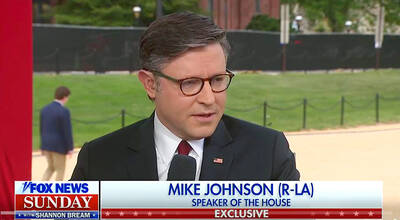
RESOLUTE BACKING: Two Republican senators are planning to introduce legislation that would impose immediate sanctions on China if it attempts to invade Taiwan US House of Representatives Speaker Mike Johnson on Sunday reaffirmed US congressional support for Taiwan, saying the US and “all freedom-loving people” have a stake in preventing China from seizing Taiwan by force. Johnson made the remarks in an interview with Fox News Sunday on US President Donald Trump’s summit with Chinese President Xi Jinping (習近平) last week. In an interview that aired on Friday on Fox News, just as Trump wrapped up a high-stakes visit to China, he said he has yet to green-light a new US$14 billion arms package to Taiwan and that it “depends on China.” “It’s a very good
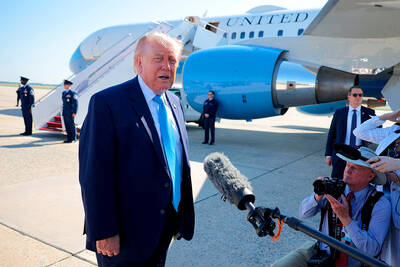
US President Donald Trump yesterday said he would speak to President William Lai (賴清德) as his administration considers whether to move ahead with a US$14 billion weapons sale to Taiwan — a potential arms deal that has drawn criticism from China. “Well, I’ll speak to him. I speak to everybody,” Trump told reporters yesterday when asked if he had any plans to call his counterpart, although he did not offer a time frame for when such a conversation could take place. Trump previously said he would speak to the person “that’s running Taiwan,” without specifying who he meant. “We have that situation very


 RSS
RSS