

Fourteen members of the US Congress have written to US President George W. Bush urging him not to forget Taiwan during his final days in office.
They want Bush to warn President Ma Ying-jeou (馬英九) that he must respect Taiwan’s basic freedoms and civil rights as he tries to improve relations with China.
“We want to express our concern about recent developments in Taiwan,” the letter written by Republican Representative Scott Garrett said. “The latest events appear to signal a disturbing erosion of civil liberties and human rights in Taiwan.”
The letter charges that during Association for Relations Across the Taiwan Strait Chairman Chen Yunlin’s (陳雲林) visit last month, police seized Republic of China flags from anyone waving them along routes traveled by Chen; people were forbidden to display Tibetan flags; a shop was closed because it played Taiwanese folk music and police mistreated those who opposed the visit.
The letter says that several Democratic Progressive Party members had been interrogated, arrested and detained by police for politically motivated reasons.
“With this in mind, we hope that you will keep a close eye on these developments and urge the Ma Yin-jeou [sic] government to respect the basic freedoms and civil rights that Taiwan’s people have fought so diligently to achieve,” the letter said.
The letter was also signed by Republicans John Culberson, Dana Rohrabacher, Thaddeus McCotter, Kenny Marchant, Trent Franks, John Duncan, Michele Bachmann, Sue Myriuck, John Sullivan and Peter Roskam, and Democrats Robert Andrews, Dennis Moore and Rush Holt.
It is unlikely at this late stage of his administration that Bush will take any direct action. However, the letter will certainly be noted by president-elect Barack Obama’s administration and those officials he is appointing to foreign policy positions concerned with Taiwan.
There is concern that the Obama administration will be so anxious to promote good relations with China that it might overlook civil and human rights violations in Taiwan.
“Letters of this kind are very important because they act as a reminder that it is wrong to sacrifice civil rights for political policies — the end does not justify the means,” an Amnesty International official said.
Bob Yang (楊英育), president of the US-based Formosan Association for Public Affairs, said: “Sending this letter demonstrates the US Congress’ serious commitment to Taiwan’s democracy and freedom. We urge the Ma administration to heed international concern and to pledge to uphold the highest standard of universal human rights and civil liberty in Taiwan.”
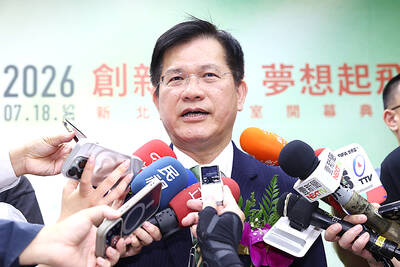
SHOW OF SUPPORT: The US said it was ‘deeply concerned’ about the Pacific nation’s decision, as Taiwan is a reliable partner and its relationships provide ‘significant benefits’ Taiwan is reassessing its economic ties with Papua New Guinea (PNG) after the Pacific nation on Wednesday unexpectedly ordered the immediate closure of Taipei’s representative office in Port Moresby, Ministry of Foreign Affairs Lin Chia-lung (林佳龍) said yesterday. The ministry convened a meeting to discuss potential responses, which included reviewing Taiwan’s liquefied natural gas (LNG) purchases from Papua New Guinea, Lin said, adding that the nation’s imports of about 1.2 million tonnes of LNG annually accounted for about one-third of the Pacific nation’s LNG exports and were a major source of revenue for the country. In 2024, Papua New Guinea exported US$5.36
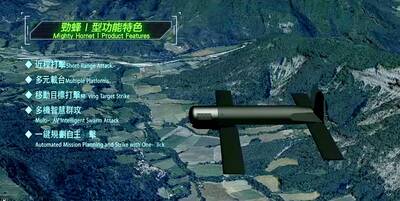
Taiwan and the US have agreed to jointly produce the National Chungshan Institute of Science and Technology (NCSIST)-developed Chien Feng I (勁蜂一型, Mighty Hornet I) drone, a high-level government official familiar with the matter said. The Mighty Hornet I, which is in service with the Marine Corps, has passed live-fire tests, including being launched from fast-moving surface ships, the source said, speaking on condition of anonymity. Under the collaboration — which must still undergo a national security review and receive budget approval from the legislature — Taiwan and the US would jointly produce the attack drone, while the US would

BIG DREAMS: The education ministry said it hoped that by hosting the competition next year, it could help Taiwan nurture talented students and foster global connections Taiwanese high-school students over the weekend swept four gold medals at the International Biology Olympiad (IBO) in Lithuania, and secured three golds and one silver at the International Chemistry Olympiad (IChO) in Uzbekistan. All four members of the Taiwan team for IBO — Hsu Ting-jui (許庭睿) from Taichung First Senior High School, Chen Yu-chen (陳語晨) from Taipei First Girls’ High School, and Chan Wei-chun (詹緯濬) and Yao Yi-keng (姚亦耕) from Taipei Municipal Chien Kuo High School — received gold medals in the competition, which was held from Sunday last week to yesterday, the Taiwanese Representative Office in Lithuania said in a
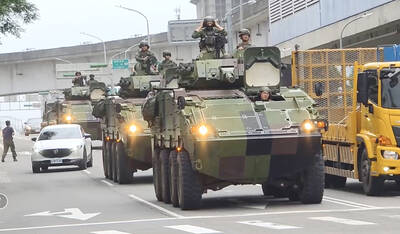
CROSS-SERVICE: The exercise focuses on integrating the capabilities of separate military branches, improving joint operations and testing decentralized command structures The military yesterday began a joint defense exercise featuring Marine Corps units mobilizing to reinforce the Taipei metropolitan area. The five-day exercise simulates scenarios including the detection of hostile vessels entering Taiwan’s territorial waters, focusing on integrating the capabilities of the separate military branches and improving joint operations, testing decentralized command structures, and command-and-control mechanisms. A key component of the exercise involved Marine Corps units conducting mobile reinforcement operations, with dozens of military vehicles, including trucks, field ambulances and communications vehicles deploying from southern Taiwan to Taipei’s Nangang District (南港) and New Taipei City’s Sijhih District (汐止) to establish temporary command posts


 RSS
RSS