


The Special Investigation Panel (SIP) of the Supreme Prosecutor’s Office said yesterday it would appeal the release of former president Chen Shui-bian (陳水扁), who was freed without bail on Saturday morning after being held for 32 days.
“We will appeal Chen’s case to the Taiwan High Court tomorrow [today],” SIP spokesman Chen Yun-nan (陳雲南) told reporters yesterday.
State public Prosecutor-General Chen Tsung-ming (陳聰明) and the eight SIP prosecutors investigating the former president’s finances met yesterday morning to reach a decision on whether to appeal.
Chen Yun-nan had said on Saturday that the SIP respected the Taipei District Court’s decision to release the former president and would not appeal, but admitted on Sunday he had spoken without consulting the other prosecutors.
Chen Tsung-ming told reporters on Sunday it was normal for a defendant to be released by a district court after an investigation was complete and the case was to be brought to court.
However, in Chen Shui-bian’s case, prosecutors said they were still probing other allegations involving the former first family and the release of the former president could allow him to discuss the investigations with other individuals.
In their appeal of the release, prosecutors will argue that Chen Shui-bian could conspire with other individuals involved in the case, Chen Yun-nan said.
The high court can reject the request or order the district court to reconsider its decision.
Commenting on the prosecutors’ decision to appeal, DPP caucus whip William Lai (賴清德) said it was surprising that the SIP had changed its mind.
“The SIP should explain to the public whether or not politics were involved,” he said.
Chen Shui-bian, who was detained on Nov. 12, was indicted on charges of embezzling government funds, money laundering and forgery along with 13 others, including his wife, son and daughter-in-law.
As prosecutors are seeking the “severest penalty,” legal experts say the former president could face life in prison if convicted.
Chen Shui-bian has repeatedly denied all the charges against him, saying he is the victim of political persecution.
Prosecutors charged him and his wife, Wu Shu-jen (吳淑珍), with illegally receiving or embezzling NT$490 million (US$14.7 million), some of which was sent overseas.
Of that total, the indictment says, NT$104.15 million was embezzled from the “state affairs” fund during the former president’s eight years in office.
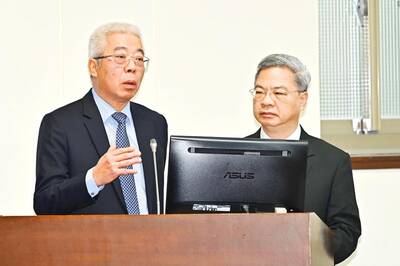
Taiwan has arranged for about 8 million barrels of crude oil, or about one-third of its monthly needs, to be shipped from the Red Sea this month to bypass the Strait of Hormuz and ease domestic supply pressures, CPC Corp, Taiwan (CPC, 台灣中油) said yesterday. The state-run oil company has worked with Middle Eastern suppliers to secure routes other than the Strait of Hormuz, through which about 20 percent of the world’s oil and liquefied natural gas typically passes, CPC chairman Fang Jeng-zen (方振仁) said at a meeting of the legislature’s Economics Committee in Taipei. Suppliers in Saudi Arabia have indicated they
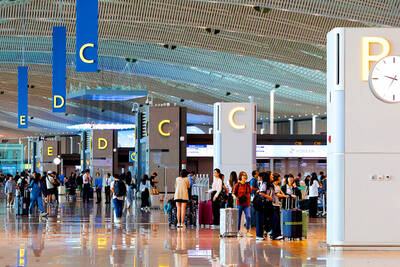
South Korea has adjusted its electronic arrival card system to no longer list Taiwan as a part of China, a move that the Ministry of Foreign Affairs said would help facilitate exchanges between the two sides. South Korea previously listed “Taiwan” as “Taiwan (China)” in the drop-down menus of its online arrival card system, where people had to fill out where they came from and their next destination. The ministry had requested South Korea make a revision and said it would change South Korea’s name on Taiwan’s online immigration system from “Republic of Korea” to “Korea (South),” should the issue not be
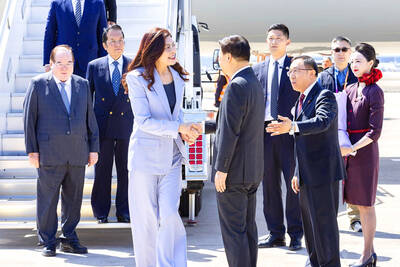
CCP ‘PAWN’? Beijing could use the KMT chairwoman’s visit to signal to the world that many people in Taiwan support the ‘one China’ principle, an academic said Chinese Nationalist Party (KMT) Chairwoman Cheng Li-wun (鄭麗文) yesterday arrived in China for a “peace” mission and potential meeting with Chinese President Xi Jinping (習近平), while a Taiwanese minister detailed the number of Chinese warships currently deployed around the nation. Cheng is visiting at a time of increased Chinese military pressure on Taiwan, as the opposition-dominated Legislative Yuan stalls a government plan for US$40 billion in extra defense spending. Speaking to reporters before going to the airport, Cheng said she was going on a “historic journey for peace,” but added that some people felt uneasy about her trip. “If you truly love Taiwan,

Tainan, Taipei and New Taipei City recorded the highest fines nationwide for illegal accommodations in the first quarter of this year, with fines issued in the three cities each exceeding NT$7 million (US$220,639), Tourism Administration data showed. Among them, Taipei had the highest number of illegal short-term rental units, with 410. There were 3,280 legally registered hotels nationwide in the first quarter, down by 14 properties, or 0.43 percent, from a year earlier, likely indicating operators exiting the market, the agency said. However, the number of unregistered properties rose to 1,174, including 314 illegal hotels and 860 illegal short-term rental


 RSS
RSS