


Opposition lawmakers yesterday slammed proposed amendments to remove the monthly pension and security details of former heads of state convicted of corruption by the district court as a politically motivated move aimed at former president Chen Shui-bian.
The legislature's Judiciary, Organic Laws and Statutes Committee failed to reach a consensus on two amendments to the Statute Governing Preferential Treatment to Retired Presidents and Vice Presidents (卸任總統副總統禮遇條例) proposed by Chinese Nationalist Party (KMT) lawmakers and decided to debate the proposals article by article at the next meeting.
Democratic Progressive Party (DPP) legislators said they were aimed at former president Chen Shui-bian (陳水扁).
The revision proposed by KMT Legislator Wu Yu-sheng (吳育昇) would cancel all preferential treatment for a retired national leader should he or she be found guilty in a first trial, although the privileges would be reinstated if an acquittal passed the Supreme Court.
The amendments proposed by KMT Legislator Chiu Yi (邱毅) were even stricter. They stated that a retired president or vice president under investigation for corruption, colluding with the enemy or treason be stripped of all security protection. The proposed revision would be retroactive to May 20 this year, when Chen handed over the presidency to Ma Ying-jeou (馬英九).
DPP Legislator Ker Chien-ming (柯建銘) said he was against both the proposed amendments, describing them as “idiotic” and politically motivated.
“The revisions are part of a political vendetta,” Ker said.
“It is pathetic that the administration uses the government machinery to wage a political vendetta against the former president,” he said.
If the legislature passes the amendments, Ker said, it would further split society and cause tension between the ruling and opposition parties.
Another DPP legislator, Su Chen-ching (蘇震清), criticized KMT legislators for claiming that the proposed amendments were aimed at perfecting the system.
Deputy secretary-general of the Presidential Office Lai Feng-wei (賴峰偉) blamed it on Chen, saying: “The legal revisions would not have been proposed if it weren't for Chen's case.”
Lai had originally declined to reveal the position of the Presidential Office on the issue, saying it would respect the decision of the legislature.
He later said the Presidential Office was in favor of the legal revisions if “a balance could be reached between presumption of innocence and public impression of the suspect.”
Lai said if retired presidents or vice presidents were relieved of their preferential treatment after being convicted by a district court, it would be a reminder for future national leaders not to follow Chen's example and avoid corruption.
Lai urged the public to learn from Ma, who he said “governed the country with honesty.”
When the environment is clean, he said, “the body will be healthy and full of energy.”
Su criticized Lai for “sucking up to Ma.”
Lai rebutted the accusation and disagreed that his remark was inappropriate.

SILENCING CRITICS: In addition to blocking Taiwan, China aimed to prevent rights activists from speaking out against authoritarian states, a Cabinet department said The Ministry of Foreign Affairs (MOFA) yesterday condemned transnational repression by Beijing after RightsCon, a major digital human rights conference scheduled to be held in Zambia this week, was abruptly canceled due to Chinese pressure over Taiwanese participation. This year’s RightsCon, the world’s largest conference discussing issues “at the intersection of human rights and technology,” was scheduled to take place from tomorrow to Friday in Lusaka, and expected to draw 2,600 in-person attendees from 150 countries, along with 1,100 online participants. However, organizers were forced to cancel the event due to behind-the-scenes pressure from China, the ministry said, expressing its “strongest condemnation”
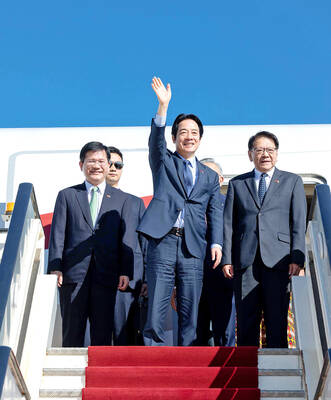
DELAYED BUT DETERMINED: The president’s visit highlights Taiwan’s right to international engagement amid regional pressure from China President Willaim Lai (賴清德) yesterday arrived in Eswatini, more than a week after his planned visit to Taiwan’s sole African ally was suspended because of revoked overflight permits. “The visit, originally scheduled for April 22, was postponed due to unforeseen external factors,” Lai wrote on social media. “After several days of careful arrangements by our diplomatic and national security teams, we successfully arrived today.” Lai said he looked forward to further deepening Taiwan-Eswatini relations through closer cooperation in the economy, agriculture, culture and education, as well as advancing the nation’s international partnerships. The president was initially scheduled to arrive in time to celebrate
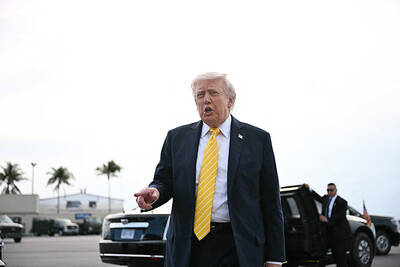
Iran’s Islamic Revolutionary Guard Corp (IRGC) yesterday said the US faced a choice between an “impossible” military operation or a “bad deal” with Tehran, after US President Donald Trump disparaged Iran’s latest peace proposal. Negotiations between the two countries have been deadlocked since a ceasefire came into effect on April 8, with only one round of direct peace talks held so far. Iran’s Tasnim and Fars news agencies reported that Tehran had submitted a 14-point proposal to mediator Pakistan, but Trump was quick to cast doubt on it. “I will soon be reviewing the plan that Iran has just sent to us, but

A group affiliated with indicted Chinese immigrant Xu Chunying (徐春鶯) is to be dissolved for monitoring Chinese immigrants in Taiwan, a source said yesterday. Xu, the secretary-general of the Cross-Strait Marriage and Family Service Alliance, was indicted on March 24 on charges of violating the Anti-Infiltration Act (反滲透法). The alliance “illegally monitored" Chinese immigrants living in Taiwan on behalf of the Chinese Communist Party (CCP) and the Ministry of the Interior is expected to dissolve the organization in the coming days under provisions of the Civil Associations Act (人民團體法), the source said. Xu, who married a Taiwanese in 1993 and became a Republic


 RSS
RSS