


Faced with a sliding approval rating and rising public concern over his China-friendly policy, President Ma Ying-jeou (馬英九) yesterday vowed to maintain a strong army to protect Taiwanese interests and dignity while seeking to improve relations with Beijing.
Speaking in Mandarin and Hoklo (or Taiwanese) at the Double Ten national day ceremony outside the Presidential Office yesterday morning, Ma said the public looks forward to improved cross-strait relations under the framework of the Republic of China (ROC) Constitution and the “three noes” policy — meaning no discussion of unification during his presidency, no pursuit of de jure Taiwanese independence and no use of military force.
Ma said that his administration does not harbor any wishful thinking toward Beijing, however.
“When we engage with China, we will make sure that Taiwan comes first and the interests of the people are served,” he said. “We will not yield the rights of Taiwan and we will insist on maintaining the dignity of the Taiwanese people.”
Ma said the global economic crisis and China’s exports of tainted milk powder reflected the risks of engaging with the world beyond Taiwan, but the nation must not shy away from such engagement because of occasional bad experiences.
“We must turn every crisis into an opportunity,” he said.
As Taipei and Beijing remain divided over the issue of Taiwan’s sovereignty, Ma said he hoped that the two sides could set aside their differences and use their collective wisdom to promote political reconciliation not only in the Taiwan Strait but also in the international community.
“Both sides should no longer engage in confrontation in the international arena to create a win-win-win situation for Taiwan, the mainland and the international community,” he said.
On national defense, Ma said his government would maintain a strong defense capability while pushing cross-strait peace.
“Let’s protect national sovereignty and our beautiful homeland,” he said.
Saying the country was at a historic crossroads, Ma said that as head of state, he was duty bound to lead the country out of the current economic difficulties and was confident he could push the economy to a new peak as well as build a clean and corruption-free government.
“The government has worked hard to make the country a better place, but I realize that you expect even more,” he said. “I fully understand that many of you are struggling under difficult economic conditions, and I am sad at heart ... The government will continue to exert itself ... I will not shun responsibility and will keep working hard.”
Ma said the nation’s economic fundamentals remain sound. He said that by joining forces, he believed the country would overcome current difficulties.
High on the government’s agenda is improving the economy, he said.
The administration will continue to deregulate and reconstruct the economic system, as well as strengthen security control and crisis management, he said.
Citing Sun Yat-sen (孫中山) and former president Chiang Ching-kuo (蔣經國), Ma said his administration would pursue economic reconstruction with the same stamina and determination that the two had shown and he believed the public would soon see a “clear sky after the storm.”
Ma said Sun failed 10 times before he successfully overthrew the Qing dynasty and founded the ROC.
Chiang faced two energy crises but handled them in a calm and decisive manner and created Taiwan’s economic miracle, Ma said.
LORD AND MASTER
“The Taiwanese are the lord and master of Taiwan and the driving force of the Chinese people,” the president said.
“The tougher the environment, the more determined the Taiwanese will be in demonstrating their true spirit,” he said.
Ma concluded his address by chanting “long live Taiwan’s democracy” and “long live the Republic of China.”
In a separate speech he delivered at the Presidential Office, Ma said the direction of the government’s policies was clear: to lay the groundwork for national prosperity and the future of the next generation.
OPPORTUNITY
“A crisis is a challenge for the brave and an opportunity for transformation,” Ma said, adding that the nation had encountered many difficulties over the years and prevailed.
He was confident that this time Taiwan would recover and regain its prosperity.
Ma received some 180 foreign guests attending the national day celebrations at the Presidential Office before delivering his public speech yesterday morning.
The guests included Guatemalan President Alvaro Colom, Kiribati Parliament Speaker Taomati Iuta, St. Kitts and Nevis National Assembly Speaker Earl Asim Martin and Gambia National Assembly Speaker Fatoumatta Jahumpa Ceesay.
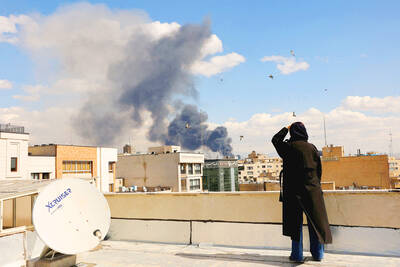
CHAOS: Iranians took to the streets playing celebratory music after reports of Khamenei’s death on Saturday, while mourners also gathered in Tehran yesterday Iranian Supreme Leader Ayatollah Ali Khamenei was killed in a major attack on Iran launched by Israel and the US, throwing the future of the Islamic republic into doubt and raising the risk of regional instability. Iranian state television and the state-run IRNA news agency announced the 86-year-old’s death early yesterday. US President Donald Trump said it gave Iranians their “greatest chance” to “take back” their country. The announcements came after a joint US and Israeli aerial bombardment that targeted Iranian military and governmental sites. Trump said the “heavy and pinpoint bombing” would continue through the week or as long
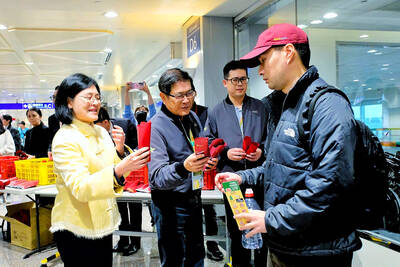
An Emirates flight from Dubai arrived at Taiwan Taoyuan International Airport yesterday afternoon, the first service of the airline since the US and Israel launched strikes against Iran on Saturday. Flight EK366 took off from the United Arab Emirates (UAE) at 3:51am yesterday and landed at 4:02pm before taxiing to the airport’s D6 gate at Terminal 2 at 4:08pm, data from the airport and FlightAware, a global flight tracking site, showed. Of the 501 passengers on the flight, 275 were Taiwanese, including 96 group tour travelers, the data showed. Tourism Administration Deputy Director-General Huang He-ting (黃荷婷) greeted Taiwanese passengers at the airport and
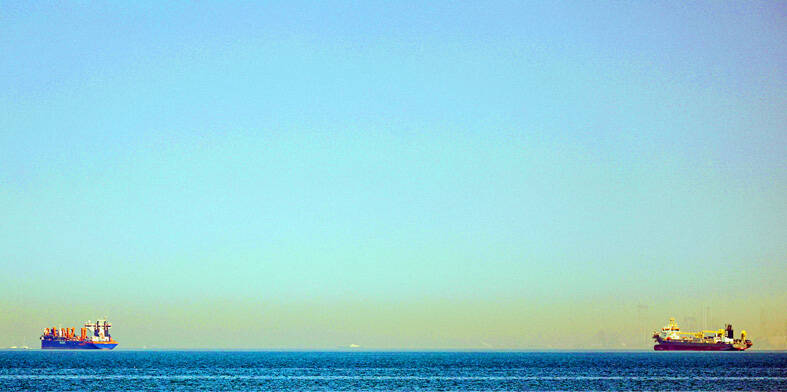
State-run CPC Corp, Taiwan (CPC, 台灣中油) yesterday said that it had confirmed on Saturday night with its liquefied natural gas (LNG) and crude oil suppliers that shipments are proceeding as scheduled and that domestic supplies remain unaffected. The CPC yesterday announced the gasoline and diesel prices will rise by NT$0.2 and NT$0.4 per liter, respectively, starting Monday, citing Middle East tensions and blizzards in the eastern United States. CPC also iterated it has been reducing the proportion of crude oil imports from the Middle East and diversifying its supply sources in the past few years in response to geopolitical risks, expanding
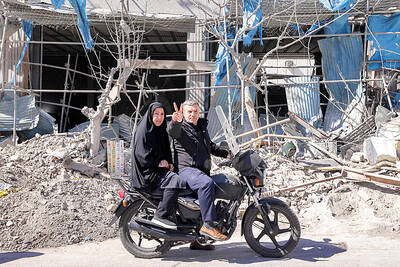
STRAIT OF HORMUZ: In the case of a prolonged blockade by Iran, Taiwan would look to sources of LNG outside the Middle East, including Australia and the US Taiwan would not have to ration power due to a shortage of natural gas, Minister of Economic Affairs Kung Ming-hsin (龔明鑫) said yesterday, after reports that the Strait of Hormuz was closed amid the conflict in the Middle East. The government has secured liquefied natural gas (LNG) supplies for this month and contingency measures are in place if the conflict extends into next month, Kung told lawmakers. Saying that 25 percent of Taiwan’s natural gas supplies are from Qatar, Chinese Nationalist Party (KMT) caucus secretary-general Lin Pei-hsiang (林沛祥) asked about the situation in light of the conflict. There would be “no problems” with


 RSS
RSS