


An earthquake that hit Sichuan and Yunnan provinces has killed 25 people, damaged or destroyed more than 100,000 homes and affected at least 440,000 residents, state media said yesterday.
The epicenter of Saturday’s quake, which struck at about 4:30pm, was about 30km southeast of Panzhihua, near Sichuan’s border with Yunnan, the US Geological Survey (USGS) said. The quake was about 10km deep.
The US Geological Survey put the magnitude of the quake at 5.7.
A 5.6-magnitude aftershock hit the same area 24 hours later, the USGS said yesterday. There were no immediate reports of further damage from the second quake.
Xinhua said Saturday’s quake had injured 192 people and three more were missing.
It said 656 schools had also been damaged and that heavy rain and difficult terrain were hampering rescue efforts, with mobile telephone communications patchy.
State TV showed pictures of houses with large cracks in their sides, broken tiles on the road and people receiving medical attention under tents.
A woman who answered the phone at the Sichuan provincial seismological bureau said the region was hit by about 300 aftershocks yesterday morning. She declined to give her name, saying she was not authorized to speak to the media.
The earthquake administration sent teams and seismic experts to the quake-hit area while the Yunnan provincial civil affairs bureau and the Yunnan Red Cross Society sent 3,400 tents and 2,000 quilts, Xinhua said.
Relief efforts were hampered by heavy rains and the region’s rugged terrain, it said.
Dozens of evacuees were assembled on a primary school field in Panzhihua, footage from state broadcaster China Central Television showed. Wrapped in quilts, the evacuees, including children and the elderly, lay on plastic sheets and mats on the ground.
Also on Saturday, an earthquake measuring 5.3 struck Xinjiang, Xinhua said in a separate report.
No casualties were reported from the quake that hit the sparsely inhabited Tianshan mountains. The tremor was felt in nearby counties and the city of Korla, Xinhua said.
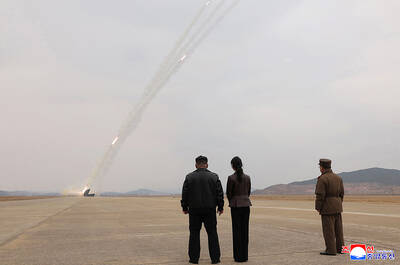
North Korea tested nuclear-capable rocket launchers, state media reported yesterday, a day after Seoul detected the launch of about 10 ballistic missiles. The test comes after South Korean and US forces launched their springtime military drills, due to run until Thursday. North Korean leader Kim Jong-un on Saturday oversaw the testing of the multiple rocket launcher system (MRLS), the Korean Central News Agency (KCNA) said. The test involved 12 600mm-caliber ultra-precision multiple rocket launchers and two artillery companies, it said. Kim said the drill gave Pyongyang’s enemies, within the 420km striking range, a sense of “uneasiness” and “a deep understanding
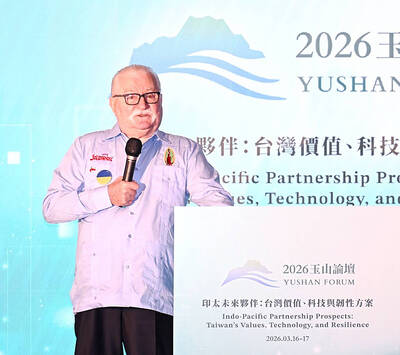
RECOGNITION: Former Fijian prime minister Mahendra Chaudhry said that Taiwan’s New Southbound Policy serves as a stabilizing force in the Indo-Pacific region Taiwan can lead the unification of the Chinese people, Nobel Peace Prize laureate and former Polish president Lech Walesa said in Taipei yesterday, adding that as the world order is changing, peaceful discussion would find good solutions, and that the use of force and coercion would always fail. Walesa made the remarks during his keynote address at a luncheon of the Yushan Forum in Taipei, titled “Indo-Pacific Partnership Prospects: Taiwan’s Values, Technology and Resilience,” organized by the Taiwan-Asia Exchange Foundation with the Ministry of Foreign Affairs. Walesa said that he had been at the forefront of a big peaceful revolution and “if
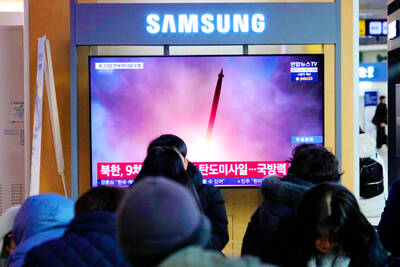
North Korea yesterday fired about 10 ballistic missiles to the sea toward Japan, the South Korean Joint Chiefs of Staff (JCS) said, days after Pyongyang warned of “terrible consequences” over ongoing South Korea-US military drills. Pyongyang recently dashed hopes of a diplomatic thaw with Seoul, Washington’s security ally, describing its latest peace efforts as a “clumsy, deceptive farce.” Seoul’s military detected “around 10 ballistic missiles launched from the Sunan area in North Korea toward the East Sea [Sea of Japan] at around 1:20pm,” JCS said in a statement, referring to South Korea’s name for the body of water. The missiles

‘UNWAVERING FRIENDSHIP’: A representative of a Japanese group that co-organized a memorial, said he hopes Japanese never forget Taiwan’s kindness President William Lai (賴清德) yesterday marked the 15th anniversary of the Tohoku earthquake and tsunami, urging continued cooperation between Taiwan and Japan on disaster prevention and humanitarian assistance. Lai wrote on social media that Taiwan and Japan have always helped each other in the aftermath of major disasters. The magnitude 9 earthquake struck northeastern Japan on March 11, 2011, triggering a massive tsunami that claimed more than 19,000 lives, according to data from Japanese authorities. Following the disaster, Taiwan donated more than US$240 million in aid, making it one of the largest contributors of financial assistance to Japan. In addition to cash donations and


 RSS
RSS