


Ten days after a Taiwanese boat sank following a collision with a Japanese patrol vessel near the disputed Diaoyutai (釣魚台) islands, a representative from Japan’s de facto embassy in Taiwan visited the home of the fishing boat captain and offered an apology yesterday.
Deputy chief representative of the Interchange Association Hitoshi Funamachi visited Taiwanese boat captain Ho Hung-yi (何鴻義) at his home in Ruifang Township (瑞芳), Taipei County, to personally deliver a letter of apology written by Hideo Nasu, head of the 11th Operational Region of the Japan Coast Guard.
“I bow and once again offer my sincere apologies to you over the sinking of your boat and the injuries you sustained during the collision,” Funamachi said to Ho, reading from Nasu’s letter. “I hope we will begin negotiations soon on compensation, in accordance with the law.”
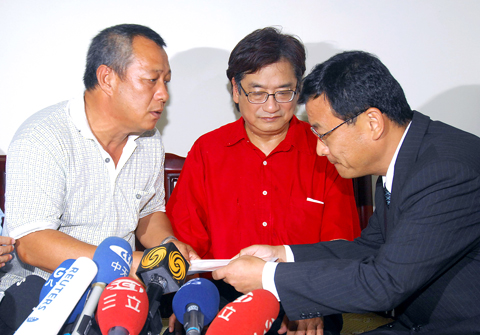
PHOTO: SAM YEH, AFP
Nasu had also bowed at a televised press conference in Japan several days ago in apology over the accident.
Ho accepted Nasu’s apology, saying he was “very pleased” with the way that the Japan Coast Guard official was handling the aftermath of the accident, in which Ho lost his boat and sustained several injuries.
Meanwhile, after a 30-minute closed door meeting at the Ministry of Foreign Affairs with Minister of Foreign Affairs Francisco Ou (歐鴻鍊) yesterday afternoon, Tadashi Ikeda, the chief representative of the Interchange Association, said he hoped the peaceful end to the ordeal would strengthen Taiwan-Japan relations.
Standing next to Ou, Ikeda said he was pleased to see that Taiwan and Japan could “overcome the difficult situation together.”
“The Japanese have a saying that after the rain, the ground will be more solid and firm. I hope that Japan-Taiwan relations will continue to improve after this ordeal,” Ikeda said.
Ou welcomed the gesture by Japan, calling it a “perfect ending,” but said the next step in resuming negotiations with Tokyo on fishing rights and sovereignty claims would be the “beginning of the real, difficult task.”
The incident took place early in the morning on June 10 when a Japan Coast Guard patrol boat rammed into a Taiwanese fishing boat 11km off the Diaoyutai islands, an island chain claimed by Taiwan, Japan and China.
While the Japanese claim the crash was caused by the Taiwanese boat zigzagging abruptly, Ho insists his boat was stationary.
The Japanese agreed to release the crew and pay reparations, but held off on issuing a formal apology.
In related news, Ou yesterday confirmed that President Ma Ying-jeou (馬英九) had officially accepted the resignation of Taiwan’s representative to Japan, Koh Se-kai (許世楷), who asked to be relieved of his duties on Monday.

The nation’s fastest supercomputer, Nano 4 (晶創26), is scheduled to be launched in the third quarter, and would be used to train large language models in finance and national defense sectors, the National Center for High-Performance Computing (NCHC) said. The supercomputer, which would operate at about 86.05 petaflops, is being tested at a new cloud computing center in the Southern Taiwan Science Park in Tainan. The exterior of the server cabinet features chip circuitry patterns overlaid with a map of Taiwan, highlighting the nation’s central position in the semiconductor industry. The center also houses Taiwania 2, Taiwania 3, Forerunner 1 and
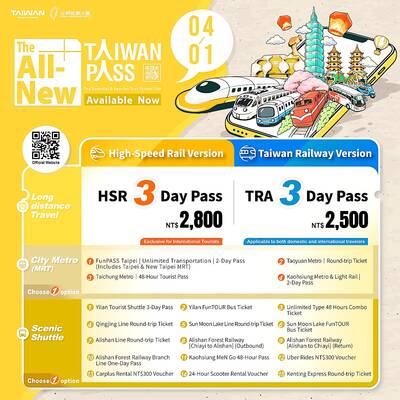
MORE POPULAR: Taiwan Pass sales increased by 59 percent during the first quarter compared with the same period last year, the Tourism Administration said The Tourism Administration yesterday said that it has streamlined the Taiwan Pass, with two versions available for purchase beginning today. The tourism agency has made the pass available to international tourists since 2024, allowing them to access the high-speed rail, Taiwan Railway Corp services, four MRT systems and four Taiwan Tourist Shuttles. Previously, five types of Taiwan Pass were available, but some tourists have said that the offerings were too complicated. The agency said only two types of Taiwan Pass would be available, starting from a three-day pass with the high-speed rail and a three-day pass with Taiwan Railway Corp. The former costs NT$2,800
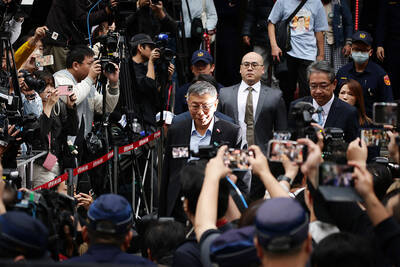
FIRST TRIAL: Ko’s lawyers sought reduced bail and other concessions, as did other defendants, but the bail judge denied their requests, citing the severity of the sentences Former Taipei mayor Ko Wen-je (柯文哲) was yesterday sentenced to 17 years in prison and had his civil rights suspended for six years over corruption, embezzlement and other charges. Taipei prosecutors in December last year asked the Taipei District Court for a combined 28-year, six-month sentence for the four cases against Ko, who founded the Taiwan People’s Party (TPP). The cases were linked to the Core Pacific City (京華城購物中心) redevelopment project and the mismanagement of political donations. Other defendants convicted on separate charges included Chinese Nationalist Party (KMT) Taipei City Councilor Angela Ying (應曉薇), who was handed a 15-year, six-month sentence; Core Pacific
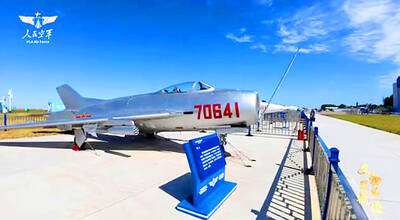
J-6 REMODEL: The converted drones are part of Beijing’s expanding mix of airpower weapons, including bombers with stand-off missiles and UAV swarms, the report said China has stationed obsolete supersonic fighters converted to attack drones at six air bases close to the Taiwan Strait, a report published this month by the Arlington, Virginia-based Mitchell Institute for Aerospace Studies said. Satellite imagery of the airfields from the institute’s “China Airpower Tracker” shows what appear to be lines of stubby, swept-winged aircraft matching the shape of J-6 fighters that first flew with the Chinese People’s Liberation Army (PLA) Air Force in the 1960s. Since their conversion to drones, the aircraft have been identified at five bases in China’s Fujian Province and one in Guangdong Province, the report said. J.


 RSS
RSS