


The Central Election Commission (CEC) said yesterday it would employ the help of foreign diplomatic missions in Taiwan to check if either of the two presidential candidates holds foreign citizenship.
The commission's decision came in the wake of allegations from Democratic Progressive Party (DPP) presidential hopeful Frank Hsieh (謝長廷) that his Chinese Nationalist Party (KMT) rival, Ma Ying-jeou (馬英九), has a US green card.
Ma recently admitted he had applied for permanent residency when he was studying in the US, but contended that his green card had already expired.
Hsieh insists Ma's green card is still valid.
The DPP candidate accused Ma last month of holding a US green card and early this month disclosed the alleged card number -- "AXXX39789" -- saying it was granted to Ma on Aug. 26, 1977, in New York.
Ma at first denied that he had a green card, but later said he once owned one.
He said he had obtained a green card in 1977, but the green card was automatically invalidated in 1985 when he applied for a visa at the American Institute in Taiwan (AIT) to travel to the US.
To ensure that neither of the candidates is a citizen of a foreign country, the CEC said it has decided to seek help from foreign diplomatic missions.
"Since the two candidates have clearly said they do not have foreign citizenships, we have decided to get in touch with foreign diplomatic offices and with the Ministry of Foreign Affairs ... to confirm that information," CEC Secretary-General Teng Tien-yu (鄧天祐) told reporters yesterday.
If either of the candidates is found to be in possession of foreign citizenship, "his candidacy will be considered void," Teng said.
Hsieh's manager, Lee Ying-yuan (李應元), backed the move.
"We respect and abide by the law," Lee said. "The president of a country should certainly not be a citizen of another country -- a president should not even be only one step away from having another country's citizenship."
Ma yesterday also welcomed the commission's decision.
Ma's spokesman, Su Jun-pin (
"Our rivals made accusations without evidence, but we will not join them," Su said yesterday in front of the commission's office.
In related news, campaign officials from both camps drew lots to decide the order in which the candidates will be listed on the ballot.
Hsieh was represented by his campaign manager, Yeh Chu-lan (葉菊蘭), who drew the number "one."
"Taiwan's No. 1, prosperity all the way," Hsieh's campaign officials shouted outside the CEC's headquarters.
Chanting "Ma-Siew team wins, victory for Taiwan," Ma's campaign director Chan Chun-po (
Chan and Su later joined KMT Youth Corps members outside the CEC, cheering "March 22, cast your vote for number two."
Ma said that he was pleased with the number two, as the hand gesture for two was the same as "V" for victory.
ADDITIONAL REPORTING BY MO YAN-CHIH
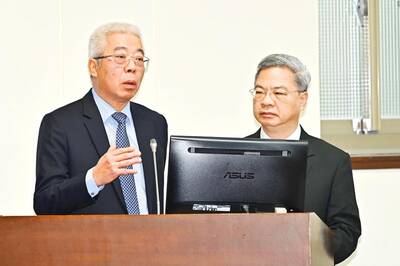
Taiwan has arranged for about 8 million barrels of crude oil, or about one-third of its monthly needs, to be shipped from the Red Sea this month to bypass the Strait of Hormuz and ease domestic supply pressures, CPC Corp, Taiwan (CPC, 台灣中油) said yesterday. The state-run oil company has worked with Middle Eastern suppliers to secure routes other than the Strait of Hormuz, through which about 20 percent of the world’s oil and liquefied natural gas typically passes, CPC chairman Fang Jeng-zen (方振仁) said at a meeting of the legislature’s Economics Committee in Taipei. Suppliers in Saudi Arabia have indicated they
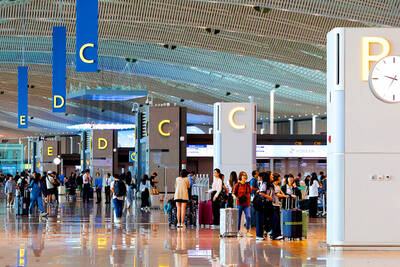
South Korea has adjusted its electronic arrival card system to no longer list Taiwan as a part of China, a move that the Ministry of Foreign Affairs said would help facilitate exchanges between the two sides. South Korea previously listed “Taiwan” as “Taiwan (China)” in the drop-down menus of its online arrival card system, where people had to fill out where they came from and their next destination. The ministry had requested South Korea make a revision and said it would change South Korea’s name on Taiwan’s online immigration system from “Republic of Korea” to “Korea (South),” should the issue not be
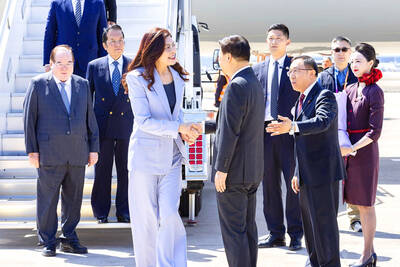
CCP ‘PAWN’? Beijing could use the KMT chairwoman’s visit to signal to the world that many people in Taiwan support the ‘one China’ principle, an academic said Chinese Nationalist Party (KMT) Chairwoman Cheng Li-wun (鄭麗文) yesterday arrived in China for a “peace” mission and potential meeting with Chinese President Xi Jinping (習近平), while a Taiwanese minister detailed the number of Chinese warships currently deployed around the nation. Cheng is visiting at a time of increased Chinese military pressure on Taiwan, as the opposition-dominated Legislative Yuan stalls a government plan for US$40 billion in extra defense spending. Speaking to reporters before going to the airport, Cheng said she was going on a “historic journey for peace,” but added that some people felt uneasy about her trip. “If you truly love Taiwan,
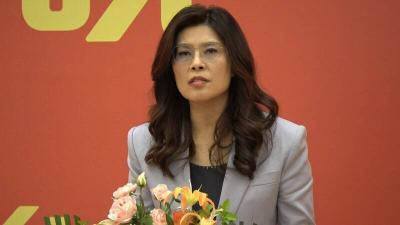
Both sides of the Taiwan Strait share a political foundation based on the “1992 consensus” and opposition to Taiwanese independence, Chinese Nationalist Party (KMT) Chairwoman Cheng Li-wun (鄭麗文) today said during her meeting with Chinese President Xi Jinping (習近平). Both sides of the Strait should plan and build institutionalized and sustainable mechanisms for dialogue and cooperation based on that foundation to make peaceful development across the Strait irreversible, she said. Peace is a shared moral value across the Strait, and both sides should move beyond political confrontation to seek institutionalized solutions to prevent war, she said. Mutually beneficial cross-strait relations are what the


 RSS
RSS