


The Kremlin on Sunday kicked the only independent contender in Russia's presidential election off the ballot, a move described by activists as undemocratic and predictable.
Russia's Central Election Commission disqualified Michael Kasyanov from taking part in the March 2 poll. It claimed that more than 13 percent of the signatures needed for his candidacy to be registered had been faked.
The disqualification will raise further questions about the election's legitimacy. International observers described last month's parliamentary poll as profoundly rigged.
Kasyanov is a former prime minister who fell out with Russian President Vladimir Putin in 2004. He was the only genuinely independent candidate in the race. Under Kremlin rules he had to gather 2 million signatures, something officials said he failed to do.
"Undoubtedly the decision not to register my candidacy ... was made personally by Vladimir Putin," Kasyanov said.
"Hopes that the political process [in Russia] will develop constitutionally have not been justified," he said.
Human rights activists said the disqualification of Kasyanov, who was thought unlikely to get more than 5 percent of the vote, was a Kremlin strategy designed to prevent him from embarrassing the authorities during the campaign.
"The denial of registration to Mikhail Kasyanov is a well thought out maneuver. It lowers the democratic level of this election," Lyudmila Alexeyeva, a human rights activist and leader of the Moscow Helsinki Group, told the agency Interfax.
There is not much doubt who will win the election. Dmitry Medvedev, Russia's first deputy prime minister, is favored to win easily following Putin's endorsement of him as his successor last month. None of the three remaining candidates has any chance.
The Organisation for Security and Cooperation in Europe said the elections for the state Duma were unfair.
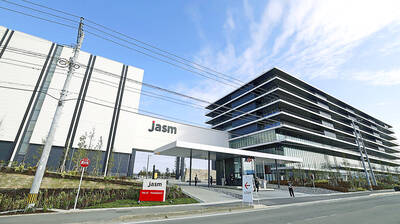
The subsidiary of Taiwan Semiconductor Manufacturing Co (TSMC, 台積電) in Kumamoto, Japan, turned a profit in the first quarter of this year, marking the first time the first fab of the unit has become profitable since mass production started at the end of 2024. According to the contract chipmaker’s financial statement released on Friday, Japan Advanced Semiconductor Manufacturing Inc (JASM), a joint venture running the fab in Kumamoto, posted NT$951 million (US$30.19 million) in profit in the January-to-March period, compared with a loss of NT$1.39 billion in the previous quarter, and a loss of NT$3.25 billion in the first quarter of
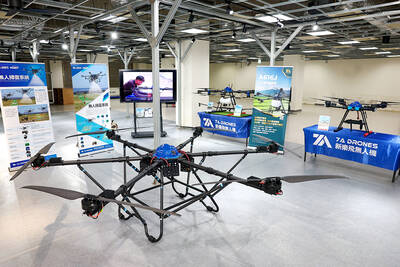
DRONE CENTRAL: Taiwan aims to become Asia’s democratic hub for drones, with most exports focused on high-quality military-grade models, an official said Taiwan’s drone industry is expected to expand significantly by 2030, producing 100,000 units per month and exporting half of them, the Ministry of Economic Affairs said yesterday. Current drone production capacity is about 15,000 units per month, but the industry can quickly scale up as demand increases, Industrial Development Administration Director-General Chiou Chyou-huey (邱求慧) told a news conference in Taipei. Taiwan’s drone output grew 2.5-fold last year to NT$12.9 billion (US$408.3 million) under a government program to develop the uncrewed vehicle sector, he said. The Executive Yuan in October last year approved plans to invest NT$44.2 billion into domestic production of uncrewed aerial
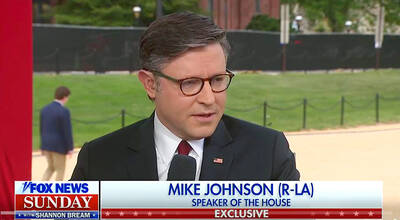
RESOLUTE BACKING: Two Republican senators are planning to introduce legislation that would impose immediate sanctions on China if it attempts to invade Taiwan US House of Representatives Speaker Mike Johnson on Sunday reaffirmed US congressional support for Taiwan, saying the US and “all freedom-loving people” have a stake in preventing China from seizing Taiwan by force. Johnson made the remarks in an interview with Fox News Sunday on US President Donald Trump’s summit with Chinese President Xi Jinping (習近平) last week. In an interview that aired on Friday on Fox News, just as Trump wrapped up a high-stakes visit to China, he said he has yet to green-light a new US$14 billion arms package to Taiwan and that it “depends on China.” “It’s a very good
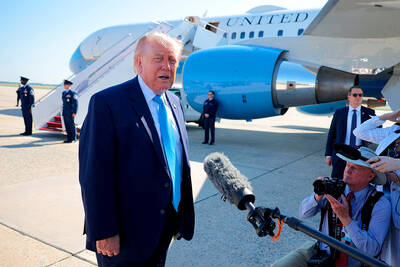
US President Donald Trump yesterday said he would speak to President William Lai (賴清德) as his administration considers whether to move ahead with a US$14 billion weapons sale to Taiwan — a potential arms deal that has drawn criticism from China. “Well, I’ll speak to him. I speak to everybody,” Trump told reporters yesterday when asked if he had any plans to call his counterpart, although he did not offer a time frame for when such a conversation could take place. Trump previously said he would speak to the person “that’s running Taiwan,” without specifying who he meant. “We have that situation very


 RSS
RSS