


The father of an eight-year-old girl who completed a 55-day run across eastern China denied forcing her into the ordeal, saying she considered pounding the pavement for hours each day a form of play.
"You can force your child one day," Zhang Jianmin (張建民) was quoted as saying in the China Daily newspaper, referring to his daughter, Huimin (張惠敏).
"But you can't force one to wake up early in the morning everyday if one doesn't want to," he said.

PHOTO: AP
Zhang Huimin arrived in Beijing on Sunday after she started her extraordinary odyssey on July 3 from Sanya, at the southern tip of the island of Hainan, 3,560km from Beijing. Her father, a distance runner in his youth, followed her on an electric bicycle.
The girl, who weighs 20kg and stands 1.25m tall, got up at 2:30am every day to train for the run and would have had to have run about 65km a day for 55 days -- the equivalent of about one-and-a-half marathons a day.
On the Beijing trip, she only rode twice on her father's motorized bicycle, the China Daily said -- when she was chased by four wild dogs and when a mountain road was too steep to run down.
Huimin herself appeared unfazed by the whole marathon event and the attention it had brought.
"I've liked running since I was very young," she said. "Running makes me happy."
China Daily said experts believed Zhang's health could suffer.
However, Zhang Jianmin said he was just carrying out his daughter's wishes, saying: "I never impose my will on her."
For the girl, running is "more about jumping and playing, rather than a chore," the paper quoted him as saying.
"I don't care about what the experts say. Although they accuse me of being cruel or abusive, I think I'm right," he said.
"She is always healthy around me and never said her legs hurt or that she was tired after running 30km," Zhang told reporters in Tiananmen Square. "I am suffering huge media pressure. But I have never worried about her future health. As she was able to endure the long distance running and has grown up healthily from the year three to eight, which are the weakest ages, there's no reason she could not endure this in the next years."
Huimin started running 3km a day when she was three and was hitting 23km a day by the time she was seven, the China Daily said.
As for her future, Dad had one eye on the Olympics.
"If she is interested in running then we will keep working on it. She'll be 18 in 10 years' time and it will be possible to take part in the Olympics ... Whatever she is interested in, I'll do my utmost to support her," he said.
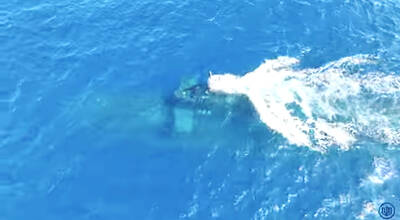
CSBC Corp, Taiwan (台灣國際造船) yesterday released the first video documenting the submerged sea trials of Taiwan’s indigenous defense submarine prototype, the Hai Kun (海鯤), or Narwhal, showing underwater navigation and the launch of countermeasures. The footage shows the vessel’s first dive, steering and control system tests, and the raising and lowering of the periscope and antenna masts. It offered a rare look at the progress in the submarine’s sea acceptance tests. The Hai Kun carried out its first shallow-water diving trial late last month and has since completed four submerged tests, CSBC said. The newly released video compiles images recorded from Jan. 29 to
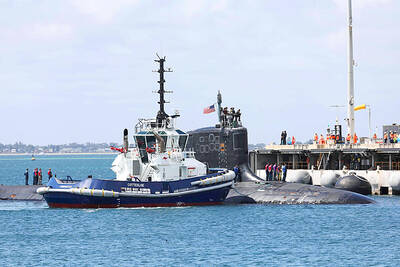
DETERRENCE EFFORTS: Washington and partners hope demonstrations of force would convince Beijing that military action against Taiwan would carry high costs The US is considering using HMAS Stirling in Western Australia as a forward base to strengthen its naval posture in a potential conflict with China, particularly over Taiwan, the Wall Street Journal reported on Saturday. As part of its Indo-Pacific strategy, Washington plans to deploy up to four nuclear-powered submarines at Stirling starting in 2027, providing a base near potential hot spots such as Taiwan and the South China Sea. The move also aims to enhance military integration with Pacific allies under the Australia-UK-US trilateral security partnership, the report said. Currently, US submarines operate from Guam, but the island could

RESTRAINTS: Should China’s actions pose any threat to Taiwan’s security, economic or social systems, China would be excluded from major financial institutions, the bill says The US House of Representatives on Monday passed the PROTECT Taiwan Act, which states that Washington would exclude China from participating in major global financial organizations if its actions directly threaten Taiwan’s security. The bill, proposed by Republican Representative Frank Lucas, passed with 395 votes in favor and two against. It stipulates that if China’s actions pose any threat to Taiwan’s security, economic or social systems, the US would, “to the maximum extent practicable,” exclude Beijing from international financial institutions, including the G20, the Bank for International Settlements and the Financial Stability Board. The bill makes it clear that China must be prepared

Taiwanese trade negotiators told Washington that Taipei would not relocate 40 percent of its semiconductor production to the US, and that its most advanced technologies would remain in the nation, Vice Premier Cheng Li-chiun (鄭麗君) said on Sunday. “I told the US side very clearly — that’s impossible,” Cheng, who led the negotiation team, said in an interview that aired on Sunday night on Chinese Television System. Cheng was referring to remarks last month by US Secretary of Commerce Howard Lutnick, in which he said his goal was to bring 40 percent of Taiwan’s chip supply chain to the US Taiwan’s almost


 RSS
RSS