

Thailand's voters have approved an army-drafted constitution, but a hefty "No" vote suggests December's general election will be messy, with former Thai prime minister Thaksin Shinawatra still a potent political force.
Announcing the official results of Thailand's first referendum, the Election Commission said yesterday 57.8 percent of voters had accepted the charter, designed to prevent a repeat of Thaksin's powerful single-party style of government.
However, 42.2 percent rejected it, sending a signal to the generals who removed the telecommunications billionaire in a coup last September that they will struggle to control the make-up of the next administration.
Just more than 25 million, or 57.6 percent, of the 45 million electorate voted.
Having pressed for a "Yes" vote, the army-appointed post-coup government had been hoping for at least a 60 percent turnout for what will be the 18th charter for the nation.
The election commission chief Apichart Sukhakanon suggested Dec. 16 for the election but said the commissioners would meet and choose between that and Dec. 23 and forward their recommendation to the government.
However, a stony-faced Surayud refused to talk to reporters yesterday when the extent of lingering Thaksin support was clear.
"We missed our target," said Thirapat Serirangsan, a minister in the prime minister's office. "But when you get more than 50 percent of the votes, that's a majority."
Army chief and coup leader Sonthi Boonyaratglin told state Channel 9 television from Kuala Lumpur he was "satisfied" with the turnout even though it was below his target.
Thaksin, 58, has been in exile in Britain since the coup and spent Sunday afternoon watching his newly acquired soccer club, Manchester City, beat Manchester United 1-0 in a match that generated as much interest back home as the referendum.
Many Thais, especially those in Bangkok, appeared motivated to vote by a desire to see an end to the turmoil that has reigned since Thaksin's family sold control of the telecoms empire he founded to Singapore for a tax-free US$1.9 billion in January last year.
The stock market rose 3.5 percent, in line with a rally across Asia, amid relief there had been no major upset, although analysts said the "Yes" camp's smaller-than-expected margin of victory suggested the upcoming election would be both closely fought and dirty.
"This is telling the junta that they are going to have trouble at an election and that could mean all kinds of attempts to influence the result -- and that's worrying," Bangkok-based political analyst and Thaksin biographer Chris Baker said.
Even though Thaksin's Thai Rak Thai (Thais Love Thais) party has been disbanded and 111 top members barred from politics, its leaders hope the mass rural support that twice swept it to power will rally to a new party under a new flag.
The Sunday vote showed the country remains largely divided between Bangkok residents, who staged months of protests calling for Thaksin to step down, and those in the poor, rural northeastern provinces where support for the former prime minister runs high.
Analysts say the charter is designed to restore rule by the elites challenged by Thaksin, son of an ethnic Chinese silk merchant, and rekindle the "managed democracy" of the 1980s under ex-army chief Prem Tinsulanonda -- now the king's top adviser and seen by Thaksin supporters as the coup mastermind.
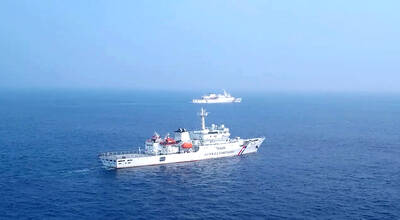
PATROL PARTNERS: The ‘Chiayi’ and the ‘Penghu’ departed for a two-day joint patrol of Palau’s exclusive economic zone, the CGA’s second diplomatic visit to the country The Coast Guard Administration (CGA) set a record for its southernmost deployment of a coast guard vessel as the vessels Chiayi and the Penghu reached Palau’s Pulo Anna Island on Saturday in a cooperative exercise between the two countries. The island, about 217 nautical miles (401km) southwest of Koror in the Palauan state of Sonsorol and 1,220 nautical miles from Taiwan’s southernmost point, Oluanpi (鵝鑾鼻), is the furthest south a CGA vessel has sailed. The two vessels are in Palau for the coast guard’s second diplomatic visit to the country. They docked at Malakal Harbor on Tuesday last week. The coast guard
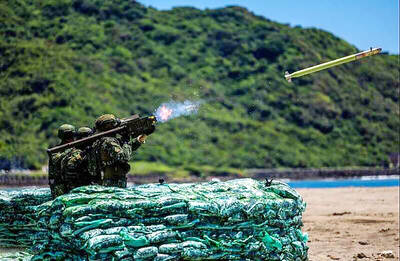
BATCH 1: The military has plans to assign the weapons to the army to defend Taiwan proper, as well as outlying islands and the navy for the Marine Corps, the official said Taiwan is to receive 500 Stinger missiles and 178 launchers from the US by the end of the year, the first batch under a planned two-stage acquisition totaling 2,621 missiles and 763 launchers, a defense official said yesterday on condition of anonymity. The portable missiles would play a vital role in the nation’s air defense capabilities, the source said. The army plans to deploy 2,235 missiles and 657 launchers to defend Taiwan proper and outlying islands, they said, citing military documents. The navy is allotted 295 missiles and 85 launchers to arm the Marine Corps and some surface vessels that lack air defense

The European Parliament on Wednesday adopted a recommendation on EU-China political relations that rejected China’s efforts to restrict Taiwan’s participation in international organizations and exchanges. The recommendation, addressed to the European Council, the European Commission and EU High Representative for Foreign Affairs and Security Policy Kaja Kallas, includes several references to EU-Taiwan relations and expresses support for closer ties, saying they would bring positive benefits and have strategic importance. Describing Taiwan as a valuable partner in trade and technology, the European Parliament said it “rejects China’s attempts to coerce international organizations, third countries and other actors into restricting Taiwan’s international participation and
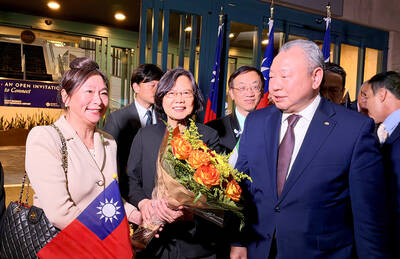
Former president Tsai Ing-wen (蔡英文) on Monday arrived in San Francisco, receiving a warm welcome from hundreds of overseas Taiwanese as she launched a week-long visit. Accompanied by Representative to the US Alexander Yui (俞大?), and head of Taiwan’s San Francisco office Wu Chih-hsiang (伍志翔), Tsai arrived at her hotel, waving, smiling and giving high-fives to Taiwanese compatriots amid cheers of “Taiwan’s democracy involves you and me” to welcome her to the San Francisco Bay Area. It is Tsai’s first visit to the US since she left office in May 2024 after serving two four-year terms as president. Tsai is today to deliver


 RSS
RSS