

A defiant Prime Minister Shinzo Abe clung desperately to his job yesterday, despite a humiliating election defeat that threw the future of his feeble government into question and triggered calls for the leader's resignation.
Abe raised the specter of a "political vacuum" as he dismissed mounting public pressure to step down for losing the majority in parliament's upper house on Sunday. Instead, he vowed to soothe voter anger by reshuffling his Cabinet and pushing forth reforms with new vigor.
"I cannot walk away even though the situation is extremely difficult. I decided [to stay] because we cannot afford to create a political vacuum," Abe said at an afternoon news conference focusing on damage control on Sunday's devastating loss.
"My responsibility is to fulfill the duty to fully achieve economic recovery," he said.
Abe also shot down suggestions that he should call snap elections in parliament's lower house -- where his coalition still maintains a tight grip -- to re-establish his political mandate. Any upheaval in that chamber could put a new premier in office.
Public outrage over millions of missing pension records and a series of political scandals stripped Abe's Liberal Democratic Party of its majority in parliament's 242-seat upper house on Sunday, while handing the opposition huge gains.
The LDP has ruled almost continuously since 1955 and remains in control of the lower house, which chooses the prime minister. But Sunday's defeat could usher in an era of political instability and policy-making gridlock. It also further undercut already tenuous support for Abe, who has fallen from grace since taking office with stellar approval ratings less than a year ago as Japan's youngest-ever premier.
By yesterday morning, newspaper editorials were urging Abe to resign.
"Voters gave a clear failing mark," the Asahi newspaper said. "The prime minister should face the results seriously and step down."
The Tokyo and Mainichi newspapers meanwhile called on Abe to disband the lower house for elections.
"You have yet to be baptized in a general election," the Tokyo Newspaper said in an editorial addressed to the beleaguered prime minister. "We call for an election to be held promptly to give voters the opportunity to make their choice."
Official election results released early Monday showed the LDP and its junior coalition partner, the New Komeito, with a total of 103 seats -- a 30-seat loss that left it far short of the 122 needed to control the house. The main opposition Democratic Party grabbed 112 seats, up from 81.
Only 121, or half, of the upper chamber's 242 seats were up for grabs in Sunday's polls.
Among the first casualties was the LDP's No. 2 official, Secretary-General Hidenao Nakagawa, who resigned after polls closed.
Calls for Abe's resignation could also start sounding from within the Liberal Democratic Party. While there is no clear front-runner to succeed Abe as premier, Foreign Minister Taro Aso is often cited as a possible contender.
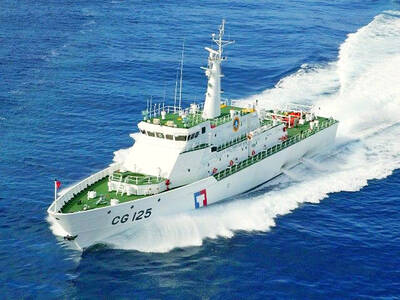
GEOPOLITICAL SIGNIFICANCE: The CGA’s nonmilitary role makes it a tool to avert diplomatic issues, an official said, while confirming the donation of a ship to Manila Coast Guard Administration (CGA) ships are scheduled to sail to the Philippines bearing the words “Taiwan Coast Guard” in a high-profile visit in October next year, the first such visit by a Taiwanese maritime law enforcement vessel to the Southeast Asian nation, the agency said yesterday. The CGA also confirmed that it had donated one of its decommissioned patrol vessels to the Philippines in a rare transfer of a retired ship to a nondiplomatic ally. The Republic of China (ROC) Navy last made such a visit in 1974, shortly before the Philippines switched diplomatic recognition to the People’s Republic of China in
CALL FOR CHANGE: They urged the UN to facilitate Taiwan’s involvement in the body, recognize its peace efforts and to work with members in preventing military conflict Representatives to the UN from five of Taiwan’s diplomatic allies sent a joint letter to UN Secretary-General Antonio Guterres on Friday, calling for the country’s inclusion in the body. Allies in the letter sent ahead of the 81st session of the UN General Assembly General Debate made three demands in support of Taiwan: inclusion, recognition and camaraderie. They implored the UN to seek an appropriate way to facilitate Taiwan’s meaningful involvement in the world governing body, saying that UN Resolution 2758, which accepted the People’s Republic of China (PRC) as a member of the UN, does not exclude Taiwan. Beijing claims that the

‘GLOBAL WARNING’: The infiltration is not just a local problem, as Beijing has been deploying the same tactics worldwide against Western democracies, a report said Between 50,000 and 100,000 Chinese spies are operating in Taiwan, far more than the National Security Bureau’s previous estimate of 5,000, German journalist and author Jurgen Kremb said on Monday. Kremb presented his research, titled “The War of Spies: How China’s Intelligence Services Are Infiltrating Taiwan — and What Europe Must Learn from It,” at a joint event held by the Taiwan offices of the Friedrich Naumann Foundation and the European Values Center for Security Policy. The report was published in June in the Ministry of Justice Investigation Bureau’s Prospect & Exploration Monthly (展望與探索月刊). By spies, he said he was referring to informants,

WASHINGTON MEETING: Japan’s Hirofumi Takinami said participants rejected the idea that the US should limit its defensive perimeter to the Second Island Chain US and Japanese lawmakers agree that the US must defend the First Island Chain, including Taiwan, and should not fall back to the Second Island Chain, while “a Taiwan contingency is a Japan contingency and therefore a US-Japan alliance contingency,” media reported after a meeting between officials of the two nations in Washington on Tuesday. A delegation of Japanese lawmakers from the Liberal Democratic Party met with US Senator Thom Tillis, co-chair of the Senate Taiwan Caucus, and US Representative Ami Bera, co-chair of the US Congressional Taiwan caucus, to discuss issues concerning East Asia and the Taiwan Strait. The Japanese and


 RSS
RSS