


Opposition lawmakers yesterday threatened to foil the government's plan to change the name of the Chiang Kai-shek Memorial Hall in Taipei.
The Ministry of Education is planning to invite President Chen Shui-bian (
However, Taipei Mayor Hau Lung-bin (
Hau said on Wednesday that if anyone dared to remove the current name plaque or put up a new name, he would have the person arrested.
The ministry's plan drew harsh criticism from the opposition in the legislature's Organic Laws and Statutes Committee yesterday.
KMT Legislator Joanna Lei (雷倩), who chaired the committee meeting, said her caucus would initiate a signature drive among legislators to demand a review of the ministry's proposal on the name change.
At least 30 signatures would be required to back the opposition's move.
The ministry has sent the proposal to the legislature for ratification, but argues that the name "CKS Memorial Hall" became invalid as soon as the Executive Yuan approved the proposal.
KMT Legislator Hung Hsiu-chu (洪秀柱) criticized the ministry's planned name change as an "election ploy" to woo pro-independence voters in the year-end legislative elections and next year's presidential poll.
KMT Legislator Hsu Shao-ping (徐少萍) also proposed a review of the ministry's proposal and accused the ministry of attempting to score political points for the Chen administration, which Hsu said was characterized by lackluster performance.
Hsu said that the ministry's hasty action was a meaningless gesture and would only provoke political confrontation.
KMT Legislator Diane Lee (
She said that the ministry should have waited until the legislature agreed to abolish the law governing the CKS Memorial Hall before issuing an executive order to change its name and structure.
Vice Minister of Education Chou Tsan-der (
"The CKS Memorial Hall ceased to exist the day the Executive Yuan approved our proposal," he said.
"If the legislature eventually decides to keep the old museum and its name, we will respect the legislature's decision, but until then, we can't sit idly by and do nothing," Chou said.
Chou was elusive about the design of the new plaque and how it would be displayed.
He said that the sign would be placed somewhere "visible" and would not violate the Cultural Heritage Preservation Law (
The museum compound is protected by the law, as the Taipei City Government is in the process of investigating its worthiness as an historic site.
Yeh Chin-yuan (葉慶元), a member of the city government's laws and regulations commission, told the legislative committee yesterday that the city would monitor the situation at the hall closely tomorrow to see if anyone damages the hall.
no right
Saying that the ministry had no right to trample on the legislature's authority and ignore the law, Yeh added that the Chen administration should have spent more time and effort improving the economy, instead of spending approximately NT$8 million (US$250,000) on changing the name of a museum.
Meanwhile, Democratic Progressive Party (DPP) legislators said that the Taipei City Government had no right to challenge the central government's authority.
budget
If the KMT really cared for the preservation of historical sites, it would waste no time in passing the central government's annual budget for the current fiscal year so that funds could be appropriated for the maintanence of historical sites, the DPP legislators said.
The campaign came after the government rekindled a name-change campaign earlier this year to purge the country of Chiang's legacy and the words "China" or "Chinese."
Additional reporting by DPA and CNA

‘NO SECURITY RISK’: The Railway Bureau reassured the public that the technicians’ activities were limited to technical guidance and did not involve sensitive systems The Railway Bureau yesterday said it had invited eight Chinese technicians to assist with an airport MRT construction project. The bureau issued the confirmation after an Internet user said Chinese nationals had entered the construction zone of Taiwan Taoyuan International Airport’s Terminal 3 project. They asked why “individuals from an enemy state” were allowed access to such a major national infrastructure project, which raised serious concerns over Taiwan’s industrial safety, sensitive systems and information security. The bureau’s Northern Region Engineering Branch Office said subcontractor Taiwan Handle Industrial Co (台灣手把工業) of the Taoyuan airport MRT’s “Contract No. CU05 Project A14 Station Civil, MEP &

The National Chungshan Institute of Science and Technology yesterday showcased its locally developed variants of the Vision 60 robotic patrol dog, which it plans to deploy on the nation’s outlying territories in the South China Sea. The variants were produced under the Joint Lab project — created by the institute and domestic companies — and assembled with domestically produced motors, lenses and artificial intelligence (AI) systems alongside licensed tech from the US, Missile and Rocket Systems Research Division deputy director Jen Kuo-kang (任國光) told the media event at a military base in Taipei’s Dazhi (大直) area. Taiwan has built up its strengths

NOT IMMEDIATE: Taiwan has a chance to appeal the proposed 10 percent tariff before it starts, while other countries face a 12.5 percent tariff from the trade office Taiwan is among 60 economies determined by the US to have failed to impose or enforce a ban on the importation of goods produced with forced labor, according to a notice released on Tuesday by the Office of the US Trade Representative (USTR), which proposed imposing an additional 10 percent or more tariff on them. The USTR in a statement said that following an investigation, it had determined under Section 301 of the Trade Act of 1974 that the failure of the 60 economies to impose and effectively enforce a prohibition on the importation of goods produced with forced labor is
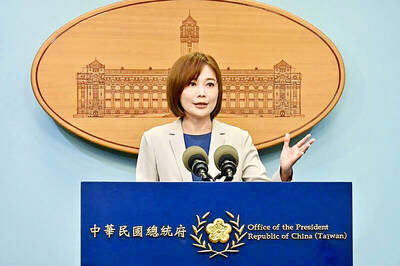
TIT-FOR-TAT: The US allegedly revoked the visa of a Chinese national working at Xinhua News Agency in the US in response to Beijing’s expulsion of Vivian Wang The Presidential Office yesterday condemned China for expelling a New York Times correspondent from Beijing following the newspaper’s interview with President William Lai (賴清德), saying the move highlighted Beijing’s suppression of press freedom and its threat to international news media. Taiwan has noted a series of recent incidents in which Beijing used similar tactics to “threaten and pressure international media outlets and journalists,” Presidential Office spokeswoman Karen Kuo (郭雅慧) said in a statement. “This concerns not only press freedom and freedom of expression, but also the safety of journalists, and Taiwan and relevant partners are paying close attention to the situation,” she


 RSS
RSS