


When Wang Chien-ming (王建民), the Taiwanese starting pitcher for the New York Yankees, returned home for a break at the end of the last US baseball season, local media were eager to ask him what his goal for this year would be.
A man known for giving short answers, Wang simply said the most important thing was "not to get hurt" and "just pitch." But now, Wang is having to confront his worst fear.
The New York Yankees issued an official statement yesterday saying that Wang is currently on the team's injured list. According to the statement, Wang suffered a strain of his right hamstring during a conditioning practice on Friday.
"I don't look for him [Wang] to touch our Major League roster until sometime in late April," said the Yankees' general manager Brian Cashman.
The injury means Wang will miss out on an opportunity to be the first Asian to be the Opening Day starter, in a game scheduled for April 2.
Wang said in a television interview that he felt sad about the unexpected setback but hoped he would recover from the injury soon so that he could return to the mound again.
Wang's misfortune means that another pitcher on the Yankee's roster will get the chance to throw the first pitch.
Yankees manager Joe Torre said that Carl Pavano, Kei Igawa and Jeff Karstens were potential candidates but of the three, Pavano was the "likely favorite," he said.
Wang, however, may not be the only starting pitcher from Taiwan forced to sit in the dugout at the start of the season.
A report in the Los Angeles Times on Saturday indicated that LA Dodgers starter Kuo Hong-chih (郭泓志) is unlikely to pitch again this spring as his left shoulder is showing signs of inflammation.
The pain in his shoulder looks likely to have played a role in a series of disappointing performances in this season's warm-up games.
Kuo has only recently recovered from "Tommy John" surgery, performed last year, otherwise known as ulnar collateral ligament reconstruction.
This is a surgical procedure in which a medial ligament in the elbow is replaced with a ligament from elsewhere in the patient's body (often from the forearm, hamstring, knee or foot).
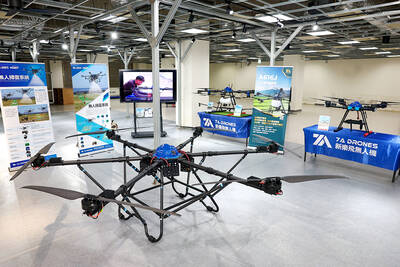
DRONE CENTRAL: Taiwan aims to become Asia’s democratic hub for drones, with most exports focused on high-quality military-grade models, an official said Taiwan’s drone industry is expected to expand significantly by 2030, producing 100,000 units per month and exporting half of them, the Ministry of Economic Affairs said yesterday. Current drone production capacity is about 15,000 units per month, but the industry can quickly scale up as demand increases, Industrial Development Administration Director-General Chiou Chyou-huey (邱求慧) told a news conference in Taipei. Taiwan’s drone output grew 2.5-fold last year to NT$12.9 billion (US$408.3 million) under a government program to develop the uncrewed vehicle sector, he said. The Executive Yuan in October last year approved plans to invest NT$44.2 billion into domestic production of uncrewed aerial
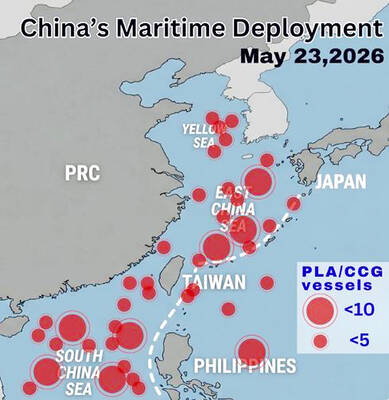
WARNING: China should stop engaging in actions that undermine regional peace and stability, as it would only build resentment among people across the Strait, the CGA said China has deployed more than 100 navy, coast guard and other vessels in waters from the Yellow Sea to the South China Sea and the western Pacific since US President Donald Trump and Chinese President Xi Jinping (習近平) met in Beijing, National Security Council Secretary-General Joseph Wu (吳釗燮) said yesterday. “In this part of the world, #China is the one & only PROBLEM wrecking the #StatusQuo & threatening regional peace & stability,” Wu wrote on X. In a separate post, he said Beijing was coercing Taiwan’s maritime domain, calling it illegal and provocative, after the Coast Guard Administration (CGA) expelled a

VERBOSE VESSELS: A CGA cutter and a China Coast Guard exchanged verbal barbs for more than a day in Taiwanese-controlled waters before the Chinese vessel left The Taiwanese and Chinese coast guards had a standoff near the strategically located Pratas Islands (Dongsha Islands, 東沙群島) in the north of the South China Sea, the Coast Guard Administration (CGA) said yesterday. The two sides engaged in intense radio exchanges over sovereignty claims during the 33-hour standoff. China Coast Guard vessel 3501 eventually left the restricted waters, 26.6 nautical miles (49.2km) west of the Pratas Islands, at 5pm yesterday, the CGA said. Lying approximately between southern Taiwan and Hong Kong, the Taiwan-controlled Pratas are seen by some security experts as vulnerable to Chinese attack due to their distance — more than
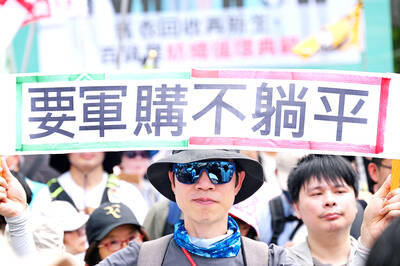
More than 8,000 people took part in a rally in Taipei yesterday to express support for more defense spending, after the opposition slashed the Cabinet’s proposed NT$1.25 trillion (US$39.6 billion) special defense budget and capped it at NT$780 billion. The demonstrators urged the Cabinet to propose another bill. Taiwan Economic Democracy Union convener Lai Chung-chiang (賴中強) said the main problem of the passed budget plan is the removal of funding for critical items, not just that the total amount is smaller. Critical budget items included purchasing or developing uncrewed vehicles, Strong Bow (強弓) missile systems, additional ammunition, artificial intelligence-powered combat systems and Taiwan-US


 RSS
RSS