


Prosecutors yesterday detained two people in connection with a financial scandal that has sent shockwaves through Taiwan's political system, and has even begun to affect cross-strait ties.
Chia Hsin Food and Synthetic Fiber Co (嘉新食品化纖) general manager Wang Lin-i (王令一) and Union Insurance Co (友聯產險) president Frank Wang (王事展) were held on suspicion of violating the Securities and Exchange Law (證券交易法).
The detentions came as authorities investigated the parent group of the companies, Rebar Asia Pacific Group. The Rebar Group's chairman, Wang You-theng (王又曾), fled to China on Dec. 30 with his wife, and is suspected of having embezzled millions of dollars from the group.
Lin-i is Wang You-theng's son, while Frank is his younger brother.
They were the first two people to be detained in the Rebar case.
"We found it necessary to detain the two defendants as they are suspected of having earned more than NT$100 million [US$3 million] from illegal transactions. They face more than seven years in prison." said Fred Lin (
Kuo Chi-ling (
Prosecutors are also probing whether operations in dozens of other units in the group run by family members involved irregularities such as insider trading, breach of trust and forgery.
Prosecutors have ordered about 40 members of the Wang family and the conglomerate's top executives to remain in the country pending investigation.
The scandal began to unfold after a bank run last Friday quickly turned into a wide-ranging criminal investigation into financial malfeasance.
The scandal has threatened thousands of jobs and has erased millions of dollars of wealth on the stock market.
The run on The Chinese Bank (中華銀行) began after China Rebar Co (中國力霸) and Chia Hsin Food and Synthetic Fiber, all under the parent Rebar Asia Pacific Group (力霸亞太企業集團), filed applications for insolvency protection on Dec. 29.
Wang You-theng fled to China the next day.
The firms failed to notify the Taiwan Stock Exchange Corp of their insolvency claims immediately -- as required under financial regulations -- postponing notification until last Thursday.
Approved
The companies' request to the Taipei District Court for insolvency protection was approved on the same day.
The Central Deposit Insurance Corp (
Chia Hsin Food and Synthetic Fiber is suffering from a NT$19.9 billion debt stemming from losses in its man-made fiber business.
China Rebar, an insurance, financing, broadband and TV shopping business which acts as a guarantor for Chia Hsin Food and Synthetic Fiber, has debts worth NT$20.7 billion.
The Taiwan Stock Exchange has also announced that 41 listed companies had suffered losses of NT$3.11 billion from investments in Rebar's Asia Pacific Broadband Telecom Co (
The Rebar Group employs more than 5,000 people, many of whom took to the streets to try to protect their jobs, saying that authorities' decision to freeze the assets of the two troubled firms will force employees out of work.
In related news, the Chinese Nationalist Party (KMT) yesterday announced that it would cancel Wang You-theng and his wife's party memberships. It also suspended Frank Wang's central standing committee membership.
The KMT decided that action should be taken immediately, as the scandal had damaged its reputation.
"As a responsible opposition party, the KMT made a quick and necessary decision in response to the scandal. We hope that the DPP will solve the incident and stop dragging the KMT into the Rebar scandal," KMT Spokesman Huang Yu-cheng (
Additional reporting by Mo Yan-chih
also see stories:
Premier calls on China to hand over Rebar fugitive
President asks Su Tseng-chang to conduct inquiry
Legislature likely to pass bill on debtor disclosure
Asia Pacific Telecom `on track'
CLA vows to protect Rebar employees
Banks refuse loan to Rebar-linked Eastern Multimedia
Union Insurance attempts to allay clients' concerns

PROVOCATIVE: Chinese Deputy Ambassador to the UN Sun Lei accused Japan of sending military vessels to deliberately provoke tensions in the Taiwan Strait China denounced remarks by Japan and the EU about the South China Sea at a UN Security Council meeting on Monday, and accused Tokyo of provocative behavior in the Taiwan Strait and planning military expansion. Ayano Kunimitsu, a Japanese vice foreign minister, told the Council meeting on maritime security that Tokyo was seriously concerned about the situation in the East China and South China seas, and reiterated Japan’s opposition to any attempt to change the “status quo” by force, and obstruction of freedom of navigation and overflight. Stavros Lambrinidis, head of the EU delegation to the UN, also highlighted South China Sea

The final batch of 28 M1A2T Abrams tanks purchased from the US arrived at Taipei Port last night and were transported to the Armor Training Command in Hsinchu County’s Hukou Township (湖口), completing the military’s multi-year procurement of 108 of the tanks. Starting at 12:10am today, reporters observed more than a dozen civilian flatbed trailers departing from Taipei Port, each carrying an M1A2T tank covered with black waterproof tarps. Escorted by military vehicles, the convoy traveled via the West Coast Expressway to the Armor Training Command, with police implementing traffic control. The army operates about 1,000 tanks, including CM-11 Brave Tiger
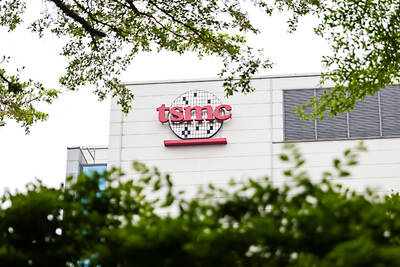
Taiwan Semiconductor Manufacturing Co (TSMC, 台積電), the world’s largest contract chipmaker, said it expects its 2-nanometer (2nm) chip capacity to grow at a compound annual rate of 70 percent from this year to 2028. The projection comes as five fabs begin volume production of 2-nanometer chips this year — two in Hsinchu and three in Kaohsiung — TSMC senior vice president and deputy cochief operating officer Cliff Hou (侯永清) said at the company’s annual technology symposium in Silicon Valley, California, last week. Output in the first year of 2-nanometer production, which began in the fourth quarter of last year, is expected to

Taiwan’s drone exports surged past US$100 million in the first quarter, exceeding last year’s full-year total, with the Czech Republic emerging as the largest buyer, the Ministry of Economic Affairs said. Exports of complete drones reached US$115.85 million in the period, about 1.2 times the total recorded for all of last year, the ministry said in a report. Exports to the Czech Republic accounted for about US$100 million, far outpacing other markets. Poland, last year’s top destination, recorded about US$11.75 million in the first quarter. Taiwan’s drone exports have expanded rapidly in the past few years, with last year’s total


 RSS
RSS