


Acknowledging his office's mishandling of the special mayoral allowance, Taipei Mayor Ma Ying-jeou (馬英九) yesterday apologized for what he called "administrative defects," adding that he would not resign over the matter.
"Although I knew nothing about it and so far there is no evidence to prove [my staffer] pocketed the money, I still need to shoulder administrative, political and moral responsibility for this blemish ... I offer my sincere apologies to Taipei residents," Ma told a press conference at Taipei City Hall.
Yu Wen (余文), a Taipei City staffer who handled reimbursements for the allowance, was found by the city government last month to have substituted receipts for smaller amounts with personal receipts for larger amounts in a bid to reduce his paperwork.
In an attempt to simplify the reimbursement procedure for amounts ranging between NT$10,000 and NT$20,000 -- usually between 50 and 100 receipts each month -- Yu substituted his own receipts for larger amounts for several of the smaller ones, Taipei City Government Secretariat Director Lee Sush-der(李述德) said.
This was not discovered until prosecutors began investigating Ma's use of the special fund, and as a result 3,754 receipts, totaling around NT$800,000, had been "exchanged" in this way since 2003, Lee added.
Ma acknowledged that the case had damaged both his and the city government's reputations and denied shifting the responsibility onto Yu, while saying that he did not need to resign over the matter.
"We did not shift the responsibility onto him to save ourselves. It's the truth, and the prosecutors are investigating the case now ? I don't think that I should resign because I wasn't directly involved in the matter," he said.
Director of the mayor's office Cheng An-kuo (鄭安國), who supervised the allowance reimbursements, offered his resignation yesterday. This was later approved by Ma.
"The situation began before I arrived at the city government, but I did not discover it and failed to prevent it from having such a big impact on both Mayor Ma and the city government. I feel very sorry and I need to take responsibility for this," Cheng told the media.
Yu, on the other hand, was questioned by prosecutors yesterday after the city government's department of government ethics reported Yu's case to prosecutors on Tuesday.
According to Lee, the government ethics department found all of the original receipts in the basement of the city government and the internal investigation found no evidence that Yu had pocketed any of the money.
The government regulations state that half of the mayor's monthly NT$340,000 allowance requires no receipts, while the other half requires receipts for reimbursement.
Of the NT$170,000 portion of the allowance that required receipts, about NT$80,000 was used for rewarding staff members, and another NT$90,000 was spent on public affairs matters.
Ma said his secretaries, drivers and bodyguards received most of the rewards.
Asked to compare this situation with the alleged use of fake receipts to claim reimbursement from the president's "state allowance fund," Ma said while the president and the first lady collected receipts to cover their own expenses, in the city government's case it was only a procedural blemish.
In response to questions from DPP legislators on the amount of money spent on red envelopes for parties and white envelopes for funerals, Cheng said that in addition to the money paid out for the envelopes, there were other related expenses such as flowers and postage.
Cheng dismissed allegations that Ma had used the allowance for his personal living expenses.
Some of the allowance was used to pay for breakfast for Ma's bodyguards and drivers, who usually get up very early to pick the mayor up from his house, he added.
Prosecutor Hou Kuan-jen (
Another 10 people, including Taipei officials and others were also questioned.
"The eleven were released after questioning," Taiwan High Court Prosecutors' Office spokesman Chang Wen-cheng (
Prosecutors said Yu, however, had been barred from leaving the country.
Additional reporting by Rich Chang
also see story:
Editorial: Different rules for different folks
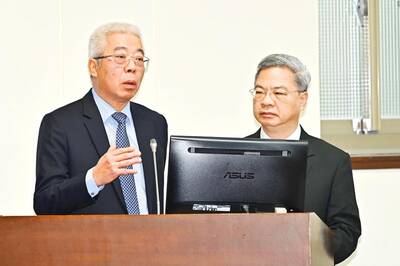
Taiwan has arranged for about 8 million barrels of crude oil, or about one-third of its monthly needs, to be shipped from the Red Sea this month to bypass the Strait of Hormuz and ease domestic supply pressures, CPC Corp, Taiwan (CPC, 台灣中油) said yesterday. The state-run oil company has worked with Middle Eastern suppliers to secure routes other than the Strait of Hormuz, through which about 20 percent of the world’s oil and liquefied natural gas typically passes, CPC chairman Fang Jeng-zen (方振仁) said at a meeting of the legislature’s Economics Committee in Taipei. Suppliers in Saudi Arabia have indicated they
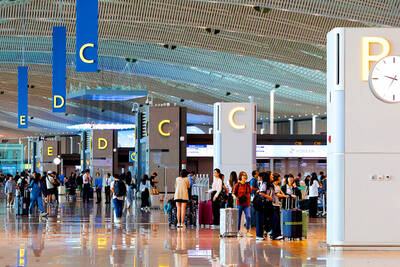
South Korea has adjusted its electronic arrival card system to no longer list Taiwan as a part of China, a move that the Ministry of Foreign Affairs said would help facilitate exchanges between the two sides. South Korea previously listed “Taiwan” as “Taiwan (China)” in the drop-down menus of its online arrival card system, where people had to fill out where they came from and their next destination. The ministry had requested South Korea make a revision and said it would change South Korea’s name on Taiwan’s online immigration system from “Republic of Korea” to “Korea (South),” should the issue not be
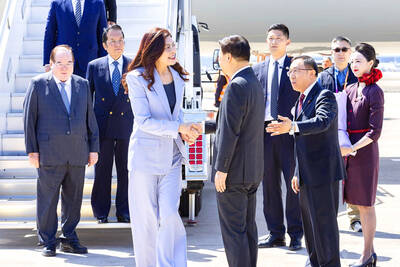
CCP ‘PAWN’? Beijing could use the KMT chairwoman’s visit to signal to the world that many people in Taiwan support the ‘one China’ principle, an academic said Chinese Nationalist Party (KMT) Chairwoman Cheng Li-wun (鄭麗文) yesterday arrived in China for a “peace” mission and potential meeting with Chinese President Xi Jinping (習近平), while a Taiwanese minister detailed the number of Chinese warships currently deployed around the nation. Cheng is visiting at a time of increased Chinese military pressure on Taiwan, as the opposition-dominated Legislative Yuan stalls a government plan for US$40 billion in extra defense spending. Speaking to reporters before going to the airport, Cheng said she was going on a “historic journey for peace,” but added that some people felt uneasy about her trip. “If you truly love Taiwan,
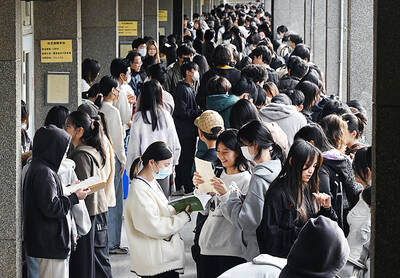
A global survey showed that 60 percent of Taiwanese had attained higher education, second only to Canada, the Ministry of the Interior said. Taiwan easily surpassed the global average of 43 percent and ranked ahead of major economies, including Japan, South Korea and the US, data from the Organisation for Economic Co-operation and Development (OECD) for 2024 showed. Taiwan has a high literacy rate, data released by the ministry showed. As of the end of last year, Taiwan had 20.617 million people aged 15 or older, accounting for 88.5 percent of the total population, with a literacy rate of 99.4 percent, the data


 RSS
RSS