


The Democratic Progressive Party (DPP) was dealt another blow yesterday when two prominent legislators resigned to protest the party's handling of the corruption scandal implicating President Chen Shui-bian (陳水扁) and his wife.
DPP Legislators Lin Cho-shui (林濁水) and Lee Wen-chung (李文忠) dropped a bombshell when they announced they would leave the legislature.
Lin and Lee, who were know as "senior reformists" of the party, said the DPP's attitude toward those who have been indicted in connection with the "state affairs fund" case -- first lady Wu Shu-jen (吳淑珍) and three presidential aides as well as Chen -- "did not conform to the public's expectations" or the party's high moral standards.
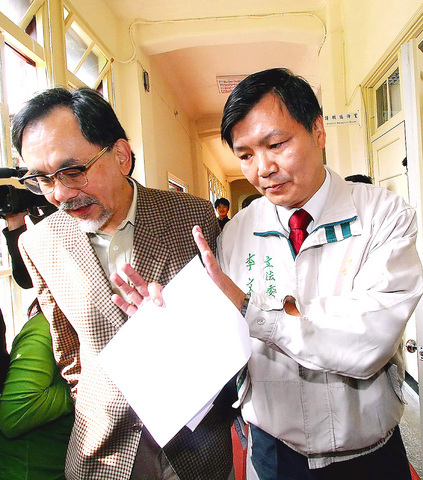
PHOTO: STEVE CHEN, AP
The pair had promised before the indictments were handed down that they would ask Chen to step down if he was "involved or indicted in the case."
They said they did not want to violate the DPP's resolution opposing the third recall motion or hurt the feeling of the party's supporters, although they knew they had to keep their promise. They also said they feared the public would pay a huge cost if the recall motion were put to a referendum. Therefore they decided to resign, they said.
While the two are leaving the legislature, they are not leaving the party. They said they believed the DPP remains the only party where "the force of reform in the nation is concentrated."
"We've never thought about leaving the party. It is, after all, what we have dedicated our best years to," Lee said.
Lin said the DPP has been trusted by the public as a clean and reform-oriented party and that they both felt sad when the public questioned the party's spirit. He said their belief in the party remained unchanged.
When asked what they expected Chen to do in response to their move, Lee said: "Do the right thing."
In a second press conference yesterday, Lee refused to comment on whether the DPP's response to his suggestions on how the party should have dealt with Chen had disappointed him. He also refused to say when he had made the decision to quit.
Both men said they would not change their minds even if senior DPP members tried to dissuade them.
"Thank you, but there's nothing to talk about," Lin said.
They said they made an "imperfect but less harmful" decision as DPP supporters, but they did not encourage other DPP members to do the same.
Their announcement was criticized by fellow DPP members and legislators.
DPP Chairman Yu Shyi-kun said party members should stick together during difficult times because the party would suffer without unity.
Caucus whip Ker Chien-ming (
"The one thing that I feared the most has happened," Ker said.
Presidential Office Deputy Secretary-General Cho Jung-tai (卓榮泰) had called the pair before their press conference to try to get them to change their minds, Ker said.
He said he believed that all DPP members were working hard for the party's future, though in different ways. He urged other members not to blame Lin and Lee for their decisions.
DPP Legislator Kuan Bi-ling (
"We lost the opportunity to have a dialogue with the reformers, the more sophisticated people and the middle class," she said.
"If we had discussed more rationally whether the party should suspend the president's membership and showed the public the party's reform spirit, they [Lin and Lee] would have felt differently."
DPP Legislator Lin Kuo-ching (林國慶), however, said the resignations "rubbed salt in the party's wound."
He said "the timing was wrong" because the party had been listening to all kinds of suggestions. He also said he was worried the pair would "harm the DPP" by continuing to criticize it.
DPP Legislator Lai Ching-te (
"I think, in this difficult time, all warriors have to stay on the battlefield. This is the warriors' responsibility," Lai said.
Whether yesterday's resignations would have a domino effect in the DPP was unclear last night.
Legislator Lin Tai-hua (
The Chinese Nationalist Party (KMT) caucus said the two DPP lawmakers had made "a choice about right and wrong."
KMT Legislator Lin Hsu Shao-ping (
The KMT caucus called on other DPP supporters to distance themselves from the party and urged the DPP to reflect on itself.
Lin Cho-shui and Lee Wen-chung were among the founders of the DPP's former New Tide faction. Both have been active in the democratic movement since the DPP was an opposition party.
They said they would leave their positions by the end of this week.
Lin Cho-shui's position as a legislator-at-large will be filled by Hsu Te-hsiang (許德祥), while Lee Wen-chung's seat as a representative of a Taipei County district will not be filled, according to the Election and Recall Law of Civil Servants (公職人員選罷法).
The DPP will now have 84 seats in the Legislative Yuan.
"They are both remarkable DPP members. We are truly sorry they are leaving their posts," Government Information Office Minister and Cabinet Spokesman Cheng Wen-tsang (鄭文燦) said on behalf of Premier Su Tseng-chang (蘇貞昌).
"We were fully aware of their decision to leave before they made the announcement," he said.
"We respect their decision. But their decision also indicates that there are problems at the DPP and the DPP must do something to fix them as soon as possible," Cheng said.
Legislative Speaker Wang Jin-pyng (王金平) said that he had persuaded the pair to hold off submitting their resignation letters to him for a few days.
"Lee [Wen-chung] spoke to me on the telephone after their press conference and I told them that they should sleep on it as their resignations would become effective once they have submitted them," he said.
But Wang said that the pair seemed to be determined to follow through with their plan.
also see story:
Editorial: Chen faces a tough choice

CHAOS: Iranians took to the streets playing celebratory music after reports of Khamenei’s death on Saturday, while mourners also gathered in Tehran yesterday Iranian Supreme Leader Ayatollah Ali Khamenei was killed in a major attack on Iran launched by Israel and the US, throwing the future of the Islamic republic into doubt and raising the risk of regional instability. Iranian state television and the state-run IRNA news agency announced the 86-year-old’s death early yesterday. US President Donald Trump said it gave Iranians their “greatest chance” to “take back” their country. The announcements came after a joint US and Israeli aerial bombardment that targeted Iranian military and governmental sites. Trump said the “heavy and pinpoint bombing” would continue through the week or as long
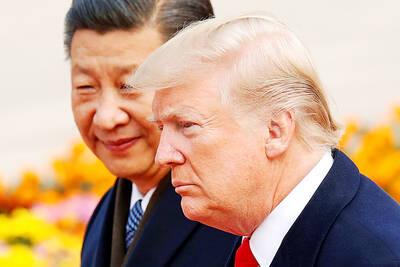
TRUST: The KMT said it respected the US’ timing and considerations, and hoped it would continue to honor its commitments to helping Taiwan bolster its defenses and deterrence US President Donald Trump is delaying a multibillion-dollar arms sale to Taiwan to ensure his visit to Beijing is successful, a New York Times report said. The weapons sales package has stalled in the US Department of State, the report said, citing US officials it did not identify. The White House has told agencies not to push forward ahead of Trump’s meeting with Chinese President Xi Jinping (習近平), it said. The two last month held a phone call to discuss trade and geopolitical flashpoints ahead of the summit. Xi raised the Taiwan issue and urged the US to handle arms sales to

State-run CPC Corp, Taiwan (CPC, 台灣中油) yesterday said that it had confirmed on Saturday night with its liquefied natural gas (LNG) and crude oil suppliers that shipments are proceeding as scheduled and that domestic supplies remain unaffected. The CPC yesterday announced the gasoline and diesel prices will rise by NT$0.2 and NT$0.4 per liter, respectively, starting Monday, citing Middle East tensions and blizzards in the eastern United States. CPC also iterated it has been reducing the proportion of crude oil imports from the Middle East and diversifying its supply sources in the past few years in response to geopolitical risks, expanding
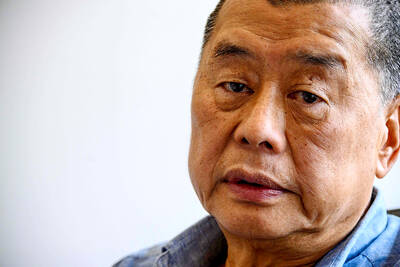
Pro-democracy media tycoon Jimmy Lai’s (黎智英) fraud conviction and prison sentence were yesterday overturned by a Hong Kong court, in a surprise legal decision that comes soon after Lai was jailed for 20 years on a separate national security charge. Judges Jeremy Poon (潘兆初), Anthea Pang (彭寶琴) and Derek Pang (彭偉昌) said in the judgement that they allowed the appeal from Lai, and another defendant in the case, to proceed, as a lower court judge had “erred.” “The Court of Appeal gave them leave to appeal against their conviction, allowed their appeals, quashed the convictions and set aside the sentences,” the judges


 RSS
RSS