

After surviving a recall motion initiated by the pan-blue camp last month, President Chen Shui-bian (
A group of pan-green academics yesterday held a press conference urging Chen to take political and moral responsibility and seriously consider stepping down, while another pro-green group was mulling whether to hold a press conference tomorrow to counter the former's motion.
A statement entitled "Democracy and the Moral Crisis of Taiwanese Identity -- Our Appeal to the President, the Ruling Party and Taiwanese Citizens," was released yesterday at the press conference by a number of pan-green academics.
Group member Fan Yun (范雲), quoting from the statement, said: "We expect President Chen to realize how heavy his responsibility is as a president ... When he loses credibility and the trust of the people, we urge him to seriously consider resigning from his post."
Together with a signature drive launched earlier this week, which has attracted more than 4,000 signatures, the group pressed for the president to resign voluntarily in order to "set a good example and make a contribution to Taiwan's democracy."
Wu Nai-teh (吳乃德), one of the academics and the younger brother of former Taiwan Stock Exchange chairman Wu Nai-jen (吳乃仁), denied the move was an "anti-Chen Shui-bian movement."
He said that seeking a more mature democracy and Taiwanese identity were the ultimate goal.
"Taking down the president is not the objective. What we want is to raise the quality of Taiwan's democracy," he said
Wu added that Chen's resignation on his own initiative would help raise the quality of democratic politics.
Chang Fu-chung (
Chang also said that the DPP had drifted away from its spirit and ideals established during the dangwai ("outside the party,"
Chang questioned the DPP's silence on recent corruption cases involving the president's family members and close aides in an attempt to protect Chen.
"Where is the party's self-critical spirit now?" he said.
The academics said that the president failed to clarify the corruption scandals and lost his ability to solve the country's crisis as a leader of pro-localization forces.
If the president shrugged off their appeal and refused to step down, Wu Rwei-ren
While the group's online signature drive has attracted thousands of signatures over the past two days, the Web site's lack of an identity verification system has allowed some mischief makers into the site. Names like Chen Shui-bian, Vice President Annette Lu (
Meanwhile, Chinese Nationalist Party (KMT) Chairman Ma Ying-jeou (
"But the same remarks made by the pan-blue camp were twisted as ethnic or political clashes ... Now that the pro-green academics have come out and made their statement, it's easier to see the problem," Ma said after presiding over a municipal event.
Other pan-green groups, however, disagreed with the academics' view. These include the Northern Society and the Southern Society, which are planning to hold a news conference tomorrow to present their opposing views.
Meanwhile, Chen will invite key players within his administration and party, legislators as well as city and county chiefs tomorrow to discuss the latest political development.
Cho Jung-tai (
But with regards to allegations that the president was lacking in "self-reflection," Cho said, "this is far from true."
DPP legislators yesterday expressed hope that the president will hear the "true voice of the grassroots" in tomorrow's meeting.
DPP caucus whip Chen Chin-jun (
One DPP legislator who requested anonymity said the president had called for similar meetings before whenever he ran into difficulties, but the meetings ended with no results.
DPP Legislator William Lai (
Lai hoped the president would listen closely to all views, instead of "lecturing" as in the past; otherwise, "no one will take part in such meetings anymore."
DPP Legislator Wang Hsin-nan (

BAVI: Taipei, New Taipei City, Taoyuan and others announced work and class closures today, with the storm expected to affect Taiwan through tomorrow The outer rain bands of Typhoon Bavi would begin affecting Taiwan today, with its storm circle reaching land this evening and its level-10 wind radius covering all of northern Taiwan by noon tomorrow, an official said yesterday. The Central Weather Administration (CWA) issued a sea warning for the storm at 2:30pm yesterday, advising of heightened danger in eastern areas and in the Bashi Channel south of Taiwan. Typhoon Bavi is expected to bring strong winds, extremely heavy rainfall and rough seas to Taiwan today and tomorrow, with the heaviest rain forecast for mountainous areas and sustained winds of up to 12 on
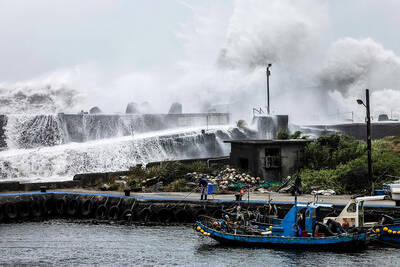
Typhoon Bavi was expected to have its strongest impact on Taiwan from last night through daytime today, with its storm circle forecast to reach areas from New Taipei City’s northeast coast to Yilan and Hualien counties early today, the Central Weather Administration (CWA) said yesterday. As of 6pm yesterday, the center of the typhoon was about 590km east of Taiwan’s southernmost tip at Oluanpi (鵝鑾鼻), moving northwest at 26kph, the CWA said. The storm was packing maximum sustained winds of 155kph near its center, with gusts reaching 191kph. It had a radius of 380km. A land warning, issued at 5:30am yesterday, remains in
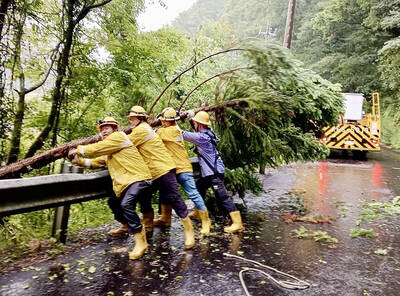
Typhoon Bavi lashed Taiwan yesterday, injuring 113 people, prompting the evacuation of 14,605 residents and knocking out power in 234,481 households, the government said. Most of the injuries were due to people falling off motorcycles or bicycles due to strong winds and slippery roads, and others occurred during the typhoon preparations, Central Emergency Operations Center (CEOC) data as of 8pm yesterday showed. No fatalities or severe injuries had been reported as of press time last night. Due to flooding and landslide risks, 14,605 people had been evacuated nationwide, led by 5,182 people in Hualien County, 2,096 in Taichung, 1,700 in New Taipei,
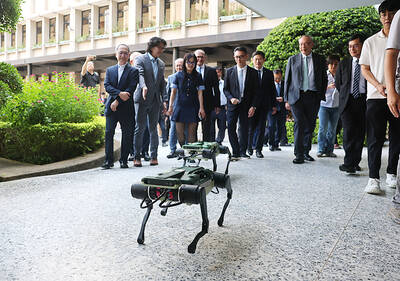
APPLICATIONS: The robots are capable of disaster and firefighting response, autonomous navigation, swarm operations as well as underground tunnel inspections, the ministry said The Ministry of Economic Affairs is working with the Industrial Technology Research Institute (ITRI) and industry partners to create a homegrown program to develop four-legged robots to tap into the US$4 billion global robot dog market. The initiative aims to leverage Taiwan’s strengths in information and communications technology, semiconductors and precision machinery to build indigenous technologies and a non-China supply chain, the ministry said. Technology is evolving from robotic arms to wheeled, quadruped and humanoid robots with autonomous mobility capabilities, it said. Driven by rapid advancements in generative artificial intelligence (AI), visual recognition, sensors and high-performance computing, robots are now capable of


 RSS
RSS