


Thailand's military chiefs yesterday said the country did not need to declare a state of emergency, after Prime Minister Thaksin Shinawatra threatened to impose one if protests against him turn violent.
"There is no need for emergency rule. That would only hurt the country's image, and the army does not agree with the idea of emergency rule," army commander General Sonthi Boonyaratglin told reporters.
Thailand's top military chief, Supreme Commander Ruengroj Mahasaranond, said emergency rule was meant only for very serious situations and not for non-violent protests like the one currently facing Thaksin.
"The armed forces are under the king and we do everything for the sake of the people. Emergency rule can be declared only if the country is in a riot situation, or if there were an arson attack on public buildings," he said.
Both military leaders have repeatedly assured the public that the armed forces would not step into the political crisis, seeking to ease fears of a coup in a country with a long and relatively recent history of military governments.
Earlier yesterday, Thaksin had threatened to impose emergency rule on Bangkok if a protest outside his office turned violent.
Demonstrators seeking Thaksin's resignation castigated him with fiery speeches but remained peaceful as their latest mass protest passed the 24-hour mark yesterday.
Tens of thousands of demonstrators early yesterday morning marched from a field where they held an all-night anti-Thaksin rally to the prime minister's office, putting the seat of government under virtual -- but calm -- siege.
Thaksin was in the country's northeast, and attended his weekly Cabinet meeting at Government House remotely, by video teleconference.
The prime minister has arranged his schedule to allow him to be out of town during many of the past week's protests against him, depriving his detractors of a chance to confront him with their charges of corruption and abuse of power.
Chamlong Srimuang, a protest leader, said demonstrators would stay outside Government House until Thaksin resigned, but would wait patiently and shun violence.
"If we use violence, it is our fellow Thais who will die," he said.
With Thaksin daily reaffirming that he will not step down, protest leaders have been advocating new actions to pressure him.
A member of the Thai Senate, Maleerat Kaewka, urged the crowd outside Government House to adopt civil obedience.
She suggested that civil servants take extended leave and people not pay their taxes until Thaksin resigns.
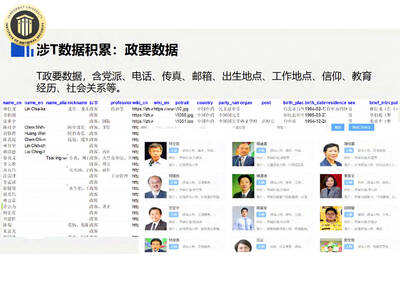
NETWORK-MAPPING PROJECT: The database contains 170 detailed files of Taiwanese politicians and about 23 million records of household registration data in Taiwan China has developed a network-mapping project targeting political figures and parties in Taiwan to monitor public opinion during elections and to craft tailored influence campaigns aimed at dividing Taiwanese society, according to documents leaked by Chinese technology firm GoLaxy (中科天璣). The documents, collected by Taipei-based Doublethink Lab, showed a database was specifically created to gather detailed information on Taiwanese political figures, including their political affiliations, job histories, birthplaces, residences, education, religion and a brief biography about them. Several notable Taiwanese politicians are in the database, including President William Lai (賴清德), former president Tsai Ing-wen (蔡英文), Minister of Foreign Affairs Lin Chia-lung (林佳龍),

RECOGNITION: Former Fijian prime minister Mahendra Chaudhry said that Taiwan’s New Southbound Policy serves as a stabilizing force in the Indo-Pacific region Taiwan can lead the unification of the Chinese people, Nobel Peace Prize laureate and former Polish president Lech Walesa said in Taipei yesterday, adding that as the world order is changing, peaceful discussion would find good solutions, and that the use of force and coercion would always fail. Walesa made the remarks during his keynote address at a luncheon of the Yushan Forum in Taipei, titled “Indo-Pacific Partnership Prospects: Taiwan’s Values, Technology and Resilience,” organized by the Taiwan-Asia Exchange Foundation with the Ministry of Foreign Affairs. Walesa said that he had been at the forefront of a big peaceful revolution and “if
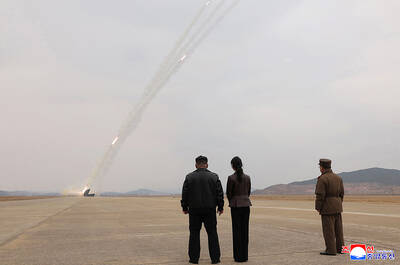
North Korea tested nuclear-capable rocket launchers, state media reported yesterday, a day after Seoul detected the launch of about 10 ballistic missiles. The test comes after South Korean and US forces launched their springtime military drills, due to run until Thursday. North Korean leader Kim Jong-un on Saturday oversaw the testing of the multiple rocket launcher system (MRLS), the Korean Central News Agency (KCNA) said. The test involved 12 600mm-caliber ultra-precision multiple rocket launchers and two artillery companies, it said. Kim said the drill gave Pyongyang’s enemies, within the 420km striking range, a sense of “uneasiness” and “a deep understanding

North Korea yesterday fired about 10 ballistic missiles to the sea toward Japan, the South Korean Joint Chiefs of Staff (JCS) said, days after Pyongyang warned of “terrible consequences” over ongoing South Korea-US military drills. Pyongyang recently dashed hopes of a diplomatic thaw with Seoul, Washington’s security ally, describing its latest peace efforts as a “clumsy, deceptive farce.” Seoul’s military detected “around 10 ballistic missiles launched from the Sunan area in North Korea toward the East Sea [Sea of Japan] at around 1:20pm,” JCS said in a statement, referring to South Korea’s name for the body of water. The missiles


 RSS
RSS