


"I told [former] president Lee Teng-hui (李登輝) that I too am a `New Taiwanese,'" said incoming director of the Taipei Office of the American Institute in Taiwan (AIT) Stephen Young at a press conference on Wednesday at AIT's Washington Office.
Young, who assumes his new post on March 18, speaks good Mandarin and has been taking classes in Hoklo (commonly known as Taiwanese) in preparation for his new job.
Besides looking forward to meeting with President Chen Shui-bian (陳水扁) again, Young, who previously served as deputy director of AIT's Taipei Office from 1998 to 2001, also talked about the prospect of future talks with Premier Su Tseng-chang (蘇貞昌), Chinese Nationalist Party (KMT) Chairman Ma Ying-jeou (馬英九) and other political leaders.
Young said that Taiwan's democracy could be a model for countries around the world. He also said that Taiwan had made rapid progress and that he would be learning more about challenging issues such as the Taiwanese national identity, cross-strait relations and the special arms procurement bill.
Citing US President George W. Bush, who said in a speech in Kyoto, Japan, last November that Taiwan was a good example for China and the rest of the world to follow, Young said the nation could promote political openness in an orderly and stable way.
He said that while serving as the US ambassador to Kyrgyzstan, he had used Taiwan as an example to show that a country with limited resources can promote democracy.
Young said Taiwan's presidential elections in 2000 and 2004 did not result in significant instability or economic disruption, and this showed that its democracy had rapidly matured, something that both Taiwanese and Americans could be proud of.
Bush and US Secretary of State Condoleezza Rice have stressed the importance of the universal values of democracy and freedom, and if these were to be used as a gauge of friendship with the US, Taiwan would receive a high score, Young said.
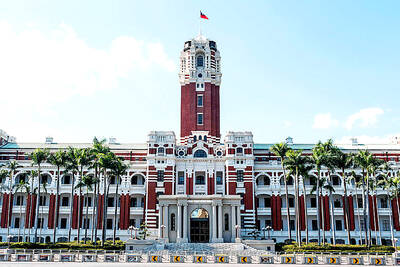
SECURITY: Taipei presses the US for arms supplies, saying the arms sales are not only a reflection of the US security commitment to Taiwan but also serve as a mutual deterrent against regional threats Taiwan is committed to preserving the cross-strait “status quo” and contributing to regional peace and stability, the Presidential Office said yesterday. “It is an undeniable fact that the Republic of China is a sovereign and independent democratic nation,” Presidential Office spokeswoman Karen Kuo (郭雅慧) reiterated, adding that Beijing has no right to claim sovereignty over Taiwan. The statements came after US President Donald Trump warned against Taiwanese independence. Trump wrapped up a state visit to Beijing on Friday, during which Chinese President Xi Jinping (習近平) had pressed him not to support Taiwan. Taiwan depends heavily on US security backing to deter China from carrying
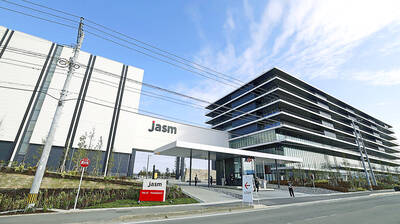
The subsidiary of Taiwan Semiconductor Manufacturing Co (TSMC, 台積電) in Kumamoto, Japan, turned a profit in the first quarter of this year, marking the first time the first fab of the unit has become profitable since mass production started at the end of 2024. According to the contract chipmaker’s financial statement released on Friday, Japan Advanced Semiconductor Manufacturing Inc (JASM), a joint venture running the fab in Kumamoto, posted NT$951 million (US$30.19 million) in profit in the January-to-March period, compared with a loss of NT$1.39 billion in the previous quarter, and a loss of NT$3.25 billion in the first quarter of
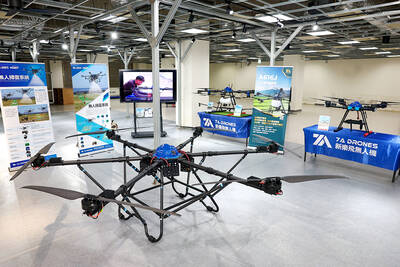
DRONE CENTRAL: Taiwan aims to become Asia’s democratic hub for drones, with most exports focused on high-quality military-grade models, an official said Taiwan’s drone industry is expected to expand significantly by 2030, producing 100,000 units per month and exporting half of them, the Ministry of Economic Affairs said yesterday. Current drone production capacity is about 15,000 units per month, but the industry can quickly scale up as demand increases, Industrial Development Administration Director-General Chiou Chyou-huey (邱求慧) told a news conference in Taipei. Taiwan’s drone output grew 2.5-fold last year to NT$12.9 billion (US$408.3 million) under a government program to develop the uncrewed vehicle sector, he said. The Executive Yuan in October last year approved plans to invest NT$44.2 billion into domestic production of uncrewed aerial
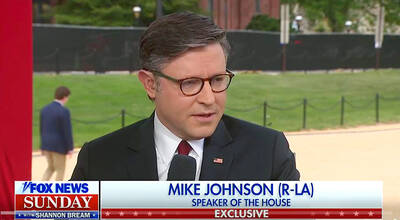
RESOLUTE BACKING: Two Republican senators are planning to introduce legislation that would impose immediate sanctions on China if it attempts to invade Taiwan US House of Representatives Speaker Mike Johnson on Sunday reaffirmed US congressional support for Taiwan, saying the US and “all freedom-loving people” have a stake in preventing China from seizing Taiwan by force. Johnson made the remarks in an interview with Fox News Sunday on US President Donald Trump’s summit with Chinese President Xi Jinping (習近平) last week. In an interview that aired on Friday on Fox News, just as Trump wrapped up a high-stakes visit to China, he said he has yet to green-light a new US$14 billion arms package to Taiwan and that it “depends on China.” “It’s a very good


 RSS
RSS