


US commanders in Iraq are expressing grave concerns that the overcrowded Abu Ghraib prison has become a breeding ground for extremist leaders and a school for terrorist foot soldiers.
The reason is that the confinement allows detainees to forge relationships and exchange lessons of combat against the US and the new Iraq government. "Abu Ghraib is a graduate-level training ground for the insurgency," said an US commander in Iraq.
The US military has halted transferring detainees to Iraqi jailers until the Iraqis improve their prisoner care. But concerns about the growing detainee population under US control have prompted a number of officers to stop sending every suspect rounded up in raids to Abu Ghraib and other prisons.
Many inmates might instead be released if initial questioning indicated that they were not hardened fighters against the US troops and the Iraqi government.
"These decisions have to be intelligence driven, on holding those who are extreme threats or who can lead us to those who are," another US officer in Iraq said. "We don't want to be putting everybody caught up in a sweep into `Jihad University.'"
The perception of the prison as an incubator for more violence is the latest shift in how Abu Ghraib has been seen -- once a feared torture dungeon of former Iraqi president Saddam Hussein's government, then the center of the storm over prisoner abuse by the US and ever since a festering symbol of the unsolved problems of handling criminals, terrorists, rebels and holdovers from the Baathist era.
Pentagon officials say the latest questions about the prison have been raised by General George W. Casey Jr, the senior US commander in Iraq, and by Major General John Gardner, commander of the US-run prison system there.
Gardner has ordered a number of measures to deal with the problem to isolate suspected terrorist ringleaders from the broader detainee population and to limit clandestine communications among those in custody.
Plans to turn over Abu Ghraib, three other prisons and their inmates to the new Iraqi government have been stalled despite US commanders' concerns that overseeing the detainees saps personnel and continues to blot the US image.
After a series of raids on Iraqi-run detention centers late last year uncovered scores of abused prisoners, commanders at US and allied prisons said neither detainees nor the centers would be handed over to Iraqi jailers until US officials were satisfied that the Iraqis were meeting international standards for detainee care.
Concerns voiced by military officers in Iraq have intensified in recent weeks, with a growing prison population at the four major detention centers under US and allied control. The overall detainee population stood at 14,767 this week, an increase from 10,135 in June and a significant jump even from the end of December, when the number was 14,055, according to US military statistics.
Abu Ghraib held 4,850 detainees as of Jan. 31, a steep increase from 3,563 in June but a slight dip from 4,924 in late December.
At present, Iraqis may be freed from the US-run detention centers after review by a special panel, the Combined Release Board. Detained Iraqis are turned over to Iraqi jailers only if they are convicted by the Central Criminal Court of Iraq, US officials said.
The problem of insurgent networking and instruction in the detention system is part of a broader problem in the US counterterrorism effort. US military and intelligence officers say Iraq has become a magnet for violent extremists from across the Islamic world. The officials warn that violent extremists who are not killed, captured and held or persuaded to give up the struggle will emerge battle tested, and more proficient at carrying out terror attacks elsewhere.
Some officers warn of a parallel to the Soviet experience in Afghanistan, when radical Islamic fighters drawn to fight the Soviet occupiers forged strong relationships with religious extremists from within Afghanistan and across the Islamic world.
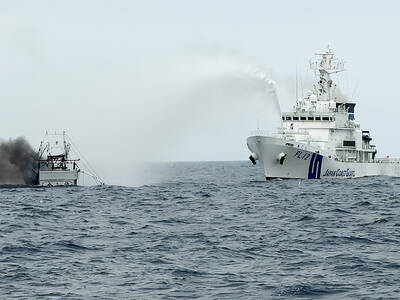
CREDIT-GRABBER: China said its coast guard rescued the crew of a fishing vessel that caught fire, who were actually rescued by a nearby Taiwanese boat and the CGA Maritime search and rescue operations do not have borders, and China should not use a shipwreck to infringe upon Taiwanese sovereignty, the Coast Guard Administration (CGA) said yesterday. The coast guard made the statement in response to the China Coast Guard (CCG) saying it saved a Taiwanese fishing boat. The Chuan Yu No. 6 (全漁6號), a fishing vessel registered in Keelung, on Thursday caught fire and sank in waters northeast of Diaoyutai Islands (釣魚台). The vessel left Keelung’s Badouzih Fishing Harbor (八斗子漁港) at 3:35pm on Sunday last week, with seven people on board — a 62-year-old Taiwanese captain surnamed Chang (張) and six

LEVERAGE: China did not ‘need to fire a shot’ to deny Taiwan airspace over Africa when it owns ‘half the continent’s debt,’ a US official said, calling it economic warfare The EU has raised concerns about overflight rights following the delay of President William Lai’s (賴清德) planned state visit to the Kingdom of Eswatini after three African nations denied overflight clearance for his charter at the last minute. Taiwanese allies Paraguay and Saint Kitts and Nevis, as well as several US lawmakers and the Inter-Parliamentary Alliance on China (IPAC) condemned China for allegedly pressuring the countries. Lai was scheduled to fly directly to Taiwan’s only African ally from yesterday to Sunday to celebrate the 40th anniversary of King Mswati III’s accession and his 58th birthday, but Seychelles, Mauritius and Madagascar suddenly revoked

RISKY BUSINESS: The ‘incentives’ include initiatives that get suspended for no reason, creating uncertainty and resulting in considerable losses for Taiwanese, the MAC said China’s “incentives” failed to sway sentiment in Taiwan, as willingness to work in China hit a record low of 1.6 percent, a Ministry of Labor survey showed. The Directorate-General of Budget, Accounting and Statistics (DGBAS) also reported that the number of Taiwanese workers in China has nearly halved from a peak of 430,000 in 2012 to an estimated 231,000 in 2024. That marked a new low in the proportion of Taiwanese going abroad to work. The ministry’s annual survey on “Labor Life and Employment Status” includes questions respondents’ willingness to seek employment overseas. Willingness to work in China has steadily declined from
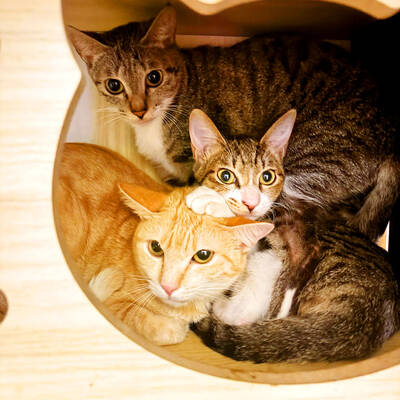
The number of pet cats in Taiwan surpassed that of pet dogs for the first time last year, reaching 1,742,033, a 32.8 percent increase from 2023, the Ministry of Agriculture said yesterday, citing a survey. By contrast, the number of pet dogs declined slightly by 1.2 percent over the same period to 1,462,528, the ministry said. Despite the shift, households with dogs still slightly outnumber those with cats by 1.2 percent. However, while the number of households with multiple dogs has remained relatively stable, households keeping more than two cats have increased, contributing to the overall rise in the feline population. The trend


 RSS
RSS