

Embattled Premier Frank Hsieh (
He will lead the Cabinet in a mass resignation on Monday.
Hsieh cited the failure of the legislature to approve the 2006 budget as the reason for his departure, but also made pointed remarks about his relationship with the president.
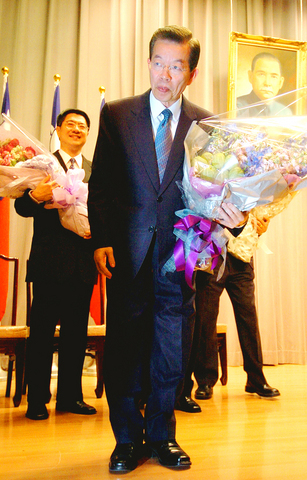
PHOTO: LUO PEI-DER, TAIPEI TIMES
"I firmly believe the foundation for reconciliation is to obtain power first and I am willing to bear the responsibility for the outcome of the [budget] request," Hsieh said. "However, it has failed to win the support [of the Presidential Office], which strengthens my determination to leave."
"While I don't have any advice for my successor, I have asked the president to let the new premier have more time to orient himself with the new position and stay on the job longer," he said.
Hsieh's tenure as premier was marked by a series of corruption scandals in the government, followed by an electoral defeat for his party.
The president accepted Hsieh's decision without protest.
"I have accepted his resignation. He has stepped down after accomplishing his mission," President Chen Shui-bian (陳水扁) said during a visit to Kinmen yesterday.
Chen said he would appoint a replacement before Lunar New Year's Day.
"I would like to appoint a new premier as soon as possible to not only stabilize the political situation but also to ensure smooth government administration," he added.
Accompanied by Vice Premier Wu Rong-i (吳榮義), Cabinet Spokesman Cho Jung-tai (卓榮泰) and other Cabinet officials, Hsieh made public his resignation during a press conference yesterday morning.
Hsieh said that he had told the president not to arrange any new position for him, because he would like to take a break from politics. He said he would like to take up writing to try to explain his policies to the public.
Hsieh added that he would like to see his Cabinet members retain their jobs, because his departure had a lot to do with personality conflicts. However, he admitted that what happened to the Cabinet after his departure was not up to him.
Hsieh said he had offered to leave twice after last month's local government elections, but that his resignation was rejected by the president because former Democratic Progressive Party (DPP) chairman Su Tseng-chang (
Hsieh said he had proposed to the president that he should sit down and talk with the party's "four superstars" -- Su, Hsieh, Vice President Annette Lu (呂秀蓮) and DPP chairman-elect Yu Shyi-kun -- in a bid to coordinate their efforts.
"To be honest with you, the relationship between me and the others [Su, Lu and Yu] is more tense than [the relationship] between the president and I," Hsieh said.
The negotiation process, however, did not go well, Hsieh said. The party was busy with the DPP chairmanship election, while the government and legislature were tied up with the budget review.
With Yu elected as the new chairman and the budget review over, Hsieh said he broached the issue again and finally obtained the president's agreement.
After the president agreed to let him go on Monday night, Hsieh said he felt greatly relieved and that he had had a good night's sleep.
"I feel my burden has been lifted," Hsieh said.
Later, however, Hsieh sounded wistful when he said he would soon be jobless and that "being jobless is sometimes very undignified."
He was speaking during an inspection of a Council of Labor Affairs job training office in Taipei County, hours after he announced he would step down.
"It's indeed very coincidental," he said, that he should be visiting a place whose purpose is to find jobs for the unemployed.
"I will always remember this day," he said.
Additional reporting by Chiu Yu-tzu
Also see stories:

SOFT TENNIS: Yu Kai-wen and Huang Shih-yuan narrowly defeated their Japanese rivals to capture Taiwan’s first gold at the Asian Games in Nagoya Yu Kai-wen (余凱文) and Huang Shih-yuan (黃詩媛) won Taiwan’s first gold of this year’s Asian Games, defeating a Japanese duo in a nail-biter in the soft tennis mixed doubles final in Nagoya, Japan, while Johnny Sun (孫家閎) won silver in wushu and Shih Cheng-chung (石政中) won bronze in men’s kumite. Yu and Huang narrowly defeated Japan’s Toshiki Uematsu and Rena Temma 5-4 (2-4, 5-3, 4-2, 1-4, 1-4, 4-0, 1-4, 4-1, 7-5) to give Taiwan its first gold in soft tennis mixed doubles at an Asian Games since 2018. Sun secured Taiwan’s first wushu medal at this year’s game, with a combined score

CALL FOR CHANGE: They urged the UN to facilitate Taiwan’s involvement in the body, recognize its peace efforts and to work with members in preventing military conflict Representatives to the UN from five of Taiwan’s diplomatic allies sent a joint letter to UN Secretary-General Antonio Guterres on Friday, calling for the country’s inclusion in the body. Allies in the letter sent ahead of the 81st session of the UN General Assembly General Debate made three demands in support of Taiwan: inclusion, recognition and camaraderie. They implored the UN to seek an appropriate way to facilitate Taiwan’s meaningful involvement in the world governing body, saying that UN Resolution 2758, which accepted the People’s Republic of China (PRC) as a member of the UN, does not exclude Taiwan. Beijing claims that the
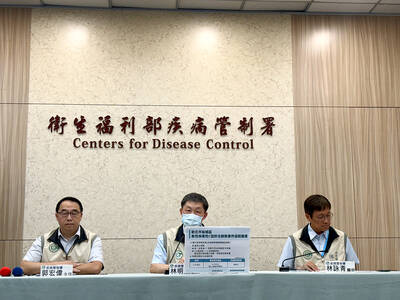
AT-RISK GROUPS: Of the accumulated 1,586 severe cases and 304 related deaths in this flu season, 65.8% were older people and 83.2% had chronic diseases, an official said The Centers for Disease Control (CDC) yesterday said that 165 severe flu cases and 30 flu-related deaths were reported last week, the highest weekly numbers in this flu season, and that cases might continue to increase, urging people to take precautions. Medical visits for flu-like illnesses increased by 1.4 percent to 141,374 last week, with 11.8 percent being emergency visits, showing that the seasonal flu is still in its epidemic period, CDC Epidemic Intelligence Center Director Guo Hung-wei (郭宏偉) said. From Tuesday last week to Monday, 165 severe flu cases and 30 flu-related deaths were confirmed, the highest weekly numbers
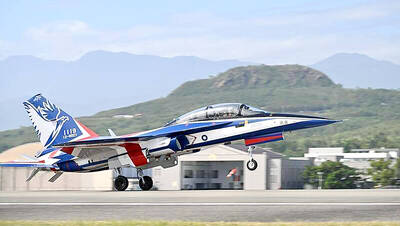
Aerospace Industrial Development Corp (AIDC, 漢翔航空工業) has finished production of the nation’s T-5 Brave Eagle (勇鷹) advanced jet trainers, with the final aircraft scheduled to be formally delivered at a ceremony on Thursday. The delivery of the trainer jets marks the end of the program, which dates back to 2017, with the first prototypes completed in 2019. Fifty-six of the 66 trainers had been delivered as of May. The Brave Eagle was developed and produced by AIDC and the National Chungshan Institute of Science and Technology. The program has provided a foundation for the development of a domestically produced next-generation primary trainer and


 RSS
RSS