


Premier Frank Hsieh (
After the Legislature made the decision to cut two-thirds from the Cabinet's annual budget proposal on Thursday, Cabinet Secretary-General and Spokesman Cho Jung-tai (
Hsieh and Cho scheduled a press conference for late Friday night when they had finished discussing the issue with other Cabinet members.
The press conference, however, was later canceled.
Sources said that Hsieh decided to hold back on the idea because he realized that he did not have the full support of the Presidential Office on the issue.
Although Hsieh visited Legislative Speaker Wang Jin-pyng (王金平) on Friday night, he did not express his gratitude toward Wang and his fellow lawmakers, nor did he mention anything about the request to reconsider the budget.
Cho said that he could not make the contents of the conversation between the premier and the president public. But he told reporters that the president was not too keen on the idea of asking the Legislature to reconsider the budget because it would require the agreement of half of the legislative floor.
"As a result, we are not too confident about it, either," he said.
The secretary-general and spokesman said that Hsieh was busy meeting with Cabinet members and discussing whether they should file the request throughout the day yesterday and a final decision would be made by tomorrow.
According to analysis in a report by the local Chinese-language United Daily News yesterday, Cho said the president might take advantage of the statement the premier made on Friday, when he said "if the Cabinet's request to reconsider the budget is declined by the Legislature, I will take the political responsibility," to relieve Hsieh of his position. Cho said the final decision on whether to file the request has nothing to do with protecting the premier's position.
"To file the request is just the way we handle things. It is not the end goal we are looking for," Cho said. "As government officials, we need money in order to work for the people, so we must do this anyway."

PROVOCATIVE: Chinese Deputy Ambassador to the UN Sun Lei accused Japan of sending military vessels to deliberately provoke tensions in the Taiwan Strait China denounced remarks by Japan and the EU about the South China Sea at a UN Security Council meeting on Monday, and accused Tokyo of provocative behavior in the Taiwan Strait and planning military expansion. Ayano Kunimitsu, a Japanese vice foreign minister, told the Council meeting on maritime security that Tokyo was seriously concerned about the situation in the East China and South China seas, and reiterated Japan’s opposition to any attempt to change the “status quo” by force, and obstruction of freedom of navigation and overflight. Stavros Lambrinidis, head of the EU delegation to the UN, also highlighted South China Sea
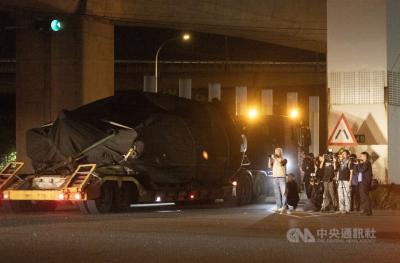
The final batch of 28 M1A2T Abrams tanks purchased from the US arrived at Taipei Port last night and were transported to the Armor Training Command in Hsinchu County’s Hukou Township (湖口), completing the military’s multi-year procurement of 108 of the tanks. Starting at 12:10am today, reporters observed more than a dozen civilian flatbed trailers departing from Taipei Port, each carrying an M1A2T tank covered with black waterproof tarps. Escorted by military vehicles, the convoy traveled via the West Coast Expressway to the Armor Training Command, with police implementing traffic control. The army operates about 1,000 tanks, including CM-11 Brave Tiger
Taiwan Semiconductor Manufacturing Co (TSMC, 台積電), the world’s largest contract chipmaker, said it expects its 2-nanometer (2nm) chip capacity to grow at a compound annual rate of 70 percent from this year to 2028. The projection comes as five fabs begin volume production of 2-nanometer chips this year — two in Hsinchu and three in Kaohsiung — TSMC senior vice president and deputy cochief operating officer Cliff Hou (侯永清) said at the company’s annual technology symposium in Silicon Valley, California, last week. Output in the first year of 2-nanometer production, which began in the fourth quarter of last year, is expected to
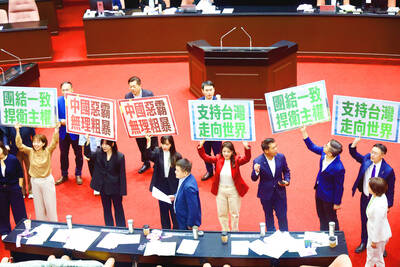
ESWATINI TRIP: The ‘irresponsible actions’ of three African nations set a dangerous precedent and they should be held accountable, a US representative said The US Senate Foreign Relations Committee on Thursday urged Washington not to normalize Chinese pressure, while a US lawmaker called on the US government to hold countries accountable for yielding to Beijing’s pressure to block President William Lai’s (賴清德) planned trip to Eswatini. Lai had been scheduled to visit Eswatini to attend birthday events for King Mswati III of Eswatini this week, but on Tuesday, the eve of his planned departure on Wednesday, the Presidential Office said the trip was “suspended” after the Seychelles, Mauritius and Madagascar unexpectedly withdrew overflight permission. “China reportedly pressured Mauritius, Seychelles, and Madagascar to deny airspace access


 RSS
RSS