


Israeli Prime Minister Ariel Sharon joked with aides and discussed affairs of state yesterday after suffering a mild stroke, but his illness raised questions about his ability to lead the country if elected to a third term in March elections.
It also left his brand-new centrist Kadima Party scrambling. Without the 77-year-old Sharon, Kadima wouldn't likely amount to much, as the prime minister's popularity is the overriding factor behind the party's commanding lead in polls. With balloting three months away, concerns about his health could become a focus of the campaign, and improve the prospects of the hardline Likud Party that he quit to form Kadima.
However, his doctors said yesterday that Sharon does not have any major health problems and will be released from the hospital today.
Sharon never lost consciousness and the stroke caused no damage to the prime minister, Dr Tamir Ben-Hur said.
Likud voters went to the polls yesterday to choose a replacement for Sharon as party leader. Polls gave former prime minister Benjamin Netanyahu a slight edge over Foreign Minister Silvan Shalom, and results were expected around midnight yesterday.
Sharon underwent additional tests yesterday after being rushed to Hadassah Hospital in Jerusalem on Sunday night, showing signs of confused speech. Israeli media reported that he was unable to tell time or count fingers when he underwent preliminary neurological tests at the hospital, but doctors later said he improved quickly.
Sharon was treated with blood thinners and suffered no damage from the stroke, said his personal doctor, Boleslaw Goldman.
Hospital spokeswoman Yael Bossem-Levy said doctors ran more tests yesterday and decided Sharon should also undergo brain and full body scans, procedures she described as routine.
Sharon held his daily staff meeting in the hospital, said aide Asaf Shariv.
"He asked questions, he received an update from the military secretary and from the Cabinet secretary. He's in good spirits," Shariv told Army Radio.
Cabinet Secretary Yisrael Maimon told Army Radio that Sharon walked around his room and showered by himself.
The Web site of the Haaretz daily reported that one of its reporters spoke to Sharon late on Sunday night.
"I'm fine," Haaretz quoted Sharon as saying. "Apparently I should have taken a few days off for vacation. But we're continuing to move forward," he said, making a play on the name of his party, Kadima, which means "forward."
In other news, the Israeli air force resumed air strikes against rocket- and mortar-launching sites in Gaza yesterday, carrying out two attacks after striking 11 times overnight, the military said. The attacks came after Palestinians fired a rocket that exploded near a power plant outside the southern Israeli city of Ashkelon.
Two Palestinian paramedics were slightly hurt by flying glass, but no Israeli injuries were reported.
Palestinian security officials said the Israeli missile attacks cut all roads between part of northern Gaza and the rest of the seaside territory. The Israeli military said the goal was to cut access roads used by militants to reach the border fence and fire their rockets.

‘NO SECURITY RISK’: The Railway Bureau reassured the public that the technicians’ activities were limited to technical guidance and did not involve sensitive systems The Railway Bureau yesterday said it had invited eight Chinese technicians to assist with an airport MRT construction project. The bureau issued the confirmation after an Internet user said Chinese nationals had entered the construction zone of Taiwan Taoyuan International Airport’s Terminal 3 project. They asked why “individuals from an enemy state” were allowed access to such a major national infrastructure project, which raised serious concerns over Taiwan’s industrial safety, sensitive systems and information security. The bureau’s Northern Region Engineering Branch Office said subcontractor Taiwan Handle Industrial Co (台灣手把工業) of the Taoyuan airport MRT’s “Contract No. CU05 Project A14 Station Civil, MEP &

A US uncrewed surface vessel (USV) encountered multiple Chinese warships during an autonomous transit of the Taiwan Strait, US defense company Seasats said in a statement on Wednesday. Seasats announced that a Lightfish USV had completed the first autonomous transit of the Taiwan Strait. Over five days, the USV traversed the entire length of the Strait while constantly monitoring surface vessel traffic, the company said. The Lightfish encountered multiple Chinese warships, one of which was a Chinese People’s Liberation Army Navy (PLAN) Type 056 corvette, it said. The Chinese vessels were operating “well within Taiwan’s exclusive economic zone without transmitting their identity via the
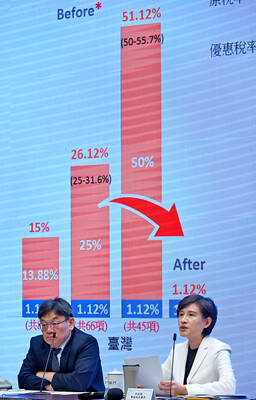
GREATER REACH? Auto parts and wood products would face tariffs of up to 15%, matching those targeting the EU, Japan and South Korea, Vice Premier said The US has announced that preferential tariff treatment for Taiwan’s non-semiconductor Section 232 goods would take effect retroactively from May 1, the Executive Yuan said yesterday. The US government yesterday posted a notice on the Federal Register’s public inspection Web site previewing tariff concessions for Taiwan under a memorandum of understanding (MOU) on Taiwan-US investment after two months of negotiations. The MOU signed on Jan. 15 stipulated three major preferential tariff arrangements: a 15 percent “reciprocal” tariff rate for Taiwan without stacking most-favored nation (MFN) rates; preferential Section 232 treatment for semiconductors and related products; and preferential Section 232 treatment for non-semiconductor

The National Chungshan Institute of Science and Technology yesterday showcased its locally developed variants of the Vision 60 robotic patrol dog, which it plans to deploy on the nation’s outlying territories in the South China Sea. The variants were produced under the Joint Lab project — created by the institute and domestic companies — and assembled with domestically produced motors, lenses and artificial intelligence (AI) systems alongside licensed tech from the US, Missile and Rocket Systems Research Division deputy director Jen Kuo-kang (任國光) told the media event at a military base in Taipei’s Dazhi (大直) area. Taiwan has built up its strengths


 RSS
RSS