


China has confirmed that police shot dead three protesters "in alarm" during an attack last week on a wind power plant, and a newspaper said yesterday the official who ordered the shooting had been detained.
Human rights group Amnesty International said it was the first time Chinese police had fired on protesters since the Tiananmen Square pro-democracy demonstrations were crushed in 1989.
Estimates from residents and rights groups put the number of dead between two and as many as 20.
Residents gave new details of last Tuesday's violence. They said they heard bursts of gunfire for at least 12 hours after the clash.
Yesterday, at least 100 police with riot shields and helmets stood guard in the village. Police stopped vehicles at roadblocks, looking for local men. There was no violence, but residents could be seen arguing angrily with police.
Police trucks drove through the village blaring promises over loudspeakers that officials would deal with local grievances.
"Have confidence in the government," the announcement said in the local dialect. "This matter will be handled well."
China's government defended the shootings, saying on Saturday that police opened fire after protesters with knives, spears and dynamite attacked a power plant and then turned on authorities. It said three people were killed and two arrested.
The government said the protests centered on land taken for use by a power plant using wind turbines, though villagers said the dispute was over a different, coal-fired power plant.
Several residents said they heard gunfire beginning at about 6pm on Tuesday. They said there were sporadic bursts of shooting through the night, lasting for about 12 hours.
"We were terrified. We all stayed inside," said a farmer who lives nearby and would give only his surname, Chen. "Even now, we all stay indoors after it gets dark."
A woman who would give only her surname, Luo, said she heard people screaming, "Save me! Save me!"
The official Xinhua news agency said in an overnight report that villagers in Dongzhoukeng and Shigongliao attacked the plant on Monday and Tuesday last week.
"The first assault on Dec. 5 caused a seven-hour suspension of the plant's power generation," Xinhua said.
"In the second onslaught, over 170 armed villagers led by instigators ... used knives, steel spears, sticks, dynamite powder, bottles filled with petroleum, and fishing detonators."
Police used tear gas to break up the protesters and arrested two, Xinhua said. The villagers then formed a blockade in a attempt to free their colleagues.
"[One of the villagers] shouted through a loudspeaker that they would throw detonators at the police and blow up the wind power plant if the police refused to retreat," Xinhua said.
"It became dark when the chaotic mob began to throw explosives at the police. Police were forced to open fire in alarm. In the chaos, three villagers died, eight were injured."
Villagers contacted on Saturday by phone gave death tolls ranging from 10 to 20. They said others were missing.
The Guangzhou Daily newspaper described the killings as a mistake and said that the Guangdong official who had ordered police to open fire had been detained.
It did not identify the official.
"The commanders at the spot did not handle the incident properly and the resulting deaths and injuries are a mistake," it said.
A middle school student said by phone the "main riots" happened on Tuesday and that police killed two villagers.
"The following morning, some families found about 20 family members missing." The next day, she said, police were no longer carrying guns, but batons.
According to the farmer Chen, the dispute began in March last year. He said farmers complained about pollution from the coal-fired power plant, which is still under construction but partly operational.
The police shootings were the deadliest known clash yet amid growing anger in areas throughout China over land seizures for construction of power plants, shopping malls and other projects.
Yesterday, government banners hung at the entrance of Dongzhou said, "Following the law is the responsibility and obligation of the people" and "Don't listen to rumors, don't let yourself be used."

The Tourism Administration yesterday announced that it would reward repeat international visitors with incentives of up to NT$8,000 to boost inbound tourism. The incentives are available to all international tourists, it said, adding that repeat visitors would be rewarded with NT$5,000 and would receive an additional NT$3,000 if they bring travel companions. The nation received 2,990,657 inbound visitors during the first quarter, marking a 3.8 percent increase from the same period last year, agency data showed. Japanese nationals are among groups visiting Taiwan the most. About 1.48 million Japanese tourists arrived last year, a year-on-year increase of more than 12
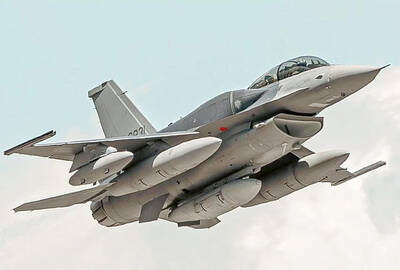
66 FIGHTER JETS: The aircraft is likely undergoing preparations for its transfer to Taiwan — a significant step forward in the nation’s modernization program, a lawmaker said The first of Taiwan’s order of F-16V Block 70 aircraft has been sighted in Texas ahead of delivery, Democratic Progressive Party (DPP) Legislator Wang Ting-yu (王定宇) said. Taiwan’s first F-16V Block 70 two-seat aircraft, tail number 6831, was seen flying from Lockheed Martin’s production facility in Greenville, South Carolina, to Naval Air Station Joint Reserve Base Fort Worth in Texas, Wang wrote on Facebook yesterday. The plane is likely undergoing preparations for its transfer to Taiwan, marking a significant step forward in the Republic of China Air Force’s modernization program, Wang said, citing military analysts. The F-16V Block 70 is a new-build version
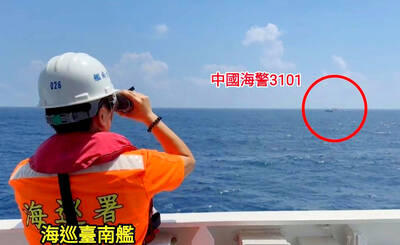
‘BRAZEN’: The holiday did not stop China from activities that infringe on Taiwan’s maritime jurisdiction, but the CGA is ready to defend the nation, Kuan Bi-ling said Beijing is intensifying maritime pressure on Taiwan, but the nation will never yield, Ocean Affairs Council Deputy Minister Sung Chen-en (宋承恩) said. The Coast Guard Administration (CGA) has adopted a “shadowing and monitoring” approach to avoid falling into a Chinese trap to escalate tensions and deepen the conflict, Sung said in an interview published yesterday in the Chinese-language Liberty Times (the Taipei Times’ sister newspaper). China Coast Guard formations patrolling waters east of Taiwan, as well as official Chinese vessels entering areas around Itu Aba Island (Taiping Island, 太平島) and Pratas Islands (Dongsha Islands, 東沙群島) show Beijing’s attempts to significantly step up
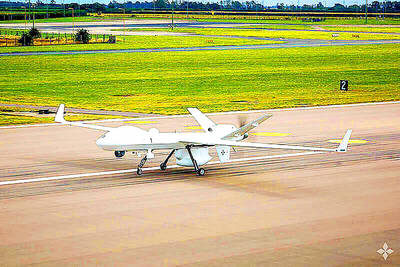
BOOST: By operating the same advanced systems as the US military, Taiwan would be better positioned to share and integrate intelligence with partners, an expert said The first batch of MQ-9B SkyGuardian drones has arrived in Taiwan, and is being assembled and tested by drone manufacturer General Atomics and the military ahead of flight trials as part of the air force’s acquisition to bolster its aerial surveillance capabilities, a source said yesterday. The air force allocated a budget of NT$21.7 billion (US$687 million) from 2022 to 2029 to procure four MQ-9B uncrewed aerial vehicles (UAVs) manufactured by General Atomics along with associated equipment such as ground control stations. The US has agreed to deliver the four MQ-9Bs to Taiwan in two batches this year and next


 RSS
RSS