


Powerful Typhoon Talim has been battering Taiwan since yesterday afternoon, leaving schools and offices closed in several counties. The Central Weather Bureau (CWB) yesterday predicted that abundant rainfall would trigger potentially devastating disasters, such as floods and mudflows, in not only the northern parts of the nation but also the south.
All cities and counties announced last night that there will be no classes nor work today in their respective areas, except Kinmen County, which said schools and offices remain open today.
Beginning yesterday afternoon, huge waves, heavy rains and powerful winds were observed in eastern Taiwan. In Hsinchu County, several roads connecting townships in mountainous areas, including remote Wufeng (五峰) Township, were destroyed due to sudden landslides triggered by heavy rains.
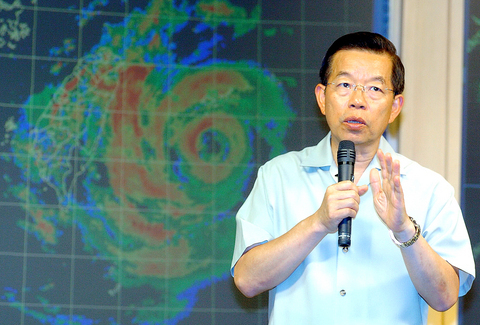
PHOTO: LIAO CHEN-HUI, TAIPEI TIMES
In several areas, schools and offices were ordered to close earlier yesterday.
The CWB expected that Talim's center would pass over Taiwan from the eastern coastline between Ilan and Hualien counties. Forecasters said that Talim, with a radius of 250km, has been formed by solid-structure clouds.
According to Hsieh Ming-chang (謝明昌), a division chief at the CWB's meteorology division, the weather in Taiwan will be significantly affected by the storm system.
"We predict that violent gusts [of wind] could be experienced in the counties of Ilan and Hualien," Hsieh said.
Forecasters said that people in Taiwan and its offshore islands, including Penghu, Green Island, Lanyu and Matsu, had to be on the alert for powerful winds.
Moving
Forecasters said Talim was steadily moving west-northwestward at a speed of 21kph and at 11am today its center is expected to be situated 250km west-northwest of Hsinchu. The bureau predicts that the weather this afternoon might become a bit milder but nationwide heavy rains in the following days remain a threat.
It is expected that rainfall in the mountainous areas in southern counties such as Kaohsiung and Pingtung, will exceed 1,000mm. In the north, accumulative rainfall exceeding 700mm is expected.
Yesterday, the Council of Agriculture (COA) issued mudflow and landslide warnings, listing 610 rivers in danger of flooding. The warning affect residents in 39 townships in eight counties. Officials said that rivers in Ilan, Hualien and Nantou counties could become highly dangerous, urging residents to stay away from them. In addition, COA officials said, a Web site showing the danger of floods and mudflows, www.fema.swcb.gov.tw, offers emergency information about possible evacuations.
Meanwhile, Premier Frank Hsieh (謝長廷) yesterday cautioned Cabinet members that "previous mistakes are not allowed to be repeated during this typhoon."
"I ask my fellow Cabinet members to remain at their posts and make sure everything is under control," he said.
`Stay alert'
"Everybody should stay alert to avoid repeating the same mistakes," he said, referring to the water shortage in Taoyuan County after Typhoon Matsa devastated Taiwan on Aug. 5.
According to the Cabinet, the water shortage occurred because the Shihmen Reservoir's water was seriously polluted by huge amounts of mud, caused by land erosion in the reservoir's catchment area. As a result, the water becomes muddy after downpours and since the water became too muddy after the devastating typhoon, water treatment plants were unable to provide a constant water supply.
Hsieh yesterday visited both the CWB and the Cabinet's Drought Disaster Relief Center to make sure everything is under control. According to Cabinet Spokesman Cho Jung-tai (卓榮泰), the premier is scheduled to meet President Chen Shui-bian (陳水扁) today to give him the latest information on the typhoon and the situation nationwide.
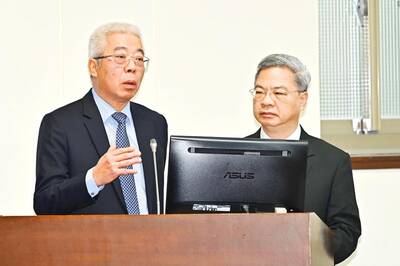
Taiwan has arranged for about 8 million barrels of crude oil, or about one-third of its monthly needs, to be shipped from the Red Sea this month to bypass the Strait of Hormuz and ease domestic supply pressures, CPC Corp, Taiwan (CPC, 台灣中油) said yesterday. The state-run oil company has worked with Middle Eastern suppliers to secure routes other than the Strait of Hormuz, through which about 20 percent of the world’s oil and liquefied natural gas typically passes, CPC chairman Fang Jeng-zen (方振仁) said at a meeting of the legislature’s Economics Committee in Taipei. Suppliers in Saudi Arabia have indicated they

South Korea has adjusted its electronic arrival card system to no longer list Taiwan as a part of China, a move that the Ministry of Foreign Affairs said would help facilitate exchanges between the two sides. South Korea previously listed “Taiwan” as “Taiwan (China)” in the drop-down menus of its online arrival card system, where people had to fill out where they came from and their next destination. The ministry had requested South Korea make a revision and said it would change South Korea’s name on Taiwan’s online immigration system from “Republic of Korea” to “Korea (South),” should the issue not be

CCP ‘PAWN’? Beijing could use the KMT chairwoman’s visit to signal to the world that many people in Taiwan support the ‘one China’ principle, an academic said Chinese Nationalist Party (KMT) Chairwoman Cheng Li-wun (鄭麗文) yesterday arrived in China for a “peace” mission and potential meeting with Chinese President Xi Jinping (習近平), while a Taiwanese minister detailed the number of Chinese warships currently deployed around the nation. Cheng is visiting at a time of increased Chinese military pressure on Taiwan, as the opposition-dominated Legislative Yuan stalls a government plan for US$40 billion in extra defense spending. Speaking to reporters before going to the airport, Cheng said she was going on a “historic journey for peace,” but added that some people felt uneasy about her trip. “If you truly love Taiwan,

Both sides of the Taiwan Strait share a political foundation based on the “1992 consensus” and opposition to Taiwanese independence, Chinese Nationalist Party (KMT) Chairwoman Cheng Li-wun (鄭麗文) today said during her meeting with Chinese President Xi Jinping (習近平). Both sides of the Strait should plan and build institutionalized and sustainable mechanisms for dialogue and cooperation based on that foundation to make peaceful development across the Strait irreversible, she said. Peace is a shared moral value across the Strait, and both sides should move beyond political confrontation to seek institutionalized solutions to prevent war, she said. Mutually beneficial cross-strait relations are what the


 RSS
RSS