


Helicopters ferried food to an Alpine resort yesterday and plucked people from roofs in the capital Berne as flood-ravaged Switzerland braced for more rain.
In Romania, one of the countries worst hit by the downpours that lashed parts of central Europe earlier this week, the death toll from flooding rose by six to 31 yesterday, with another three people missing, including a four-year-old girl.
The torrential rains forced lakes and rivers to burst their banks from Berne to Bucharest, cutting roads, power and communications to hundreds of communities and causing damage estimated at worth well over US$1 billion in Switzerland alone.
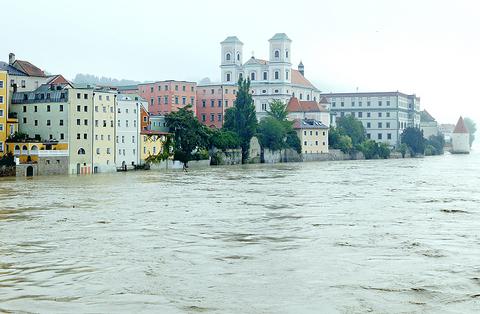
PHOTO: AP
In Berne, helicopters lifted residents from roofs and balconies of their homes in the oldest part of town where they were trapped by the waters. Officials fear centuries-old buildings could be swept away.
In Lucerne, sandbags protected shops and homes and residents watched anxiously as the river Reuss rushed perilously close beneath the city's covered 14th-century wooden bridge -- a national landmark.
Forecasters said the weather could get worse, with a further 20mm to 30mm of rain expected later in the week over Switzerland.
Driftwood has been swept into lakes and rivers and now threatens to smash bridges and other installations, rescue officials said.
The Swiss army was using Puma helicopters to supply the scenic mountain resort of Engelberg, which has been cut off since Monday by rain which also sent part of the railway line plunging down a ravine.
One of 700 tourists evacuated by air on Wednesday from the village said they had been without hot food, clean water and electricity.
The Swiss authorities have warned sightseers to stay away from the floodwaters, worried about a sudden rise in river levels or more flash floods.
In southern Germany, a 28-year-old man drowned when he ventured out with two friends in a dinghy which capsized on the River Mangfall near the town of Feldkirchen-Westerham.
He was the first person to die in Germany in the floods, which have turned regions of Bavaria into disaster zones. The other two men were rescued.
The cities of Passau and Ingolstadt were expected to escape the devastation initially predicted when torrential rains produced heavy damage in the Alpine region to the south on Monday and Tuesday.
Dry weather was forecast through much of the region, providing relief for panicked residents who had piled sandbags in front of homes and businesses in recent days to shield them from the raging waters.
Bavarian authorities said the crisis had eased in several areas but the situation remained critical along sections of the River Danube.
In Romania, the latest deaths were from the Transylvanian region of Harghita. Floods across the country have killed 67 so far this year.
Austrian crews were using heavy equipment to clear away tonnes of mud, gravel and rocks dumped inside hundreds of homes, hotels and businesses in mountain valleys in Vorarlberg and neighboring Tyrol Province.

South Korea has adjusted its electronic arrival card system to no longer list Taiwan as a part of China, a move that the Ministry of Foreign Affairs said would help facilitate exchanges between the two sides. South Korea previously listed “Taiwan” as “Taiwan (China)” in the drop-down menus of its online arrival card system, where people had to fill out where they came from and their next destination. The ministry had requested South Korea make a revision and said it would change South Korea’s name on Taiwan’s online immigration system from “Republic of Korea” to “Korea (South),” should the issue not be

The Legislative Yuan’s Finance Committee yesterday approved proposed amendments to the Amusement Tax Act (娛樂稅法) that would abolish taxes on films, cultural activities and competitive sporting events, retaining the fee only for dance halls and golf courses. The proposed changes would set the maximum tax rate for dance halls and golf courses at 50 and 20 percent respectively, with local governments authorized to suspend the levies. Article 2 of the act says that “amusement tax shall be levied on tickets sold or fees charged by amusement places, facilities or activities” in six categories: “Cinema; professional singing, story-telling, dancing, circus, magic show, acrobatics

Tainan, Taipei and New Taipei City recorded the highest fines nationwide for illegal accommodations in the first quarter of this year, with fines issued in the three cities each exceeding NT$7 million (US$220,639), Tourism Administration data showed. Among them, Taipei had the highest number of illegal short-term rental units, with 410. There were 3,280 legally registered hotels nationwide in the first quarter, down by 14 properties, or 0.43 percent, from a year earlier, likely indicating operators exiting the market, the agency said. However, the number of unregistered properties rose to 1,174, including 314 illegal hotels and 860 illegal short-term rental

INFLATION UP? The IMF said CPI would increase to 1.5 percent this year, while the DGBAS projected it would rise to 1.68 percent, with GDP per capita of US$44,181 The IMF projected Taiwan’s real GDP would grow 5.2 percent this year, up from its 2.1 percent outlook in January, despite fears of global economic disruptions sparked by the US-Iran conflict. Taiwan’s consumer price index (CPI) is projected to increase to 1.5 percent, while unemployment would be 3.4 percent, roughly in line with estimates for Asia as a whole, the international body wrote in its Global Economic Outlook Report published in the US on Monday. The figures are comparatively better than the IMF outlook for the rest of the world, which pegged real GDP growth at 3.1 percent, down from 3.3 percent


 RSS
RSS