


Typhoon Haitang, which brought tremendous rainfall and caused dozens of casualties in Taiwan, yesterday was downgraded into a less-devastating tropical storm. However, the Central Weather Bureau (CWB) reminded people of the danger of potential flooding, because torrential rainfall is expected to continue over the next few days.
The strength of Haitang began decreasing after it made landafall in Taiwan late Sunday. Yesterday, it was classified as a tropical storm before it departed Taiwan on its way to China. However, forecasters said that people in Taiwan should still be vigilant for heavy rains.
As of yesterday, the bureau's statistics said that since Sunday, cumulative rainfall exceeding 1,000mm had been measured in many places in Taiwan. In the south, Pingtung County's Sandimen Township (
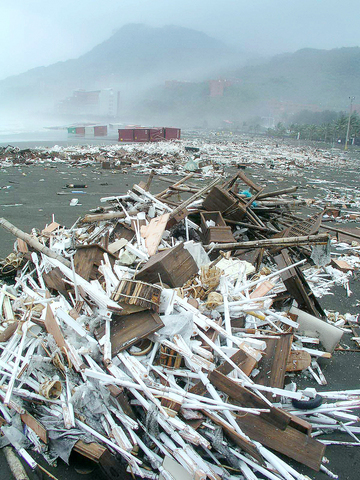
PHOTO: HUANG SHIH-LEI, TAIPEI TAIPEIS
In Kaohsiung County, yesterday's torrential rains boosted cumulative rainfall to 1,384mm. In Ilan, many areas experienced rainfall exceeding 1,000mm. Forecasters said that peripheral air currents surrounding Haitang would bring heavy rain to Taiwan, and people must be alert over the following days.
According to George Lu (呂國臣), a division chief at the bureau's Weather Forecast Center, torrential rains will continue today in the central, southern, and southeastern parts of the country.
"Residents should avoid carrying out activities in mountains and on the beaches. Heavy rains might trigger mudflows, landslides and floods in mountainous areas," Lu said.
Because of up-to-date rainfall statistics, the number of watercourses in "critical danger" of flooding has been increased from 185 to 553 yesterday by the Council of Agriculture (COA). Meanwhile, 867 watercourses have also been identified as having the potential danger of flooding.
The council said yesterday that Haitang had caused NT$1.32 billion (US$41.4 million) in financial losses in the agricultural sector. Many crops have been ruined. Farmers in the most seriously affected counties, including Miaoli, Kaohsiung, Hualien and Taitung, will be entitled to compensation through financial aid for their losses.
The passage of Haitang has also increased the turbidity of river water. The Taiwan Water Supply Corporation (TWSC) said yesterday that water restrictions in some communities in southern Taoyuan County will be solved within days. Due to the turbidity, a single water treatment plant in the county can only treat 400,000 tonnes of water a day, rather than 600,000 tonnes as is usual. However, TWSC officials said that trucks carrying potable water would remain available for affected people at all times.
Meanwhile, Japanese water experts have been invited by TWSC to check the functioning of the Shihmen Dam (石門水庫), a major reservoir in the north of the county, because some water intakes malfunctioned after Haitang hit Taiwan. To make sure water reserves in the reservoir are available, engineers for the Water Resources Agency have been working on the establishment of pumps as alternatives.
Meanwhile, the center of the typhoon landed in China near Lianjiang County, Fujian Province just after 5pm yesterday, an official at the provincial disaster relief bureau said by telephone.
At least 850,000 people were evacuated from vulnerable areas of Fujian and Zhejiang provinces since Sunday, other state media said.
In Zhejiang's Wenzhou City, water was already filling the streets as winds of up to force 12 battered buildings, the radio report said.
There were no immediate reports of casualties.
The national meteorological office forecast that the typhoon would move northwest overnight.
Chinese authorities have been on high alert after learning lessons last year when Typhoon Rananim devastated the area, killing at least 164 people.
Frantic round-the-clock preparations that began on Monday have seen volunteers and 5,000 of the People's Armed Police mobilized to evacuate people to higher ground, reports said.
also see story:
Ma, Hsieh battle over typhoon
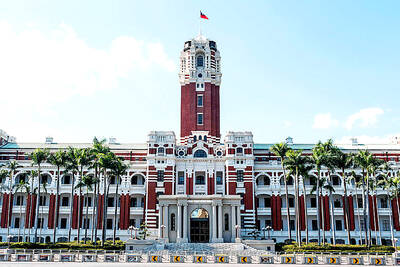
SECURITY: Taipei presses the US for arms supplies, saying the arms sales are not only a reflection of the US security commitment to Taiwan but also serve as a mutual deterrent against regional threats Taiwan is committed to preserving the cross-strait “status quo” and contributing to regional peace and stability, the Presidential Office said yesterday. “It is an undeniable fact that the Republic of China is a sovereign and independent democratic nation,” Presidential Office spokeswoman Karen Kuo (郭雅慧) reiterated, adding that Beijing has no right to claim sovereignty over Taiwan. The statements came after US President Donald Trump warned against Taiwanese independence. Trump wrapped up a state visit to Beijing on Friday, during which Chinese President Xi Jinping (習近平) had pressed him not to support Taiwan. Taiwan depends heavily on US security backing to deter China from carrying

The subsidiary of Taiwan Semiconductor Manufacturing Co (TSMC, 台積電) in Kumamoto, Japan, turned a profit in the first quarter of this year, marking the first time the first fab of the unit has become profitable since mass production started at the end of 2024. According to the contract chipmaker’s financial statement released on Friday, Japan Advanced Semiconductor Manufacturing Inc (JASM), a joint venture running the fab in Kumamoto, posted NT$951 million (US$30.19 million) in profit in the January-to-March period, compared with a loss of NT$1.39 billion in the previous quarter, and a loss of NT$3.25 billion in the first quarter of

RESOLUTE BACKING: Two Republican senators are planning to introduce legislation that would impose immediate sanctions on China if it attempts to invade Taiwan US House of Representatives Speaker Mike Johnson on Sunday reaffirmed US congressional support for Taiwan, saying the US and “all freedom-loving people” have a stake in preventing China from seizing Taiwan by force. Johnson made the remarks in an interview with Fox News Sunday on US President Donald Trump’s summit with Chinese President Xi Jinping (習近平) last week. In an interview that aired on Friday on Fox News, just as Trump wrapped up a high-stakes visit to China, he said he has yet to green-light a new US$14 billion arms package to Taiwan and that it “depends on China.” “It’s a very good
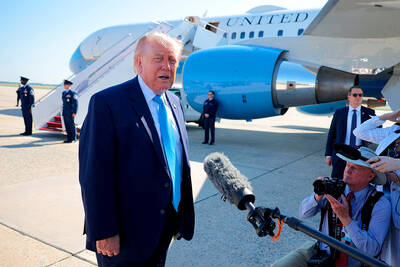
US President Donald Trump yesterday said he would speak to President William Lai (賴清德) as his administration considers whether to move ahead with a US$14 billion weapons sale to Taiwan — a potential arms deal that has drawn criticism from China. “Well, I’ll speak to him. I speak to everybody,” Trump told reporters yesterday when asked if he had any plans to call his counterpart, although he did not offer a time frame for when such a conversation could take place. Trump previously said he would speak to the person “that’s running Taiwan,” without specifying who he meant. “We have that situation very


 RSS
RSS