


President Chen Shui-bian (
The Ministry of Foreign Affairs yesterday said the Italian government pledged to grant Chen entry to the country in his capacity as head of state.
Chen's attendance at the papal funeral today will mark the first time a president from Taiwan has visited the Holy See since the establishment of diplomatic ties 63 years ago.
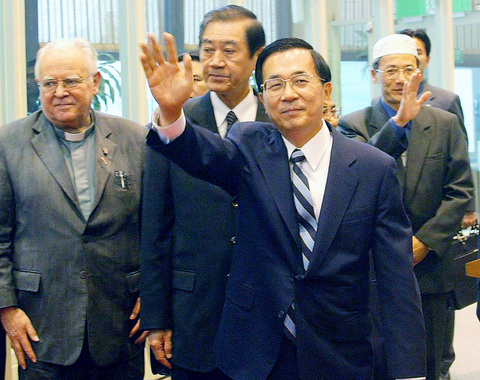
PHOTO: TONY YAO, TAIPEI TIMES
The visit will also make Chen the first president from Taiwan to set foot in a European country.
Before boarding a China Airlines charter flight to Rome yesterday afternoon, Chen made a speech at CKS International Airport, hailing the Pope's legacy and expressing condolences for his passing.
"The passing of the Pope is a cause of sorrow for all humanity," said Chen, who is attending the ceremony after receiving an invitation from the Holy See.
Chen said he wanted to join world leaders to remember the Polish pontiff and to cement ties with the Holy See.
He said that "Taiwan is the staunchest diplomatic, most peaceful and most affectionate partner of the Holy See as well as the most loyal member of the international democratic community."
"Taiwan will do its utmost to meet the Pope's standard for soothing fear through courage, resolving hatred through love, overcoming confrontation through peace and calming conflict through reconciliation," he said.
"[We] will also work to pursue a permanent cross-strait peace and open a cross-strait dialogue for reconciliation as a substantial response to the international community's expectations," he said.
Calling the trip "a visit for peace and commemoration," the delegation includes Minister of Foreign Affairs Mark Chen (陳唐山), Taipei Grand Mosque Imam Ma Shiao-chi (馬孝棋), St. Anne Home's Father Jan van Aert and Father Hsing Chao-ming (幸朝明).
The three religious leaders were invited by the president to join the delegation in response to the Pope's call for reconciliation among religious groups, Chen said.
According to Presidential Office spokesman Chen Wen-tsung (
The pontiff's funeral is scheduled to commence at 10am today.
Chen plans to stay in Vatican City for no more than 24 hours and is scheduled to leave Rome for Taipei tonight, the spokesman said.
Ma told the Central News Agency that the president's trip to the Holy See is highly significant.
"This visit will help Taiwan manifest its status as a state. It will also promote Taiwan's national image," he said.
Meanwhile, the agency reported from Rome that Chen Shui-bian will be seated in the front row with other heads of state during the Pope's funeral.
After the funeral, the president will host a lunch banquet for officials from Taiwan's embassy in the Holy See and its representative office in Italy. He will fly back to Taipei after taking a brief sightseeing tour around Rome.
"President Chen's visit to the Holy See shows diplomatic ties between Taiwan and the Vatican remain firm. Our government hopes the Holy See will send an ambassador to Taipei. But we respect the Vatican's decision on the matter," ministry spokesman Michel Lu (呂慶龍) said at a press conference.
According to the Financial Times, Cardinal Godfried Danneels, a high-ranking Vatican official, was in Beijing for talks with Chinese Vice Premier Hui Liangyu (回良玉) and religious affairs officials two days before the Pope's death.
The meeting was "the highest-level face-to-face meeting on Chinese soil between a prominent Catholic churchman and Beijing in decades," the newspaper said.
Responding to the report, Lu said it was not unusual for the Vatican to send a priest to China for talks. The purpose of the trip, he said, was to express the Holy See's concern for the well-being of Catholics in China and the development of the Church there.
Archbishop Joseph Cheng (
The visit, he said, was a perfect opportunity to show Taiwan's gratitude to the Pope for his love for the country.
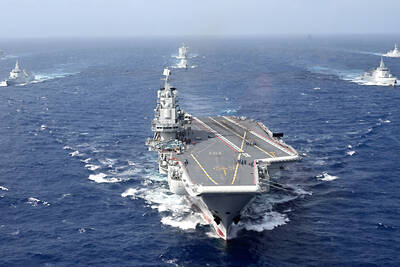
PROVOCATIVE: Chinese Deputy Ambassador to the UN Sun Lei accused Japan of sending military vessels to deliberately provoke tensions in the Taiwan Strait China denounced remarks by Japan and the EU about the South China Sea at a UN Security Council meeting on Monday, and accused Tokyo of provocative behavior in the Taiwan Strait and planning military expansion. Ayano Kunimitsu, a Japanese vice foreign minister, told the Council meeting on maritime security that Tokyo was seriously concerned about the situation in the East China and South China seas, and reiterated Japan’s opposition to any attempt to change the “status quo” by force, and obstruction of freedom of navigation and overflight. Stavros Lambrinidis, head of the EU delegation to the UN, also highlighted South China Sea
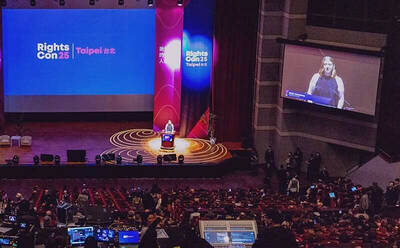
SILENCING CRITICS: In addition to blocking Taiwan, China aimed to prevent rights activists from speaking out against authoritarian states, a Cabinet department said The Ministry of Foreign Affairs (MOFA) yesterday condemned transnational repression by Beijing after RightsCon, a major digital human rights conference scheduled to be held in Zambia this week, was abruptly canceled due to Chinese pressure over Taiwanese participation. This year’s RightsCon, the world’s largest conference discussing issues “at the intersection of human rights and technology,” was scheduled to take place from tomorrow to Friday in Lusaka, and expected to draw 2,600 in-person attendees from 150 countries, along with 1,100 online participants. However, organizers were forced to cancel the event due to behind-the-scenes pressure from China, the ministry said, expressing its “strongest condemnation”
Taiwan Semiconductor Manufacturing Co (TSMC, 台積電), the world’s largest contract chipmaker, said it expects its 2-nanometer (2nm) chip capacity to grow at a compound annual rate of 70 percent from this year to 2028. The projection comes as five fabs begin volume production of 2-nanometer chips this year — two in Hsinchu and three in Kaohsiung — TSMC senior vice president and deputy cochief operating officer Cliff Hou (侯永清) said at the company’s annual technology symposium in Silicon Valley, California, last week. Output in the first year of 2-nanometer production, which began in the fourth quarter of last year, is expected to
Taiwan’s economy grew far faster than expected in the first quarter, as booming demand for artificial intelligence (AI) applications drove a surge in exports, spilling over into investment and consumption, the Directorate-General of Budget, Accounting and Statistics (DGBAS) said yesterday. GDP growth was 13.69 percent year-on-year during the January-to-March period, beating the DGBAS’ February forecast by 2.23 percentage points and marking the most robust growth in nearly four decades, DGBAS senior official Chiang Hsin-yi (江心怡) told a news conference in Taipei. The result was powered by exports, which remain the backbone of Taiwan’s economy, Chiang said. Outbound shipments jumped 51.12 percent year-on-year to


 RSS
RSS