


President Chen Shui-bian (陳水扁) yesterday announced his decision to take part in tomorrow's demonstration condemning China's military threat, but said he would not lead the march nor deliver any speeches.
The announcement puts to rest days of will-he, won't-he-style speculation.
"I cannot and will not be absent on March 26; I will take my whole family to take part in this historic sacred moment," Chen said.
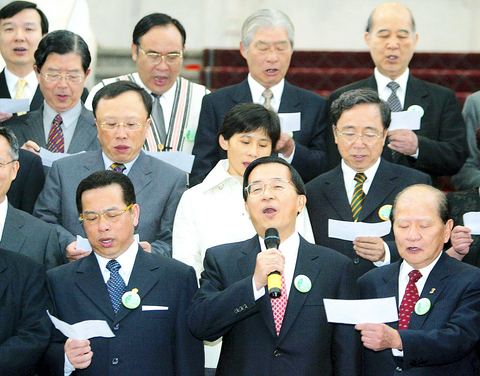
PHOTO: CNA
"I will not stand at the forefront or make a speech, but will march with and stand alongside the people of Taiwan and shout `we want democracy, love and peace' to the other side of the Strait."
However low-key Chen's participation might be, it nevertheless, marks the first time Taiwan's head of state has marched in a street demonstration.
"A-bian [Chen] would like once again to urge the general public to encourage your family members, to call on your friends, to bring along your pets and creativity and take part in this 326 March for Democracy and Peace," Chen said, speaking at a reception for representatives of the Taiwan Democratic Alliance for Peace at the Presidential Office. The group, the organizers of the rally, made the visit to extend an invitation to the president.
The demonstration, which organizers hope will bring more than a million people onto Taipei's streets, is being staged to show Taiwanese people's anger at China for passing its "Anti-Secession" Law, which the Chinese government claims provides justification for an attack on Taiwan if its seeks formal independence.
The march has been divided into 10 different routes which will converge at Ketagelan Boulevard in front of the Presidential Office.
Chen did not yesterday reveal on which of the 10 routes he would march. For security concerns, Presidential Office officials were tight-lipped as well.
Calling China's enactment of its Anti-Secession Law "a challenge to the universal values of freedom, democracy and human rights" Chen said the people of Taiwan know very well that Taiwan's democratic and economic achievements are likely to be shattered by the undemocratic and non-peaceful strategies that China favors.
Recalling that more than 2 million Taiwanese had last Feb 28 showed the world their collective resolve by holding hands to form a "Great Wall of Taiwan democracy" to protest against China's missiles aimed at Taiwan, the president said tomorrow's protest would again show the world Taiwan's true voice, and safeguard Taiwan with democracy and peace.
With that said, Chen delineated his state of emotions by alluding to Bob Dylan's song Blowing in the Wind.
"How many roads must a man walk down before you call him a man? How many seas must a white dove sail before she sleeps in the sand? How many times must the cannon balls fly before they're forever banned? The answer, my friend, is blowin' in the wind," read the lyric.
Modeled after the style, Chen asked: "How many rugged paths full of thistles and thorns must the people of Taiwan walk down before it is called a real democracy? How much time must people on both sides of the Strait take before they embrace ever-lasting peace? How much longer must China continue its saber-rattling and intimidating words before they can wake up and walk toward peace? The answer, great Taiwanese people, will blow in the wind on March 26."
Chen said he is convinced that "democracy and peace are the best remedy in dealing with dictatorship and force," and that "democracy and peace are the most powerful assets Taiwan has to win international support."
"There will be one day when the 1.3 billion people of China will stand on the side of democracy and peace," Chen said.
Meanwhile, Vice President Annette Lu (呂秀蓮), freshly returned from her 12-day overseas visit to Latin America yesterday morning, said she would seek the president's opinion before deciding whether or not to attend tomorrow's demonstration.
Presidential Office Secretary-General Yu Shyi-kun said yesterday if he were not needed to accompany the president, he, as a native of Yilan, will join his hometown people on the sixth route tomorrow.
also see stories:
Legislators divided over Chen's decision to march
Mayor Ma denies some permits to march organizers
KMT slams Chen's decision to march; PFP less angry
US is unconcerned about Chen's joining protest: Joseph Wu

The National Chungshan Institute of Science and Technology yesterday showcased its locally developed variants of the Vision 60 robotic patrol dog, which it plans to deploy on the nation’s outlying territories in the South China Sea. The variants were produced under the Joint Lab project — created by the institute and domestic companies — and assembled with domestically produced motors, lenses and artificial intelligence (AI) systems alongside licensed tech from the US, Missile and Rocket Systems Research Division deputy director Jen Kuo-kang (任國光) told the media event at a military base in Taipei’s Dazhi (大直) area. Taiwan has built up its strengths

RIGHT DIRECTION: Taiwan’s efforts to prevent forced labor include a proposal to ‘fully prohibit’ employers from withholding workers’ documents, an official said Taiwan is to establish a mechanism to restrict imports of goods linked to forced labor, the Executive Yuan said yesterday, after the US proposed imposing additional tariffs on Taiwanese goods over labor concerns. “The Ministry of Labor and the Ministry of Economic Affairs are to establish an interministerial review procedure,” Executive Yuan spokesperson Michelle Lee (李慧芝) said at a news briefing in Taipei. “The government is to use the Foreign Trade Act [貿易法] as the legal basis to restrict imports of goods produced with forced labor” and bring its supply chain governance more in line with international standards on human rights, resilience

NOT IMMEDIATE: Taiwan has a chance to appeal the proposed 10 percent tariff before it starts, while other countries face a 12.5 percent tariff from the trade office Taiwan is among 60 economies determined by the US to have failed to impose or enforce a ban on the importation of goods produced with forced labor, according to a notice released on Tuesday by the Office of the US Trade Representative (USTR), which proposed imposing an additional 10 percent or more tariff on them. The USTR in a statement said that following an investigation, it had determined under Section 301 of the Trade Act of 1974 that the failure of the 60 economies to impose and effectively enforce a prohibition on the importation of goods produced with forced labor is
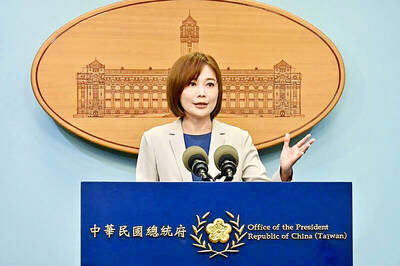
TIT-FOR-TAT: The US allegedly revoked the visa of a Chinese national working at Xinhua News Agency in the US in response to Beijing’s expulsion of Vivian Wang The Presidential Office yesterday condemned China for expelling a New York Times correspondent from Beijing following the newspaper’s interview with President William Lai (賴清德), saying the move highlighted Beijing’s suppression of press freedom and its threat to international news media. Taiwan has noted a series of recent incidents in which Beijing used similar tactics to “threaten and pressure international media outlets and journalists,” Presidential Office spokeswoman Karen Kuo (郭雅慧) said in a statement. “This concerns not only press freedom and freedom of expression, but also the safety of journalists, and Taiwan and relevant partners are paying close attention to the situation,” she


 RSS
RSS