


Israeli Prime Minister Ariel Sharon on Tuesday announced an unqualified end to all Israeli military attacks on the Palestinians as part of a historic ceasefire that formally ends more than four years of brutal intifada, suicide bombings and the destruction of occupied towns.
Sharon and Palestinian President Mahmoud Abbas offered separate but inextricably linked declarations of an end to violence at a summit in the Egyptian resort of Sharm el-Sheikh. The declarations open the way for Hamas and its allies to make an interim truce permanent and announce an end to their war on Israel.
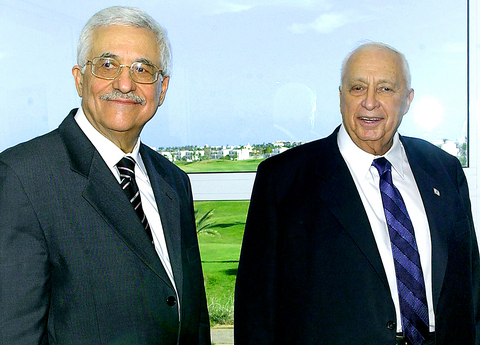
PHOTO: EPA
Although Israel shied away from calling the deal a ceasefire, preferring to describe it as an "understanding," Sharon went further than had been expected, declaring a total end to military action under pressure from the US and Arab neighbors not to undermine Abbas' efforts to end the conflict that has claimed more than 4,500 lives.
"We agreed that all Palestinians will stop all acts of violence against all Israelis everywhere and in parallel, Israel will cease all its military activity against all Palestinians anywhere," Sharon said. "We have an opportunity to disengage from the path of blood which has been forced on us ... For the first time in a long time, there exists in our region hope for a better future for our children and grandchildren."
He said Israel would transfer security control of West Bank cities to the Palestinians and implement other "confidence building" measures, including the release of hundreds of prisoners.
Hamas and Islamic Jihad in the Gaza Strip sounded a warning by saying they would have to talk to Abbas before deciding whether the Israeli declaration met their demands for guarantees of a comprehensive ceasefire. But as Sharon went further than expected, Palestinian officials said the armed Islamist groups had no grounds for backing away from their agreement with Abbas to end their armed struggle and enter the political process.
Abbas described the Israeli and Palestinian declarations at the summit, hosted by Egyptian President Hosni Mubarak, as "the beginning of a new era of peace and security."
"It is a basic step which has its own momentum in bringing peace and stability and trust between two peoples," Abbas said. "We are committed to the peace process. The time has come for the Palestinian people to achieve the independence of our people, to enjoy peace ... Dialogue will replace weapons and shells."
But Sharon rebuffed the Palestinian leadership's calls for a swift return to political negotiations by saying the two sides "must move forward cautiously," and he pressed Abbas to act "determinedly to dismantle the terrorist infrastructure."
"Only by crushing terror and violence will we build peace," Sharon said.
A senior Israeli foreign ministry official, Gideon Meir, said the ceasefire would only evolve into a political process if Abbas removed the threat of a resumption of violence by disarming Hamas and its allies, a move the Islamist groups say would be provocative.
"The short term will be a ceasefire in fact. But Israel cannot see a ceasefire as a long-term arrangement because Israelis will see a threat of violence always hanging over their heads. It's important that the terrorist organizations don't have the power of veto over negotiations," Meir said.
Sharon said he would press on with his unilateral "disengagement plan" to pull all Jewish settlers out of the Gaza Strip and only after that consider returning to the US-led "road map" to the creation of a Palestinian state.
But Sharon was facing a new revolt against his Gaza Strip pullout plan yesterday after Israeli Foreign Minister Silvan Shalom said he would lead a campaign for it to be put to a referendum.
Speaking in an interview on Tuesday night, Shalom insisted that he did not want to wreck the premier's flagship policy but said a referendum would help end divisions within the country.
A source close to the prime minister said that anyone who supported the idea of a referendum was "trying to sabotage the separation plan and bring about the downfall of the prime minister."
At the summit, Sharon also sought to dispel a widespread suspicion of his intent among ordinary Palestinians.
"To our Palestinian neighbors, I assure you that we have a genuine intention to respect your right to live independently and in dignity," he said.
He added: "You too must prove that you have the strength and the courage to compromise, abandon unrealistic dreams, subdue the forces which oppose peace, and live in peace and mutual respect side by side with us."
After the declarations, the Egyptian and Jordanian leaders said they would be returning their ambassadors to Tel Aviv. They were withdrawn at the beginning of the intifada.
British Foreign Secretary Jack Straw said there was "guarded optimism" over the declarations.
"There have been too many false dawns over the last 60 years," he said in London. "There have been more tears than smiles but I sense there is a commitment from Abbas and Sharon, a new determination to make a reality of the goal of two states living side by side."

NO HUMAN ERROR: After the incident, the Coast Guard Administration said it would obtain uncrewed aerial vehicles and vessels to boost its detection capacity Authorities would improve border control to prevent unlawful entry into Taiwan’s waters and safeguard national security, the Mainland Affairs Council (MAC) said yesterday after a Chinese man reached the nation’s coast on an inflatable boat, saying he “defected to freedom.” The man was found on a rubber boat when he was about to set foot on Taiwan at the estuary of Houkeng River (後坑溪) near Taiping Borough (太平) in New Taipei City’s Linkou District (林口), authorities said. The Coast Guard Administration’s (CGA) northern branch said it received a report at 6:30am yesterday morning from the New Taipei City Fire Department about a

IN BEIJING’S FAVOR: A China Coast Guard spokesperson said that the Chinese maritime police would continue to carry out law enforcement activities in waters it claims The Philippines withdrew its coast guard vessel from a South China Sea shoal that has recently been at the center of tensions with Beijing. BRP Teresa Magbanua “was compelled to return to port” from Sabina Shoal (Xianbin Shoal, 仙濱暗沙) due to bad weather, depleted supplies and the need to evacuate personnel requiring medical care, the Philippine Coast Guard (PCG) spokesman Jay Tarriela said yesterday in a post on X. The Philippine vessel “will be in tiptop shape to resume her mission” after it has been resupplied and repaired, Philippine Executive Secretary Lucas Bersamin, who heads the nation’s maritime council, said

REGIONAL STABILITY: Taipei thanked the Biden administration for authorizing its 16th sale of military goods and services to uphold Taiwan’s defense and safety The US Department of State has approved the sale of US$228 million of military goods and services to Taiwan, the US Department of Defense said on Monday. The state department “made a determination approving a possible Foreign Military Sale” to the Taipei Economic and Cultural Representative Office in the US for “return, repair and reshipment of spare parts and related equipment,” the defense department’s Defense Security Cooperation Agency said in a news release. Taiwan had requested the purchase of items and services which include the “return, repair and reshipment of classified and unclassified spare parts for aircraft and related equipment; US Government

More than 500 people on Saturday marched in New York in support of Taiwan’s entry to the UN, significantly more people than previous years. The march, coinciding with the ongoing 79th session of the UN General Assembly, comes close on the heels of growing international discourse regarding the meaning of UN Resolution 2758. Resolution 2758, adopted by the UN General Assembly in 1971, recognizes the People’s Republic of China (PRC) as the “only lawful representative of China.” It resulted in the Republic of China (ROC) losing its seat at the UN to the PRC. Taiwan has since been excluded from


 RSS
RSS