


FBI agents repeatedly complained about the torture of detainees at Guantanamo Bay and in Iraq and believed their eyewitness accounts of beatings, strangulation and other abuse were subject to a cover-up, official memos show.
Even after heavy censorship, the memos, obtained by the American Civil Liberties Union (ACLU), contain graphic details of abuse in which military and government interrogators put lit cigarettes in detainees' ears, spat on them, knocked them unconscious, or resorted to deliberate humiliation.
In an e-mail dated July 30, one FBI official writes: "I saw a detainee sitting on the floor of the interview room with an Israeli flag draped around him, loud music being played and a strobe light flashing."
The documents, which largely appear to be e-mails from field agents to their superiors, describe growing FBI discomfort with the interrogation methods in use at Guantanamo and in Iraq.
They provide the most detailed account yet of the methods of interrogation sanctioned by the Bush administration in the "war on terror." They also reinforce the position of human-rights groups that the abuse of detainees at Guantanamo and in Afghanistan and Iraq was a product of a new gloves-off policy.
"They provide disturbing evidence that the defense department adopted inhuman interrogation methods, methods that the FBI described as torture," said Jameel Jaffer, an attorney at the ACLU.
"The department of defense adopted these policies. They weren't just a matter of an aberration, or low level soldiers engaging in abuse," Jaffer said.
There was no comment from the Pentagon.
The documents suggest that FBI officials involved in questioning at Guantanamo and in Iraq were frequent witnesses to interrogation practices that went against FBI policy.
An urgent report last June to FBI Director Robert Mueller describes how an official came forward after witnessing strangulation and burning. It said the account was "based on his knowledge that ... were engaged in a cover-up of these abuses."
Another memo dated Jan. 21 this year, which discusses a practice by some interrogators of impersonating FBI agents, mentions Deputy Defense Secretary Paul Wolfowitz suggesting that the policy was approved high in the Pentagon.
"This technique, and all of those used in these scenarios, was approved by the Dep Sec Def," the memo reads.
The FBI agents believed that by impersonating agents, military interrogators were trying to exploit the rapport the agency had established with some inmates.
The agents believed that such tactics produced no useful intelligence; they also threatened the FBI's image.
"If this detainee is ever released or his story made public in any way interrogators will not be held accountable because these torture techniques were done by the `FBI' interrogators," a memo from December last year warns.
In a document dated last July, an FBI agent at Guantanamo tells his supervisors he was upset by the interrogation methods used.
"I did observe treatment that was not only aggressive, but personally very upsetting," the memo said.
The treatment included chaining detainees to the floor in the foetal position, or subjecting them to extreme heat or cold.
"Most times they had urinated or defecated on themselves and had been left there for 24 hours or more," one memo said.
Also see story:

‘NO SECURITY RISK’: The Railway Bureau reassured the public that the technicians’ activities were limited to technical guidance and did not involve sensitive systems The Railway Bureau yesterday said it had invited eight Chinese technicians to assist with an airport MRT construction project. The bureau issued the confirmation after an Internet user said Chinese nationals had entered the construction zone of Taiwan Taoyuan International Airport’s Terminal 3 project. They asked why “individuals from an enemy state” were allowed access to such a major national infrastructure project, which raised serious concerns over Taiwan’s industrial safety, sensitive systems and information security. The bureau’s Northern Region Engineering Branch Office said subcontractor Taiwan Handle Industrial Co (台灣手把工業) of the Taoyuan airport MRT’s “Contract No. CU05 Project A14 Station Civil, MEP &

A US uncrewed surface vessel (USV) encountered multiple Chinese warships during an autonomous transit of the Taiwan Strait, US defense company Seasats said in a statement on Wednesday. Seasats announced that a Lightfish USV had completed the first autonomous transit of the Taiwan Strait. Over five days, the USV traversed the entire length of the Strait while constantly monitoring surface vessel traffic, the company said. The Lightfish encountered multiple Chinese warships, one of which was a Chinese People’s Liberation Army Navy (PLAN) Type 056 corvette, it said. The Chinese vessels were operating “well within Taiwan’s exclusive economic zone without transmitting their identity via the
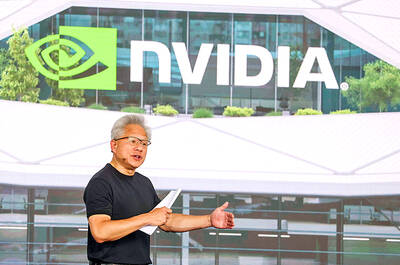
‘BOOMING’: ’ The number of partners we have here is incredible. You can see from their stock prices. They’re doing so well, they’re so happy,’ Jensen Huang said Nvidia Corp’s spending in Taiwan has ballooned to about US$150 billion a year, 10 times the US$10 billion to US$15 billion the company spent five years ago, Nvidia chief executive officer Jensen Huang (黃仁勳) said yesterday, suggesting Taiwan’s strategic importance in the global artificial intelligence (AI) supply chain. “Taiwan is the epicenter of the AI revolution. This is where the chips come, packaging comes. This is where the systems are made. This is where AI supercomputers were created,” Huang said at a meeting for the company’s employees in Beitou-Shilin Technology Park (北投士林科技園區) in Taipei, the planned site of Nvidia’s Taipei headquarters. “Taiwan
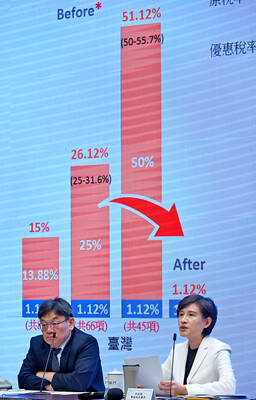
GREATER REACH? Auto parts and wood products would face tariffs of up to 15%, matching those targeting the EU, Japan and South Korea, Vice Premier said The US has announced that preferential tariff treatment for Taiwan’s non-semiconductor Section 232 goods would take effect retroactively from May 1, the Executive Yuan said yesterday. The US government yesterday posted a notice on the Federal Register’s public inspection Web site previewing tariff concessions for Taiwan under a memorandum of understanding (MOU) on Taiwan-US investment after two months of negotiations. The MOU signed on Jan. 15 stipulated three major preferential tariff arrangements: a 15 percent “reciprocal” tariff rate for Taiwan without stacking most-favored nation (MFN) rates; preferential Section 232 treatment for semiconductors and related products; and preferential Section 232 treatment for non-semiconductor


 RSS
RSS