


The Japan Interchange Association in Taipei yesterday confirmed it has issued a visa to former president Lee Teng-hui (李登輝). The visa will allow Lee to make a single entry into Japan for a maximum stay of 15 days, the same as other tourists from Taiwan, a spokesman said.
China, riled by Japan's decision to issue Lee a visa despite its protests, warned yesterday that the move might damage relations.
"The Japanese government acted in disregard of the Chinese government's solemn representation and firm opposition and stubbornly allowed Lee Teng-hui to go to Japan to carry out activities to split the country," Foreign Ministry spokesman Liu Jianchao (劉建超) said at a news briefing.
"The Chinese government ex-presses strong dissatisfaction and again demands the Japanese side rectify this wrong decision," he said.
Liu declined to say whether Beijing would retaliate against Japan. Chinese envoy to Japan Cheng Yonghua (
Liu said Japan's decision to issue the visa was "a very significant incident in China-Japan relations."
"I want to emphasize that the Japanese side should learn from past experience and adopt a correct attitude and rectify its wrong decision in order not to impair overall relations between China and Japan," he said.
Liu said the political motivations of Lee's visit were obvious.
"His political motive is to find backing and create overseas conditions for his activities to split the country. We think the Japanese side should be clear about this," he added.
Japanese Prime Minister Junichiro Koizumi told reporters yesterday that Lee wants to travel as a private citizen, so there is no reason to turn down his application.
"[Lee] also graduated from a Japanese university," Koizumi said.
The Ministry of Foreign Affairs welcomed Japan's decision.
"The ministry and our representative office in Japan will offer necessary help for former president Lee," spokesman Michel Lu (
A friend close to Lee yesterday said that apart from family members and doctors, Lee will also bring two "VIP guests" to Japan. Lee's friend declined to reveal their identities.
Lee will fly to Japan on Monday and visit his alma mater, Kyoto University, during his stay.
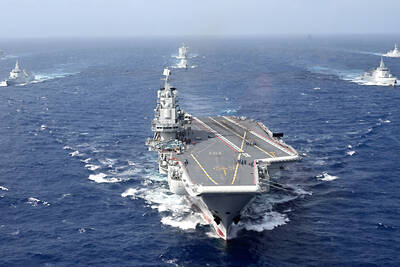
PROVOCATIVE: Chinese Deputy Ambassador to the UN Sun Lei accused Japan of sending military vessels to deliberately provoke tensions in the Taiwan Strait China denounced remarks by Japan and the EU about the South China Sea at a UN Security Council meeting on Monday, and accused Tokyo of provocative behavior in the Taiwan Strait and planning military expansion. Ayano Kunimitsu, a Japanese vice foreign minister, told the Council meeting on maritime security that Tokyo was seriously concerned about the situation in the East China and South China seas, and reiterated Japan’s opposition to any attempt to change the “status quo” by force, and obstruction of freedom of navigation and overflight. Stavros Lambrinidis, head of the EU delegation to the UN, also highlighted South China Sea
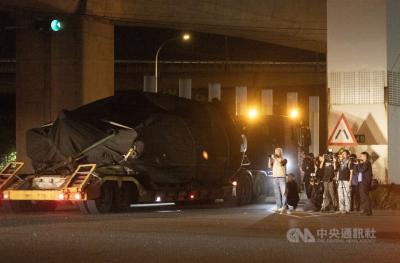
The final batch of 28 M1A2T Abrams tanks purchased from the US arrived at Taipei Port last night and were transported to the Armor Training Command in Hsinchu County’s Hukou Township (湖口), completing the military’s multi-year procurement of 108 of the tanks. Starting at 12:10am today, reporters observed more than a dozen civilian flatbed trailers departing from Taipei Port, each carrying an M1A2T tank covered with black waterproof tarps. Escorted by military vehicles, the convoy traveled via the West Coast Expressway to the Armor Training Command, with police implementing traffic control. The army operates about 1,000 tanks, including CM-11 Brave Tiger
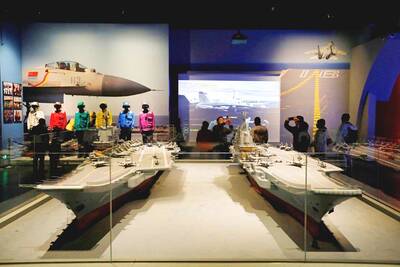
China on Wednesday teased in a video an aircraft carrier that could be its fourth, and the first using nuclear power, while making an allusion to Taiwan and vowing to further build up its islands, as it looks to boost maritime power, secure resources and bolster territorial claims. The video, issued on the eve of the 77th founding anniversary of the Chinese People’s Liberation Army Navy, featured fictional officers with names that are homophones of three commissioned aircraft carriers, the Liaoning (遼寧), Shandong (山東) and Fujian (福建). Titled Into the Deep, it showed a 19-year-old named “Hejian” (何劍) joining the group, sparking
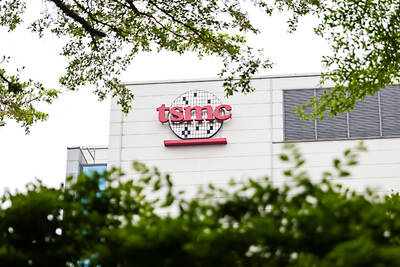
Taiwan Semiconductor Manufacturing Co (TSMC, 台積電), the world’s largest contract chipmaker, said it expects its 2-nanometer (2nm) chip capacity to grow at a compound annual rate of 70 percent from this year to 2028. The projection comes as five fabs begin volume production of 2-nanometer chips this year — two in Hsinchu and three in Kaohsiung — TSMC senior vice president and deputy cochief operating officer Cliff Hou (侯永清) said at the company’s annual technology symposium in Silicon Valley, California, last week. Output in the first year of 2-nanometer production, which began in the fourth quarter of last year, is expected to


 RSS
RSS