


President Chen Shui-bian (陳水扁) said yesterday that "Taiwan Province" should be abolished, adding that the government will strive to implement reforms, including halving the number of ministries, legislative seats, terms of military service and land capital gains tax.
While stumping for DPP legislative candidates last night in Xindian, Chen pointed out that the former Chinese Nationalist Party (KMT) government did not dare to abolish the provincial institution. After the KMT streamlined the provincial administration, Chen said, the administrative unit has had no direction. Chen said Taiwan only needs an administration of two levels, referring to the Executive Yuan and the grassroots city and county governments.
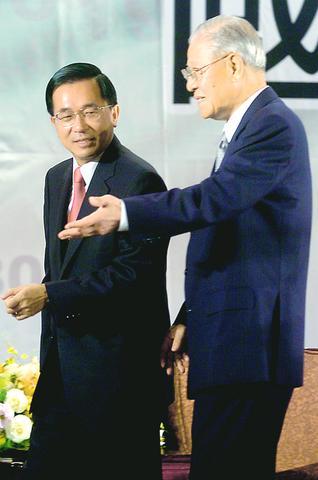
PHOTO: SEAN CHAO, TAIPEI TIMES
Currently, Taiwan Province is a level of government existing between the Cabinet and city and county governments. Its original role was to administer the city and county governments. Administratively it still exists, but with very limited functions.
Citing corporate mergers, Chen said that, "36 ministries under the Executive Yuan are burdensome. Japan only has 13 ministries."
"In European countries with populations of over 50 million, such as the UK and France, the administration only has 17 ministries. Even in China, a country of 1.3 billion population, the government is comprised of only 25 ministries," Chen said.
"The numerous ministries were actually products of the KMT government's mentality to `recover' the 35 provinces [under the `Republic of China' administration before 1949]," Chen said.
Taiwan is stipulated by the government as being one of the 35 provinces.
Only by halving the ministries can administrative efficiency be enhanced, Chen said.
Also, Chen said the government will push ahead with reforms to halve the legislative seats, terms of military service, and land value increase tax.
Earlier yesterday, Chen and former president Lee Teng-hui (李登輝) again stressed the importance of designing a new constitution for Taiwan, tailored to its specific needs.
Both Chen and Lee attended the Symposium on a New Constitution for Taiwan, held by the civic group Taiwan Advocates, to deliver the opening speeches.
Chen again urged the public to allow the pan-green camp to win a majority of legislative seats in elections two weeks away so he could end the "four kinds of chaos."
These he defined as: The unwillingness of KMT Chairman Lien Chan (連戰) and People First Party Chairman James Soong (宋楚瑜) to admit their defeat in the presidential election in March and their continuing refusal to accept the legitimacy of Chen's government; the legislature's unreasonable obstructionism in blocking important legislation out of political animosity; the long-standing confusion between party and state created by the KMT's decades of one-party rule; and the use of the 1947 Chinese Constitution in modern Taiwan.
Chen, however, sidestepped the question of whether he intended to write a new constitution or simply reform the existing one.
"People have different opinions regarding writing and rewriting and I respect both sides, but the important thing is to be engaged in the actual constitutional reform, instead of these arguments," Chen said.
"Taiwan needs a modern constitution that suits its needs," he said.
Chen also said that a committee on constitutional reform would start to operate after the legislative election. He urged the public to allow the pan-green camp to win a majority, so that "Constitutional reform can make major progress."
Chen also said that the Taiwanese public would be able to vote on the new constitution via a referendum at the end of 2006, and the Constitution would be promulgated when he stepped down on May 20, 2008.
He said the new constitution was the ultimate goal of his reelection, his promise to the people, and his mission in history.
Lee, meanwhile, echoed Chen, saying that the legislative election was the key to whether the nation could get a new constitution.
But unlike Chen's ambiguous attitude toward writing a new constitution or rewriting the old one, Lee was adamant about the necessity of drafting a completely new document.
"The territory mapped out in the existing Constitution conflicts seriously with the real territory governed by Taiwan, and for this contradiction to be adjusted to suit Taiwan's current needs, we have to make a new constitution," Lee said.
"Furthermore, can a Constitution that represents China be amended by the 23 million Taiwanese? Can this Constitution that represents China represent Taiwan after being amended?" Lee said.
Lee also said that the ROC Constitution had become an obstacle to Taiwan's future survival and development, and the Taiwanese people had to abandon it.
"A new Taiwanese constitution, more importantly, will solve the sovereignty disputes caused by the ROC Constitution between Taiwan, China, and Mongolia, and the crisis of security in the Asian region caused by these disputes," Lee said.
Lee said that the ROC Constitution encouraged China's ambition to invade and occupy Taiwan, and turned cross-strait relations into an unstable variable in East Asia.
Yesterday's symposium was attended by scholars and experts from Taiwan and other countries including the Czech Republic, France, Germany, Japan, and the US.
Scholars delivered papers on topics related to a new constitution for Taiwan yesterday, including sovereignty, human rights, the choice of political system and implementation of the new constitution.
Stephane Corcuff, a visiting scholar at Harvard University's Fairbank Center for East Asian Research, proposed "The Chinese Republic of Taiwan" (
He said that an aggressive change to the name of Republic of Taiwan was inconsiderate of Mainlanders' feelings, and it might not gain international support and further provoke China to war.
Corcuff said that instead, the compromise name was something both reunification and independence supporters could agree on.
"The Chinese Republic of Taiwan is the most simple, neutral and natural name that can be accepted, especially by those who still stick to the Republic of China name," he said.
"The independence supporters can have a de facto new regime, and all they have to do is constitutionalize the identification with China, and this doesn't mean a rejection of the identification with Taiwan," he said.
Takayuji Munakata, a member of Asia Security Forum, Japan, pointed out the best way for Taiwanese to decide Taiwan's legal status was to exercise their right to self-determination through making a new constitution for the Taiwan nation.
Munakata said that when the ROC Constitution, made by Chinese for Chinese, was implemented in Taiwan, it showed that Taiwan still had the legal status of a colony and was not,at the time, democratized.
"Those who do not negate human rights and democracy will not object to the Taiwanese making their own constitution according to human rights and democracy," he said.
Munakata also pointed out that for the Asia-Pacific region to maintain stability, international society should allow Taiwan to participate in international affairs as a sovereign nation, instead of repressing Taiwan's international space just to placate China.
Lee Yeau-tarn (
Lee pointed out that after six rounds of amendation of the present Constitution, Taiwan has come up with a political system similar to France's, with executive authority split between the president and the premier, but this variation of a parliamentary system was creating chaos and instability in Taiwan.
Lee said that a presidential system was better for Taiwan because the president was commonly recognized as the head of state in Taiwan, and Taiwan also needed a strong leadership to handle the threat from China.
Lee further pointed out that conflicts between the administrative and legislative branches had been constant, and the standoff had come to a point that needed to be resolved.
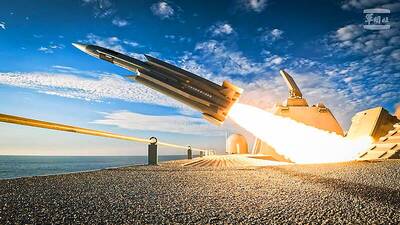
DETERRENCE: With 1,000 indigenous Hsiung Feng II and III missiles and 400 Harpoon missiles, the nation would boast the highest anti-ship missile density in the world With Taiwan wrapping up mass production of Hsiung Feng II and III missiles by December and an influx of Harpoon missiles from the US, Taiwan would have the highest density of anti-ship missiles in the world, a source said yesterday. Taiwan is to wrap up mass production of the indigenous anti-ship missiles by the end of year, as the Chungshan Institute of Science and Technology has been meeting production targets ahead of schedule, a defense official with knowledge of the matter said. Combined with the 400 Harpoon anti-ship missiles Taiwan expects to receive from the US by 2028, the nation would have

POSSIBILITIES EMERGE: With Taiwan’s victory and Japan’s narrow win over Australia, Taiwan now have a chance to advance if South Korea also beat the Aussies Taiwan has high hopes that the national baseball team would advance to the World Baseball Classic (WBC) quarter-finals after clinching a crucial 5-4 victory over South Korea in a nail-biting extra-inning game at the Tokyo Dome yesterday. Boosted by three home runs — two solo shots by Yu Chang (張育成) and Cheng Tsung-che (鄭宗哲) and a two-run homer by Stuart Fairchild — the triumph gave Taiwan a much-needed second victory in the five-team Pool C, where only the top two finishers would advance to the knockout stage in Miami, Florida. Entering extra innings with the game tied at four apiece, Taiwan scored
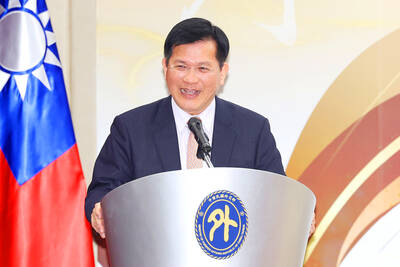
MISSION OF PEACE: The foreign minister urged Beijing to respect Taiwan’s existence as an independent nation, and work together to ensure peace and stability in the region Minister of Foreign Affairs Lin Chia-lung (林佳龍) yesterday rejected Chinese Minister of Foreign Affairs Wang Yi’s (王毅) comments about Taiwan, criticizing China as a “troublemaker” in the international community and a disruptor of cross-strait peace. Speaking at a news conference on the sidelines of the Chinese National People’s Congress, Wang said that Taiwan has always been a territory of China and that it would be impossible for it to become its own country. The “return” of Taiwan to China was the natural outcome of the Chinese people’s resistance against Japan in World War II, and that any pursuit of independence was “doomed

‘UNWAVERING FRIENDSHIP’: A representative of a Japanese group that co-organized a memorial, said he hopes Japanese never forget Taiwan’s kindness President William Lai (賴清德) yesterday marked the 15th anniversary of the Tohoku earthquake and tsunami, urging continued cooperation between Taiwan and Japan on disaster prevention and humanitarian assistance. Lai wrote on social media that Taiwan and Japan have always helped each other in the aftermath of major disasters. The magnitude 9 earthquake struck northeastern Japan on March 11, 2011, triggering a massive tsunami that claimed more than 19,000 lives, according to data from Japanese authorities. Following the disaster, Taiwan donated more than US$240 million in aid, making it one of the largest contributors of financial assistance to Japan. In addition to cash donations and


 RSS
RSS