


The US military said yesterday American and Iraqi troops have started operations to secure parts of northern Mosul from insurgents.
US troops and Iraqi security forces began moving in to secure police stations in the western part of the city, closing off the city's five bridges, said Captain Angela Bowman, with Task Force Olympia. Mosul is the third largest city in Iraq.
"We are in the process of securing all of the police stations and returning the police to these stations to implace a strong police presence," she said. "Some of those stations are in neigborhoods on the western side of the city where there has been insurgent activity and presence. We are now moving through the neighborhood."
About 1,200 US soldiers were taking part in the offensive to recapture about a dozen police stations abandoned by Iraqi police forces after an uprising that sprang up following the US-led attack on Fallujah, she confirmed.
Residents reported US warplanes and helicopters hovering over the city, as loud explosions and gunfire were heard near the American base on the northern edge of Mosul.
Eyewitnesses said three police stations already under the control of insurgents were blown up this morning before the militants left.
The Zuhour police station, and a substation in northeastern Mosul were destroyed, along with the Qahira police station in the northern part of the city. No casualties were seen as the stations were controlled by the gunmen.
Also yesterday, insurgents attacked the offices of a key Kurdish party, the Patriotic Union of Kurdistan, in a bloody gunbattle that left three attackers dead and two Kurdish guards and one attacker wounded, said party official Saadi Ahmed.
The attackers' car was carrying weapons and exploded in the confrontation, he added.
In a separate incident, unknown assailants attacked a truck carrying Kurdish peshmerga militia driving in the northern Masarif neighborhood of Mosul, injuring some of them, eyewitnesses said.
The peshmerga were called in last week to protect Kurdish political offices that have come under attack by militants in the past week.
A mass insurgent uprising began in Mosul last week in apparent support of militants in the rebel bastion of Fallujah, just days after the start of the US offensive there.
Masked and armed bands of men stormed more than a half dozen police stations, bridges and political offices in the city, clashing with US troops and Iraqi forces.
PROVOCATIVE: Chinese Deputy Ambassador to the UN Sun Lei accused Japan of sending military vessels to deliberately provoke tensions in the Taiwan Strait China denounced remarks by Japan and the EU about the South China Sea at a UN Security Council meeting on Monday, and accused Tokyo of provocative behavior in the Taiwan Strait and planning military expansion. Ayano Kunimitsu, a Japanese vice foreign minister, told the Council meeting on maritime security that Tokyo was seriously concerned about the situation in the East China and South China seas, and reiterated Japan’s opposition to any attempt to change the “status quo” by force, and obstruction of freedom of navigation and overflight. Stavros Lambrinidis, head of the EU delegation to the UN, also highlighted South China Sea
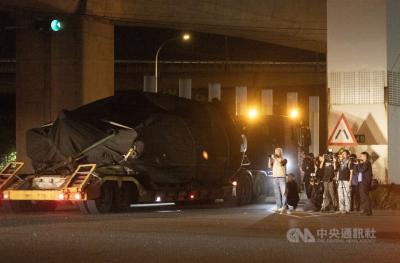
The final batch of 28 M1A2T Abrams tanks purchased from the US arrived at Taipei Port last night and were transported to the Armor Training Command in Hsinchu County’s Hukou Township (湖口), completing the military’s multi-year procurement of 108 of the tanks. Starting at 12:10am today, reporters observed more than a dozen civilian flatbed trailers departing from Taipei Port, each carrying an M1A2T tank covered with black waterproof tarps. Escorted by military vehicles, the convoy traveled via the West Coast Expressway to the Armor Training Command, with police implementing traffic control. The army operates about 1,000 tanks, including CM-11 Brave Tiger
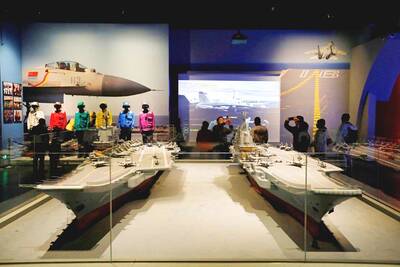
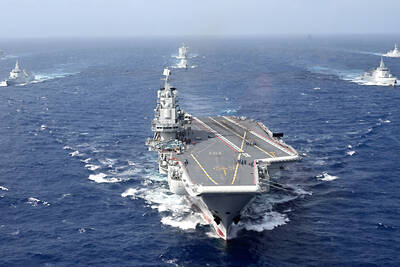
China on Wednesday teased in a video an aircraft carrier that could be its fourth, and the first using nuclear power, while making an allusion to Taiwan and vowing to further build up its islands, as it looks to boost maritime power, secure resources and bolster territorial claims. The video, issued on the eve of the 77th founding anniversary of the Chinese People’s Liberation Army Navy, featured fictional officers with names that are homophones of three commissioned aircraft carriers, the Liaoning (遼寧), Shandong (山東) and Fujian (福建). Titled Into the Deep, it showed a 19-year-old named “Hejian” (何劍) joining the group, sparking
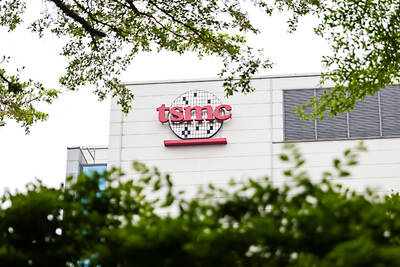
Taiwan Semiconductor Manufacturing Co (TSMC, 台積電), the world’s largest contract chipmaker, said it expects its 2-nanometer (2nm) chip capacity to grow at a compound annual rate of 70 percent from this year to 2028. The projection comes as five fabs begin volume production of 2-nanometer chips this year — two in Hsinchu and three in Kaohsiung — TSMC senior vice president and deputy cochief operating officer Cliff Hou (侯永清) said at the company’s annual technology symposium in Silicon Valley, California, last week. Output in the first year of 2-nanometer production, which began in the fourth quarter of last year, is expected to


 RSS
RSS