


The Ministry of National Defense (MND) yesterday denied a report in the local media, which claimed that President Chen Shui-bian's (
"The MND maintains efficient monitoring of any movement by the Chinese military," said a news release issued by the ministry's spokesman's office.
"In accordance with our records, Chinese jets were patrolling in an area 11 miles west of the `middle line' of the Taiwan Strait on Sept. 27, but none of the patrols occured during the afternoon while President Chen's chartered plane flew to Penghu, an outlying island."
"Moreover, during Vice President Annette Lu's (
A local newspaper reported in yesterday's front page that Chen and Lu's flights to Penghu Island had both been interfered with by Chinese jets in the area.
The president's pilots altered their flight path to avoid the Chinese jets, delaying Chen's arrival at Penghu by 15 minutes, the report said. It did not say how close the jets came to the presidential aircraft.
The MND stressed that the Air Force had comprehensive protective measures in place, including both air and ground assets, to protect the president and vice president's chartered flights when they were traveling to or from the outlying islands.
MND spokesman Major General Huang Suey-sheng (
Lo Chih-cheng (
"Not only all Taiwanese people, but also the international community should enhance their support for President Chen's recent appeal that both sides of the Taiwan Strait establish a `Code of Conduct across the Taiwan Strait' as a guarantee of peace," Lo said.
"Beijing has obviously tried to strengthen its domination of Taiwan by sending more jets to cross the middle line of the Strait, thus increasing the insecurity felt by Taiwan's people," Lo said. "However, Beijing should understand that such a strategy can only result in regional instability and increase the possibility of unnecessary military conflict."
Mainland Affairs Council (MAC) chairman Joseph Wu (吳釗燮) said that Chen is devoted to realizing his promise of building peace-ensuring mechanisms between the two sides of the Strait, and the government hopes that Beijing can react positively to the overtures to effectively reduce the possibility of any misjudgment by leaders on either side.
However, opposition politicians said that the media report was just another trick orchestrated by the government to enhance the sense of fear regarding China's military threats among ordinary Taiwanese.
"The newspaper story cited unidentified `reliable sources,' which didn't say whether the reported encounter with the Chinese jets was a coincidence or an act of intimidation by China," said Chinese Nationalist Party (KMT) legislative caucus whip Huang Teh-fu (黃德福).
"We think that it was just another trick to seek the public's support for urging the Legislative Yuan to pass the government's arms procurement budget," he said.
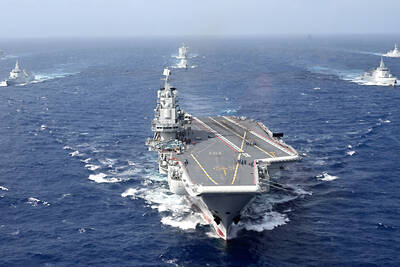
PROVOCATIVE: Chinese Deputy Ambassador to the UN Sun Lei accused Japan of sending military vessels to deliberately provoke tensions in the Taiwan Strait China denounced remarks by Japan and the EU about the South China Sea at a UN Security Council meeting on Monday, and accused Tokyo of provocative behavior in the Taiwan Strait and planning military expansion. Ayano Kunimitsu, a Japanese vice foreign minister, told the Council meeting on maritime security that Tokyo was seriously concerned about the situation in the East China and South China seas, and reiterated Japan’s opposition to any attempt to change the “status quo” by force, and obstruction of freedom of navigation and overflight. Stavros Lambrinidis, head of the EU delegation to the UN, also highlighted South China Sea
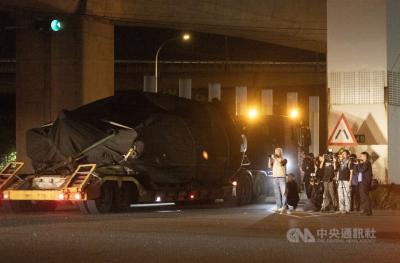
The final batch of 28 M1A2T Abrams tanks purchased from the US arrived at Taipei Port last night and were transported to the Armor Training Command in Hsinchu County’s Hukou Township (湖口), completing the military’s multi-year procurement of 108 of the tanks. Starting at 12:10am today, reporters observed more than a dozen civilian flatbed trailers departing from Taipei Port, each carrying an M1A2T tank covered with black waterproof tarps. Escorted by military vehicles, the convoy traveled via the West Coast Expressway to the Armor Training Command, with police implementing traffic control. The army operates about 1,000 tanks, including CM-11 Brave Tiger
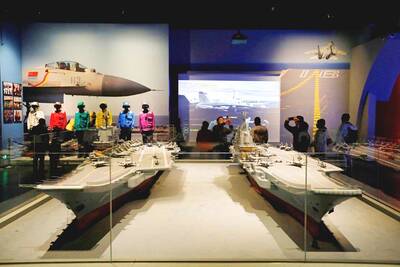
China on Wednesday teased in a video an aircraft carrier that could be its fourth, and the first using nuclear power, while making an allusion to Taiwan and vowing to further build up its islands, as it looks to boost maritime power, secure resources and bolster territorial claims. The video, issued on the eve of the 77th founding anniversary of the Chinese People’s Liberation Army Navy, featured fictional officers with names that are homophones of three commissioned aircraft carriers, the Liaoning (遼寧), Shandong (山東) and Fujian (福建). Titled Into the Deep, it showed a 19-year-old named “Hejian” (何劍) joining the group, sparking
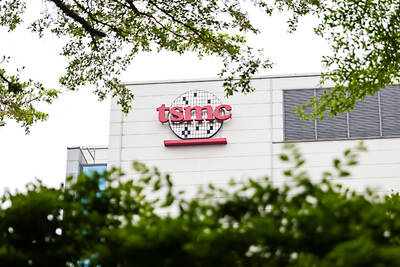
Taiwan Semiconductor Manufacturing Co (TSMC, 台積電), the world’s largest contract chipmaker, said it expects its 2-nanometer (2nm) chip capacity to grow at a compound annual rate of 70 percent from this year to 2028. The projection comes as five fabs begin volume production of 2-nanometer chips this year — two in Hsinchu and three in Kaohsiung — TSMC senior vice president and deputy cochief operating officer Cliff Hou (侯永清) said at the company’s annual technology symposium in Silicon Valley, California, last week. Output in the first year of 2-nanometer production, which began in the fourth quarter of last year, is expected to


 RSS
RSS