


Presidential Office Deputy Secretary-General Joseph Wu (
The appointment comes after President Chen Shui-bian (
Democratic Progressive Party (DPP) Legislator Chiu Tai-san (
Wu told reporters after meeting with Yu yesterday afternoon that he will exert himself in his new job based on the foundation laid down by Tsai.
"I'll also do my best to communicate with lawmakers and to develop a sound relationship with the media," he said.
The meeting between Wu and the premier came one day after Chen asked Wu about his interest in the job.
Wu, 50, was appointed to his job at the Presidential Office in 2002.
He is a former teacher and research assistant in the political science department of Ohio State University. He also served as the deputy director of the Institute of International Relations at National Chengchi University, where colleagues said he wrote papers critical of Beijing.
Analysts said Wu's assignment, coming after Chen appointed former independence activist Mark Chen (陳唐山) as foreign minister, would send a strong message to China on Taiwan's sovereignty.
"With Mark Chen in the foreign ministry and Joseph Wu in the Mainland Affairs Council, this combination sends a very powerful message to the world," said Su Chi (蘇起), who was chairman of the MAC under the former KMT administration.
"Both are diehard pro-independence individuals," said Su, a close aide to KMT Chairman Lien Chan (
According to outgoing Cabinet Spokesman Lin Chia-lung (
"She told the premier that she'd like to take care of her sick mother and have more time to herself for reading and traveling," Lin said. "She also discussed cross-strait policies with the premier but she didn't recommend any candidate as her successor."
While Lin said Chiu's appointment has not been finalized, Wu told reporters yesterday afternoon that Chiu has accepted the position.
During a meeting with Yu on April 29, Chiu was promised a No. 2 position at either the Ministry of Finance, Ministry of Economic Affairs, Mainland Affairs Council or the proposed Financial Supervisory Board.
Chiu, 48, was elected to the legislature in 1999 and is a former member of the National Assembly. He practiced law after obtaining a master's degree from National Taiwan University.
Lin yesterday dismissed speculation that Fan Yun (范雲), an assistant researcher at Academia Sinica's Institute of Sociology, has accepted the premier's offer to head the National Youth Commission.
"It's groundless speculation," Lin said. "The premier didn't contact Fan to discuss the matter, nor did she contact the premier to accept or decline the offer."
Lin said the premier had five candidates in mind but Fan was not one of them.
"It may take a while to find the most suitable person," Lin said.
Chen has pledged that the new head of the National Youth Commission will be "the youngest person in the Cabinet," and preferably a woman under 35.
Progress has not been made in the search for the two vacancies for ministers without portfolio.
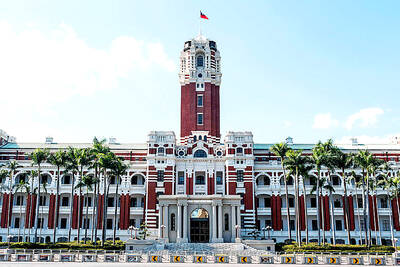
SECURITY: Taipei presses the US for arms supplies, saying the arms sales are not only a reflection of the US security commitment to Taiwan but also serve as a mutual deterrent against regional threats Taiwan is committed to preserving the cross-strait “status quo” and contributing to regional peace and stability, the Presidential Office said yesterday. “It is an undeniable fact that the Republic of China is a sovereign and independent democratic nation,” Presidential Office spokeswoman Karen Kuo (郭雅慧) reiterated, adding that Beijing has no right to claim sovereignty over Taiwan. The statements came after US President Donald Trump warned against Taiwanese independence. Trump wrapped up a state visit to Beijing on Friday, during which Chinese President Xi Jinping (習近平) had pressed him not to support Taiwan. Taiwan depends heavily on US security backing to deter China from carrying
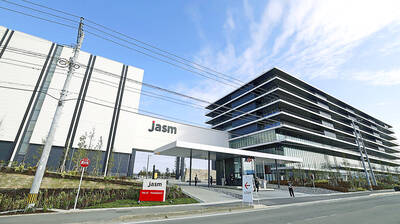
The subsidiary of Taiwan Semiconductor Manufacturing Co (TSMC, 台積電) in Kumamoto, Japan, turned a profit in the first quarter of this year, marking the first time the first fab of the unit has become profitable since mass production started at the end of 2024. According to the contract chipmaker’s financial statement released on Friday, Japan Advanced Semiconductor Manufacturing Inc (JASM), a joint venture running the fab in Kumamoto, posted NT$951 million (US$30.19 million) in profit in the January-to-March period, compared with a loss of NT$1.39 billion in the previous quarter, and a loss of NT$3.25 billion in the first quarter of
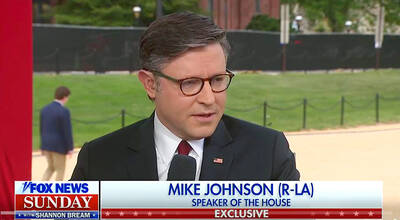
RESOLUTE BACKING: Two Republican senators are planning to introduce legislation that would impose immediate sanctions on China if it attempts to invade Taiwan US House of Representatives Speaker Mike Johnson on Sunday reaffirmed US congressional support for Taiwan, saying the US and “all freedom-loving people” have a stake in preventing China from seizing Taiwan by force. Johnson made the remarks in an interview with Fox News Sunday on US President Donald Trump’s summit with Chinese President Xi Jinping (習近平) last week. In an interview that aired on Friday on Fox News, just as Trump wrapped up a high-stakes visit to China, he said he has yet to green-light a new US$14 billion arms package to Taiwan and that it “depends on China.” “It’s a very good
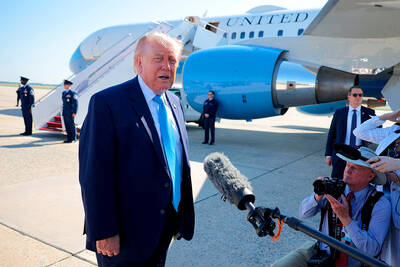
US President Donald Trump yesterday said he would speak to President William Lai (賴清德) as his administration considers whether to move ahead with a US$14 billion weapons sale to Taiwan — a potential arms deal that has drawn criticism from China. “Well, I’ll speak to him. I speak to everybody,” Trump told reporters yesterday when asked if he had any plans to call his counterpart, although he did not offer a time frame for when such a conversation could take place. Trump previously said he would speak to the person “that’s running Taiwan,” without specifying who he meant. “We have that situation very


 RSS
RSS