


Oil prices rose yesterday after the foiled weekend attempts to bomb Iraq's key Basra crude export terminal revived fears of more attacks on the country's oil infrastructure.
Iraqi Oil Minister Mohammad Bahr al-Uloum said yesterday exports resumed on Sunday from the terminal in southern Iraq, which handles about 85 percent of the country's daily exports of some 1.9 million barrels.
US light crude hit an early peak at US$36.89 a barrel, but eased to US$36.68 by 0636 GMT, a rise of US$0.22. London's Brent crude climbed US$0.27 to US$33.36 a barrel.
Suicide bombers launched three boat attacks on Saturday on the Basra oil terminal but were stopped by US-led coalition forces without damaging the facilities, which are about 10km offshore.
"Iraqi teams restored operations at 1700 GMT on Sunday. The damage was limited and exports are flowing back at the same rates," Uloum said.
He said living quarters, several electrical generators and minor installations sustained damage in the attempted bombings.
"This is a significant development in Iraq, the terminal is well guarded but the next targets will probably be the pipelines or tankers. There will be persistent attempts to disrupt Iraqi oil supplies in the next four weeks," said an oil broker.
Oil traders are nervous that any escalation in violence in the Middle East may disrupt oil supplies from the region, which holds two-thirds of global reserves.
"Security concerns look set to remain high, not helped by recent events in Madrid and in the Middle East itself," Standard Chartered Bank said in an overview this month of the oil markets referring to the bombings of four commuter trains in Madrid last month that killed almost 200 people.
Kuwait, also a major oil exporter, said at the weekend it had increased security across the country following a suicide bombing in the Saudi capital Riyadh last week and the surge in violence in Iraq between US-led forces and insurgents.
Security has also been beefed up in the oil-producing Niger delta in Nigeria after two US oil workers and at least four Nigerians were killed by armed militants in a botched robbery attempt.

PROVOCATIVE: Chinese Deputy Ambassador to the UN Sun Lei accused Japan of sending military vessels to deliberately provoke tensions in the Taiwan Strait China denounced remarks by Japan and the EU about the South China Sea at a UN Security Council meeting on Monday, and accused Tokyo of provocative behavior in the Taiwan Strait and planning military expansion. Ayano Kunimitsu, a Japanese vice foreign minister, told the Council meeting on maritime security that Tokyo was seriously concerned about the situation in the East China and South China seas, and reiterated Japan’s opposition to any attempt to change the “status quo” by force, and obstruction of freedom of navigation and overflight. Stavros Lambrinidis, head of the EU delegation to the UN, also highlighted South China Sea
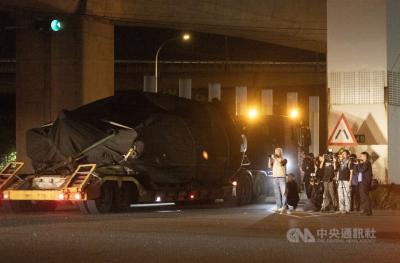
The final batch of 28 M1A2T Abrams tanks purchased from the US arrived at Taipei Port last night and were transported to the Armor Training Command in Hsinchu County’s Hukou Township (湖口), completing the military’s multi-year procurement of 108 of the tanks. Starting at 12:10am today, reporters observed more than a dozen civilian flatbed trailers departing from Taipei Port, each carrying an M1A2T tank covered with black waterproof tarps. Escorted by military vehicles, the convoy traveled via the West Coast Expressway to the Armor Training Command, with police implementing traffic control. The army operates about 1,000 tanks, including CM-11 Brave Tiger
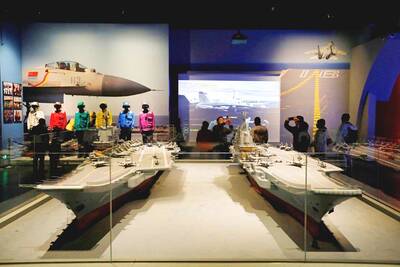
China on Wednesday teased in a video an aircraft carrier that could be its fourth, and the first using nuclear power, while making an allusion to Taiwan and vowing to further build up its islands, as it looks to boost maritime power, secure resources and bolster territorial claims. The video, issued on the eve of the 77th founding anniversary of the Chinese People’s Liberation Army Navy, featured fictional officers with names that are homophones of three commissioned aircraft carriers, the Liaoning (遼寧), Shandong (山東) and Fujian (福建). Titled Into the Deep, it showed a 19-year-old named “Hejian” (何劍) joining the group, sparking
Taiwan Semiconductor Manufacturing Co (TSMC, 台積電), the world’s largest contract chipmaker, said it expects its 2-nanometer (2nm) chip capacity to grow at a compound annual rate of 70 percent from this year to 2028. The projection comes as five fabs begin volume production of 2-nanometer chips this year — two in Hsinchu and three in Kaohsiung — TSMC senior vice president and deputy cochief operating officer Cliff Hou (侯永清) said at the company’s annual technology symposium in Silicon Valley, California, last week. Output in the first year of 2-nanometer production, which began in the fourth quarter of last year, is expected to


 RSS
RSS