


Setting aside their rivalries to fight unwanted e-mail choking cyberspace, leading Internet companies announced they had sued hundreds of people suspected of sending unsolicited junk messages known as spam.
The legal actions by Microsoft Corp, America Online, Earthlink and Yahoo, represent the first major industry actions under the US federal "can spam" legislation that went into effect Jan. 1. The suits, which are aimed at shutting down the spammers, were filed on Wednesday in federal courts in California, Georgia, Virginia and Washington state.
Dozens of those named were identified only as "John Doe" defendants accused of e-mailing unwanted pitches for prescription drugs, herbal potions and weight loss plans. Lawyers expressed confidence they can work through the courts, using subpoenas and other investigative tools, to identify and find them.
"We've been doing this a long time, and we know what we're doing. We're only a couple subpoenas away from standing at someone's door and handing them a summons," said Les Seagraves, the assistant general counsel at Earthlink, which named 75 "John Doe" defendants in its lawsuits.
The recording industry has been remarkably successful in identifying Internet users in copyright infringement lawsuits, in most cases tracing a subscriber's unique Internet address.
But spammers are famously skillful at covering their tracks, often routing unwanted e-mail through hacked or unprotected computers overseas and working under aliases and shell companies, complicating efforts to trace and identify them.
Yahoo, for example, employed as one of its lawyers in these cases Marc Zwillinger, a former computer-crimes expert at the US Justice Department who investigated the high-profile Internet attacks in February 2000 by a Canadian teenager known as "Mafia Boy."
"It is a significant challenge," acknowledged Robert Wientzen, chief executive at the Direct Marketing Association, who said he supports the latest lawsuits.
He said companies are increasingly successful tracing spammers.
"We're making some progress with techniques and tools that are starting to pay some dividends," Wientzen said.
The four companies said the defendants include some of America's most notorious large-scale spammers. They said they shared information, resources and investigative information to identify some of them.
The ``can spam'' legislation requires unsolicited e-mails to include a mechanism so recipients could indicate they did not want future mass mailings.

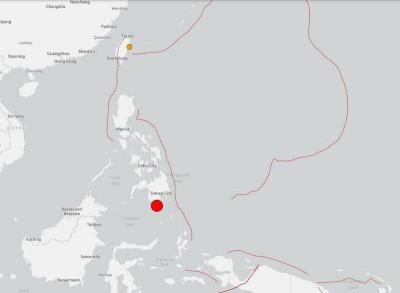
A magnitude 7.8 earthquake struck off the southern coast of Mindanao in the Philippines at 7:38am today, prompting the US Tsunami Warning System to issue an alert for neighboring countries, including Taiwan. The system issued a purple alert indicating a "tsunami threat." The potential threat zone includes Taiwan, the Philippines, Papua New Guinea, Yap and Palau. Philippine authorities were assessing the damage from the quake, with the office of civil defense seeking to verifying initial reports that 15 people had been killed and 129 injured in the region, mostly from falling debris. Arlene Hollero, disaster chief of Maasim town in the Philippines' Sarangani Province,

RESILIENCE: Taiwan plays a key role in semiconductors, energy, information infrastructure and advanced manufacturing, AIT Director Raymond Greene said Taiwan’s continued investment in deterrence and resilience remains vital, especially in uncrewed systems and other emerging technologies, American Institute in Taiwan (AIT) Director Raymond Greene said yesterday. Greene made the remarks at the annual National Strategic Summit on Supply Chain Resilience held by the Research Institute for Democracy, Society and Emerging Technology (DSET), a government-backed think tank. As Taiwan last year became the US’ fourth-largest trading partner and supply chain security is becoming more important, cooperation in emerging technologies continues to deepen between the two countries, he said. The US is committed to accelerating innovation, building key infrastructure, strengthening cooperation

The National Chungshan Institute of Science and Technology yesterday showcased its locally developed variants of the Vision 60 robotic patrol dog, which it plans to deploy on the nation’s outlying territories in the South China Sea. The variants were produced under the Joint Lab project — created by the institute and domestic companies — and assembled with domestically produced motors, lenses and artificial intelligence (AI) systems alongside licensed tech from the US, Missile and Rocket Systems Research Division deputy director Jen Kuo-kang (任國光) told the media event at a military base in Taipei’s Dazhi (大直) area. Taiwan has built up its strengths

RIGHT DIRECTION: Taiwan’s efforts to prevent forced labor include a proposal to ‘fully prohibit’ employers from withholding workers’ documents, an official said Taiwan is to establish a mechanism to restrict imports of goods linked to forced labor, the Executive Yuan said yesterday, after the US proposed imposing additional tariffs on Taiwanese goods over labor concerns. “The Ministry of Labor and the Ministry of Economic Affairs are to establish an interministerial review procedure,” Executive Yuan spokesperson Michelle Lee (李慧芝) said at a news briefing in Taipei. “The government is to use the Foreign Trade Act [貿易法] as the legal basis to restrict imports of goods produced with forced labor” and bring its supply chain governance more in line with international standards on human rights, resilience


 RSS
RSS