


Chinese Nationalist Party (KMT) Chairman Lien Chan (連戰) yesterday pressed charges against former Taiwan Pineapple Group (台鳳) vice chairman Huang Tsung-hung (黃宗宏) for libel and violation of the Presidential and Vice Presidential Election and Recall Law (總統副總統選罷法).
Lien accused Huang of spreading false information to the media and the public in an attempt to influence the election.
Huang wrote to the media two days ago, stating that he had twice provided political donations to the KMT. In his letter, Huang said that his donations were similar to the Chen Yu-hao (陳由豪) bribery scandal.
The first donation was made in 1998, when Huang gave NT$100 million to the KMT as a political donation to prevent the stock price of Taiwan Pineapple from falling, according to Huang. The second donation was made in 1999, when former Pingtung County commissioner Wu Tse-yuan (
The donations were both linked to Lien, and Huang implied that Lien took a part of the donations.
The Democratic Progressive Party (DPP) legislative caucus yesterday attacked Lien, saying former Chang Hwa Bank (
Lien pressed charges against Huang yesterday afternoon.
Chang Hwa Bank yesterday also denied that it lent money to Taiwan Pineapple after Huang paid Wu in 1999.
"We did approve Taiwan Pineapple's application for borrowing conditionally, but because Taiwan Pineapple could not have Citibank issue a letter of credit as required, the application was rejected," Chang Hwa vice president Hsieh Chao-nan (
KMT-PFP spokesman Alex Tsai (蔡正元) said yesterday that Huang and Presidential Office Deputy Secretary-General Chen Che-nan (陳哲男) were friends, but Chen Che-nan denied the charge.
The PFP caucus offered evidence in the afternoon to show that Huang and Chen were quite familiar with each other and had business relations.
The PFP produced a land registration document showing that Chen Che-nan's son, Chen Chi-yao (陳其堯), co-owned land in Pingtung County with the Dimen Arts Company (帝門藝術公司) and Huang's mother, and that they mortgaged the land together in exchange for a sum that was much greater than the land value.
"The arts company is actually an affiliate of Taiwan Pineapple, while Huang Yeh Tung-mei (黃葉冬梅) is Huang's mother. This shows the Chens and the Huangs knew each other well and even did business together," said Chang Hsien-yao (張顯耀), director of the PFP's Center for Policy Research.


RESILIENCE: Taiwan plays a key role in semiconductors, energy, information infrastructure and advanced manufacturing, AIT Director Raymond Greene said Taiwan’s continued investment in deterrence and resilience remains vital, especially in uncrewed systems and other emerging technologies, American Institute in Taiwan (AIT) Director Raymond Greene said yesterday. Greene made the remarks at the annual National Strategic Summit on Supply Chain Resilience held by the Research Institute for Democracy, Society and Emerging Technology (DSET), a government-backed think tank. As Taiwan last year became the US’ fourth-largest trading partner and supply chain security is becoming more important, cooperation in emerging technologies continues to deepen between the two countries, he said. The US is committed to accelerating innovation, building key infrastructure, strengthening cooperation

The National Chungshan Institute of Science and Technology yesterday showcased its locally developed variants of the Vision 60 robotic patrol dog, which it plans to deploy on the nation’s outlying territories in the South China Sea. The variants were produced under the Joint Lab project — created by the institute and domestic companies — and assembled with domestically produced motors, lenses and artificial intelligence (AI) systems alongside licensed tech from the US, Missile and Rocket Systems Research Division deputy director Jen Kuo-kang (任國光) told the media event at a military base in Taipei’s Dazhi (大直) area. Taiwan has built up its strengths
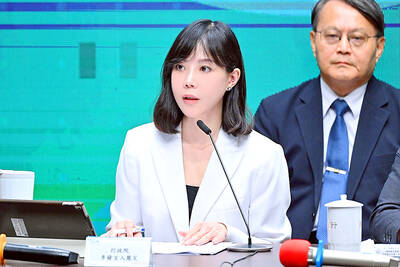
RIGHT DIRECTION: Taiwan’s efforts to prevent forced labor include a proposal to ‘fully prohibit’ employers from withholding workers’ documents, an official said Taiwan is to establish a mechanism to restrict imports of goods linked to forced labor, the Executive Yuan said yesterday, after the US proposed imposing additional tariffs on Taiwanese goods over labor concerns. “The Ministry of Labor and the Ministry of Economic Affairs are to establish an interministerial review procedure,” Executive Yuan spokesperson Michelle Lee (李慧芝) said at a news briefing in Taipei. “The government is to use the Foreign Trade Act [貿易法] as the legal basis to restrict imports of goods produced with forced labor” and bring its supply chain governance more in line with international standards on human rights, resilience

NOT IMMEDIATE: Taiwan has a chance to appeal the proposed 10 percent tariff before it starts, while other countries face a 12.5 percent tariff from the trade office Taiwan is among 60 economies determined by the US to have failed to impose or enforce a ban on the importation of goods produced with forced labor, according to a notice released on Tuesday by the Office of the US Trade Representative (USTR), which proposed imposing an additional 10 percent or more tariff on them. The USTR in a statement said that following an investigation, it had determined under Section 301 of the Trade Act of 1974 that the failure of the 60 economies to impose and effectively enforce a prohibition on the importation of goods produced with forced labor is


 RSS
RSS