


Iraqi Shiite leaders appealed for calm yesterday and urged their followers not to be provoked into civil war by a wave of bomb attacks on Tuesday that killed at least 185 worshippers as they marked their holiest day.
Huge crowds of mourners marched through the holy city of Kerbala chanting "God is Great-est" and bearing flower-laden coffins aloft through streets packed with Shiites.
Suicide bombers, mortars and concealed explosives killed at least 115 people in Kerbala on Tuesday, while three suicide bombers killed at least 70 in Baghdad, according to the latest figures from Iraqi Health Minister Khudier Abbass.
The coordinated attacks, targeting Shiites marking the holy period of Ashura with mass gatherings in Iraqi cities, made it the bloodiest day since former president Saddam Hussein was toppled.
Ayatollah Hadi al-Muddaresi, one of Iraq's leading Shiite clerics, said the bombings were an attempt by Sunni extremists to foment civil war in Iraq, where the 60 percent Shiite majority were for decades suppressed under Saddam, a Sunni.
"There are parties and groups that are willing to push Iraq towards civil war, but I don't think it will happen because the first people who will loose will be those who are pushing for it," the cleric said in his offices in Kerbala.
Iraq's US-appointed Governing Council blames the attacks on Abu Musab Zarqawi, a Jordanian who Washington says works for the militantly Sunni al-Qaeda. US forces have put a US$10 million bounty on his head and say they intercepted a letter from him last month urging attacks on Shiites to ignite civil war.
A letter purporting to come from al Qaeda and sent to the London-based al-Quds al Arabi newspaper denied any role in Tuesday's violence, blaming it instead on the US.
The Governing Council announced three days of mourning from yesterday and postponed the signing of an interim constitution agreed earlier this week after days of wrangling.
There were scenes of grief at the funerals in Baghdad and Kerbala but few signs Shiites wanted violent revenge.
"Enemies of Shiite Islam want to kill Shiites and provoke civil strife," said Hussein Shammari, a man in his 50s in Kerbala. "But anything they do against us will not affect us because we are not afraid. Saddam did worse -- he killed hundreds of thousands of Shiites, but we are still here."

PROVOCATIVE: Chinese Deputy Ambassador to the UN Sun Lei accused Japan of sending military vessels to deliberately provoke tensions in the Taiwan Strait China denounced remarks by Japan and the EU about the South China Sea at a UN Security Council meeting on Monday, and accused Tokyo of provocative behavior in the Taiwan Strait and planning military expansion. Ayano Kunimitsu, a Japanese vice foreign minister, told the Council meeting on maritime security that Tokyo was seriously concerned about the situation in the East China and South China seas, and reiterated Japan’s opposition to any attempt to change the “status quo” by force, and obstruction of freedom of navigation and overflight. Stavros Lambrinidis, head of the EU delegation to the UN, also highlighted South China Sea
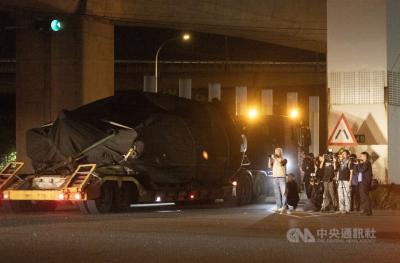
The final batch of 28 M1A2T Abrams tanks purchased from the US arrived at Taipei Port last night and were transported to the Armor Training Command in Hsinchu County’s Hukou Township (湖口), completing the military’s multi-year procurement of 108 of the tanks. Starting at 12:10am today, reporters observed more than a dozen civilian flatbed trailers departing from Taipei Port, each carrying an M1A2T tank covered with black waterproof tarps. Escorted by military vehicles, the convoy traveled via the West Coast Expressway to the Armor Training Command, with police implementing traffic control. The army operates about 1,000 tanks, including CM-11 Brave Tiger
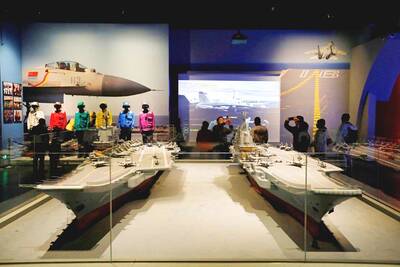
China on Wednesday teased in a video an aircraft carrier that could be its fourth, and the first using nuclear power, while making an allusion to Taiwan and vowing to further build up its islands, as it looks to boost maritime power, secure resources and bolster territorial claims. The video, issued on the eve of the 77th founding anniversary of the Chinese People’s Liberation Army Navy, featured fictional officers with names that are homophones of three commissioned aircraft carriers, the Liaoning (遼寧), Shandong (山東) and Fujian (福建). Titled Into the Deep, it showed a 19-year-old named “Hejian” (何劍) joining the group, sparking

Taiwan Semiconductor Manufacturing Co (TSMC, 台積電), the world’s largest contract chipmaker, said it expects its 2-nanometer (2nm) chip capacity to grow at a compound annual rate of 70 percent from this year to 2028. The projection comes as five fabs begin volume production of 2-nanometer chips this year — two in Hsinchu and three in Kaohsiung — TSMC senior vice president and deputy cochief operating officer Cliff Hou (侯永清) said at the company’s annual technology symposium in Silicon Valley, California, last week. Output in the first year of 2-nanometer production, which began in the fourth quarter of last year, is expected to


 RSS
RSS