


The Presidential Office took exception yesterday to the way the Washington Post interpreted remarks President Chen Shui-bian (
"President Chen never said that he `would not bow to US pressure' as the two countries have mutual concerns on certain issues; Taiwan would also be concerned about the US tilting its stance toward China," Presidential Office spokesman James Huang (
"Concern is not the same as pressure. Being concerned doesn't mean that you're going to get involved in another nation's domestic affairs. This is simply the press' excessive interpretation," Huang said.
The Washington Post, in a report published Tuesday, wrote that Chen said he "would not bow to US pressure to modify recent moves -- including holding a referendum on rewriting the constitution and adding the name Taiwan to its official Republic of China passports -- which Bush administration officials worry could heighten tensions with Beijing."
The paper quotes Chen as saying: "Taiwan is not a province of one country nor is it a state of another. Any kind of democratic reform is our own internal affairs. I don't think any democratic country can oppose our democratic ideas."
The Post said Chen's remarks were "unusual because Taiwanese leaders are rarely so dismissive of US concerns."
The report was written by the Washington Post's chief correspondent in Beijing, John Pomfret, who conducted the interview with Chen on Monday in Taipei.
Huang yesterday said that when Pomfret asked Chen whether the holding of referendums, rewriting the Constitution and adding Taiwan to the cover of passports were part of a strategy to anger Beijing and boost his chances of getting re-elected, the president replied that "such thinking was incorrect and meaningless."
"The president said these moves were based on improving the development of the nation's constitutional system and public convenience. The president emphasized that pushing these democratic reforms has nothing to do with the issues of independence or unification. So the things the US is concerned about won't happen," Huang said.
"The president considers the US to be a democratic nation. Our nation is also a democratic nation," Huang said. "So of course one democratic nation will respect decisions and choices made by the free, democratic will of people in another democracy."
Echoing the US State Department's response to Chen's comments, Huang said: "Taiwan shares common ground with the US regarding the issue of resuming cross-strait dialogue and promoting cross-strait stability."
However, he added, "Such a task is not something which can be unilaterally controlled by us."
Huang also reiterated that the government has smooth communication channels with the US regarding issues of mutual concern.
The presidential spokesman also rejected Chinese Nationalist Party (KMT) Chairman Lien Chan's (
"The opposition party's inappropriate political interpretation that Chen's remarks will sabotage US-Taiwan relations is not true and may actually damage bilateral relations," Huang said.
Also See Story:
`Post' interview worries US capital

‘NO SECURITY RISK’: The Railway Bureau reassured the public that the technicians’ activities were limited to technical guidance and did not involve sensitive systems The Railway Bureau yesterday said it had invited eight Chinese technicians to assist with an airport MRT construction project. The bureau issued the confirmation after an Internet user said Chinese nationals had entered the construction zone of Taiwan Taoyuan International Airport’s Terminal 3 project. They asked why “individuals from an enemy state” were allowed access to such a major national infrastructure project, which raised serious concerns over Taiwan’s industrial safety, sensitive systems and information security. The bureau’s Northern Region Engineering Branch Office said subcontractor Taiwan Handle Industrial Co (台灣手把工業) of the Taoyuan airport MRT’s “Contract No. CU05 Project A14 Station Civil, MEP &

A US uncrewed surface vessel (USV) encountered multiple Chinese warships during an autonomous transit of the Taiwan Strait, US defense company Seasats said in a statement on Wednesday. Seasats announced that a Lightfish USV had completed the first autonomous transit of the Taiwan Strait. Over five days, the USV traversed the entire length of the Strait while constantly monitoring surface vessel traffic, the company said. The Lightfish encountered multiple Chinese warships, one of which was a Chinese People’s Liberation Army Navy (PLAN) Type 056 corvette, it said. The Chinese vessels were operating “well within Taiwan’s exclusive economic zone without transmitting their identity via the

Taiwan is still in the process of assessing the possibility of recruiting workers from Eswatini, the Ministry of Foreign Affairs said yesterday, adding that its goal is to help Eswatini upgrade its vocational training centers. If there are plans to recruit workers from Eswatini, safeguarding national security, protecting public health and ensuring the employment rights of Taiwanese would be prerequisites, Department of West Asian and African Affairs Director-General Yen Chia-liang (顏嘉良) told a news conference. Key considerations would also include filling labor shortages in specific industries, and fostering bilateral professional and technical exchanges, he said. Yen was asked about the progress of labor
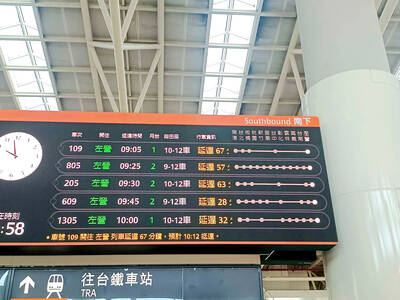
The nation’s usually punctual high-speed rail system yesterday was hit by major disruptions after all scheduled services were canceled and replaced with three hourly trains offering only non-reserved seating, affecting more than 200,000 passengers. Preliminary findings indicate the disruption was caused by a faulty power module in a track switch control cabinet, Taiwan High-Speed Rail Corp (THSRC) said, adding that as a full system inspection could only be conducted after operations end for the day, a decision on whether normal service would resume today would be announced before the first train departs. During a routine inspection early yesterday, a switch signal abnormality


 RSS
RSS