


Criminals and fraudsters are being blamed for the worldwide wave of e-mails unleashed by a new computer virus.
The Sobig.F virus, which first appeared on Monday, has entered the record books as the fastest spreading infection of its type, generating tens of millions of e-mails in three days, clogging up inboxes and bringing many computer systems to a standstill.
At its peak, between Tuesday and Wednesday, IT security firms estimate that the virus generated as many as one in 17 of every e-mail sent worldwide.
Experts suspect the virus installs a program that attempts to download a further malicious program from the Internet -- nicknamed malware -- which acts as a secret server for routing unsolicited "spam" e-mails such as those advertising pornography or quack remedies. It may also forward credit card details and passwords.
"We think there is a big tie-in with spam sellers, who may be writing these viruses in order to find new machines that they can exploit to send more spam," said Alex Shipley, senior anti-virus technologist at MessageLabs security company.
What makes the Sobig.F virus different from previous e-mail scares -- such as the so-called LoveBug virus and Klez worm -- has been its sudden appearance and rapid spread.
"It's hard to say where it originated from; it exploded so suddenly that it may have been started using spammers' tools," said Graham Cluley, a senior technology consultant at Sophos, an anti-virus IT firm.
Indications are that the virus first appeared in the US, being posted to a number of sex and erotica news groups late on Monday night. Within an hour the first infected e-mails had appeared in inboxes.
The sudden upsurge may have been helped by a commercial spammer sending out the e-mails using mass-mailing software, catching many recipients unaware that a new virus was on the rampage.
In Asia, China's top Web security firm said yesterday that Sobig.F has infected 30 percent of all e-mail users in the country.
More than 20 million users opened and passed along the virus to domestic and regional networks, Hao Ting, spokeswoman for Beijing Rising Technology Shareholding Co Ltd, said.
"We haven't seen anything spread so fast," she said.
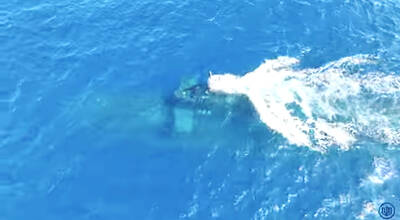
CSBC Corp, Taiwan (台灣國際造船) yesterday released the first video documenting the submerged sea trials of Taiwan’s indigenous defense submarine prototype, the Hai Kun (海鯤), or Narwhal, showing underwater navigation and the launch of countermeasures. The footage shows the vessel’s first dive, steering and control system tests, and the raising and lowering of the periscope and antenna masts. It offered a rare look at the progress in the submarine’s sea acceptance tests. The Hai Kun carried out its first shallow-water diving trial late last month and has since completed four submerged tests, CSBC said. The newly released video compiles images recorded from Jan. 29 to
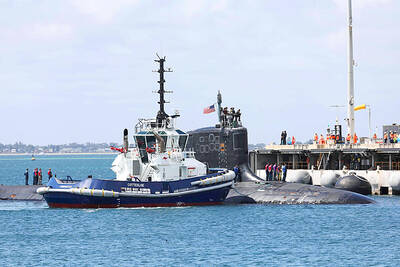
DETERRENCE EFFORTS: Washington and partners hope demonstrations of force would convince Beijing that military action against Taiwan would carry high costs The US is considering using HMAS Stirling in Western Australia as a forward base to strengthen its naval posture in a potential conflict with China, particularly over Taiwan, the Wall Street Journal reported on Saturday. As part of its Indo-Pacific strategy, Washington plans to deploy up to four nuclear-powered submarines at Stirling starting in 2027, providing a base near potential hot spots such as Taiwan and the South China Sea. The move also aims to enhance military integration with Pacific allies under the Australia-UK-US trilateral security partnership, the report said. Currently, US submarines operate from Guam, but the island could
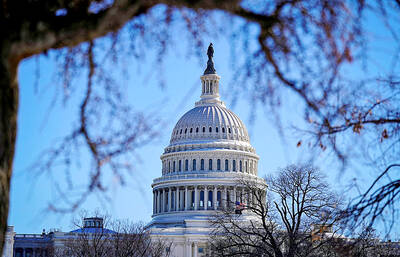
RESTRAINTS: Should China’s actions pose any threat to Taiwan’s security, economic or social systems, China would be excluded from major financial institutions, the bill says The US House of Representatives on Monday passed the PROTECT Taiwan Act, which states that Washington would exclude China from participating in major global financial organizations if its actions directly threaten Taiwan’s security. The bill, proposed by Republican Representative Frank Lucas, passed with 395 votes in favor and two against. It stipulates that if China’s actions pose any threat to Taiwan’s security, economic or social systems, the US would, “to the maximum extent practicable,” exclude Beijing from international financial institutions, including the G20, the Bank for International Settlements and the Financial Stability Board. The bill makes it clear that China must be prepared

Taiwanese trade negotiators told Washington that Taipei would not relocate 40 percent of its semiconductor production to the US, and that its most advanced technologies would remain in the nation, Vice Premier Cheng Li-chiun (鄭麗君) said on Sunday. “I told the US side very clearly — that’s impossible,” Cheng, who led the negotiation team, said in an interview that aired on Sunday night on Chinese Television System. Cheng was referring to remarks last month by US Secretary of Commerce Howard Lutnick, in which he said his goal was to bring 40 percent of Taiwan’s chip supply chain to the US Taiwan’s almost


 RSS
RSS