


US Senate Majority Leader Bill Frist is slated to lead a delegation to travel to Asia tomorrow which includes Taipei as one of the stops.
The visit will be the first time in decades that Taiwan has received such a high-level US congressional leader.
The outbreak of severe acute respiratory syndrome (SARS), however, has added uncertainty to the delegation's visit, sources said.
"Right now, everything is still on schedule," said an assistant to Senator Susan Collins, a member of the delegation, by phone on Tuesday afternoon in Washington.
"They are undecided about China," the source added.
The delegation, which includes Frist and seven other senators along with their families and staffers, is scheduled to take a US Air Force jet to Beijing and Shanghai today, before visiting South Korea, Taiwan and Japan, sources in Taipei and Washington said.
The delegation is scheduled to reach Taipei on April 18 for a whirlwind 24-hour visit.
The senators are slated to meet with high-ranking officials including President Chen Shui-bian (陳水扁), government sources said.
The trip, if completed, will mark the first time since 1985 a US Senate majority leader has visited Taiwan.
Then Senate majority leader Bob Dole visited Taipei in 1985 after the veteran Republican figure was elected to his post in the Senate in November of the previous year.
Officials said Frist's planned visit to Taipei should mark a significant milestone in Taipei-Washington relations.
"Despite the longstanding friendship between Taiwan and the US Congress, it's rare for us to see the visit of such a high-level US congressional leader in Taipei," said a Presidential Office official who declined to be named.
"The visit symbolizes the US emphasis on its relations with Taiwan, especially at a time when the US itself is busy with the war against Iraq, not to mention the threat from SARS," the official said.
The American Institute in Taiwan (AIT), which government officials said is in charge of arranging the delegation's itinerary in Taipei, did not deny nor confirm the delegation's visit yesterday.
Judith Mudd-Krijgelmans, spokesperson for AIT's Taipei office, said she could not confirm the scheduled visit to Taipei by the US congressional delegation.
A former heart and lung transplant specialist, Frist is the only physician currently serving in the US Congress.
The Harvard-educated physician joined the Senate eight years ago, representing Tennessee.
He was recently elected to replace Trent Lott, who stepped down as majority leader last December after making some comments that were taken as supporting racism.
Other key senators in the delegation include Susan Collins of Maine, who serves as the chairperson of the Senate's Government Affairs Committee and Don Nickles, who is the chairman of the Senate's Budget Committee.
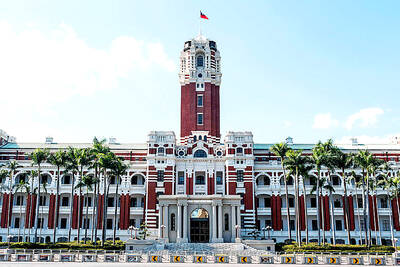
SECURITY: Taipei presses the US for arms supplies, saying the arms sales are not only a reflection of the US security commitment to Taiwan but also serve as a mutual deterrent against regional threats Taiwan is committed to preserving the cross-strait “status quo” and contributing to regional peace and stability, the Presidential Office said yesterday. “It is an undeniable fact that the Republic of China is a sovereign and independent democratic nation,” Presidential Office spokeswoman Karen Kuo (郭雅慧) reiterated, adding that Beijing has no right to claim sovereignty over Taiwan. The statements came after US President Donald Trump warned against Taiwanese independence. Trump wrapped up a state visit to Beijing on Friday, during which Chinese President Xi Jinping (習近平) had pressed him not to support Taiwan. Taiwan depends heavily on US security backing to deter China from carrying
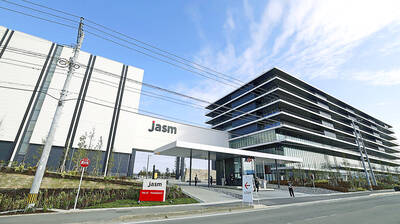
The subsidiary of Taiwan Semiconductor Manufacturing Co (TSMC, 台積電) in Kumamoto, Japan, turned a profit in the first quarter of this year, marking the first time the first fab of the unit has become profitable since mass production started at the end of 2024. According to the contract chipmaker’s financial statement released on Friday, Japan Advanced Semiconductor Manufacturing Inc (JASM), a joint venture running the fab in Kumamoto, posted NT$951 million (US$30.19 million) in profit in the January-to-March period, compared with a loss of NT$1.39 billion in the previous quarter, and a loss of NT$3.25 billion in the first quarter of
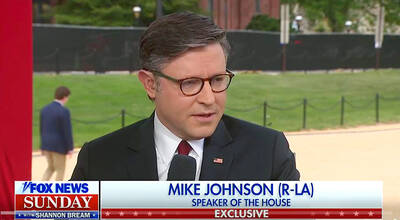
RESOLUTE BACKING: Two Republican senators are planning to introduce legislation that would impose immediate sanctions on China if it attempts to invade Taiwan US House of Representatives Speaker Mike Johnson on Sunday reaffirmed US congressional support for Taiwan, saying the US and “all freedom-loving people” have a stake in preventing China from seizing Taiwan by force. Johnson made the remarks in an interview with Fox News Sunday on US President Donald Trump’s summit with Chinese President Xi Jinping (習近平) last week. In an interview that aired on Friday on Fox News, just as Trump wrapped up a high-stakes visit to China, he said he has yet to green-light a new US$14 billion arms package to Taiwan and that it “depends on China.” “It’s a very good
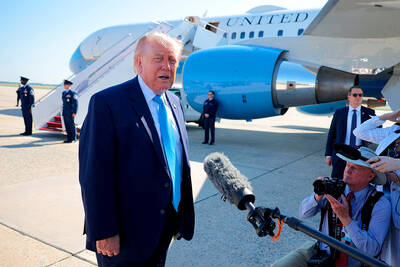
US President Donald Trump yesterday said he would speak to President William Lai (賴清德) as his administration considers whether to move ahead with a US$14 billion weapons sale to Taiwan — a potential arms deal that has drawn criticism from China. “Well, I’ll speak to him. I speak to everybody,” Trump told reporters yesterday when asked if he had any plans to call his counterpart, although he did not offer a time frame for when such a conversation could take place. Trump previously said he would speak to the person “that’s running Taiwan,” without specifying who he meant. “We have that situation very


 RSS
RSS