


National party congresses of the KMT and the PFP yesterday selected their chairmen, Lien Chan (連戰) and James Soong (宋楚瑜) respectively, as candidates for next March's presidential election.
The KMT-PFP alliance, forged by Lien and Soong last month, was also approved by the two parties' national party congresses, allowing the two parties to plan a joint ticket for the presidential race.
The KMT held its congress at the National Sun Yat-Sen Memorial Hall while the PFP's was at the Civil Service Development Institute.
In a speech delivered after getting the KMT congress' endorsement, Lien pledged that, if elected as president next year, he would make an immediate visit to China, dubbed by him as a "journey of peace."
"As long as it can enable peaceful relation for the both sides of the Strait, I am willing to shoulder this mission and responsibility for the sake of Taiwan's 23 million people and their offspring," Lien told his audience.
"I will push for immediate opening of a direct air link with China and sign several agreements with China so that Taiwan and mainland people can live in peace," Lien said.
He would also push for the proper implementation of Taiwan's "semi-presidential system" he said.
Citing the KMT's achievements made during its decades-long rule in Taiwan before losing power to the DPP in 2000, Taipei Mayor Ma Ying-jeou (
Lien and Soong are slated to meet on Wednesday to further exchange views on its KMT-PFP Alliance Policy-making Committee, which will serve to thrash out issues related to cooperation between the two parties.
While the parties have agreed to file a joint ticket for the election there has yet been no agreement on who would lead it, though it is widely assumed that Lien will take this role.
During the KMT's national party congress, Ma was named by Lien and approved by the party con-gress, with applause, to be a party vice chairman in addition to the current five.
However, one of the five vice chairpersons, Chiang Chung-ling (
"[My resignation] has nothing to do with Ma's assumption of the vice chairmanship," Chiang said.
The KMT congress both approved Chiang's resignation and the selection of Legislative Yuan vice speaker Chiang Ping-kun (
Commenting on the opposition camp's nominations of Lien and Soong, DPP Deputy Secretary General Lee Ying-yuan (
The two parties had made no progress in the last three years in the issues of strengthening intra-party democracy and exterminating "black gold" politics, Lee said.
The congress decision had been long decided in advance by the party leaders and the congress process was a travesty of a democratic selection process, Lee said.
Lee said the semi-presidential system was really a scheme seeking to pave the way for Soong's serving as vice president and premier concurrently.
This was a form of booty-sharing already agreed upon by the blue-camp leaders, he said.
Also See Story:
Editorial: Lien Chan makes China an issue
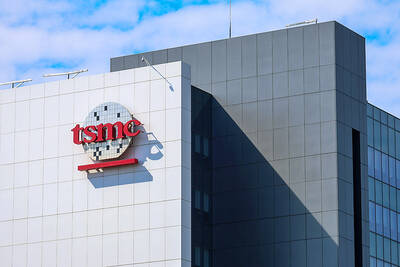
Taiwan Semiconductor Manufacturing Co (TSMC, 台積電), the world’s largest foundry service provider, yesterday said that global semiconductor revenue is projected to hit US$1.5 trillion in 2030, after the figure exceeds US$1 trillion this year, as artificial intelligence (AI) demand boosts consumption of token and compute power. “We are still at the beginning of the AI revolution, but we already see a significant impact across the whole semiconductor ecosystem,” TSMC deputy cochief operating officer Kevin Zhang (張曉強) said at the company’s annual technology symposium in Hsinchu City. “It is fair to say that in the past decade, smartphones and other mobile devices were
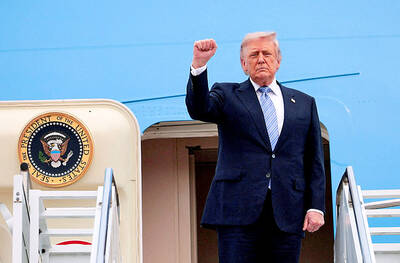
US-CHINA SUMMIT: MOFA welcomed US reassurance of no change in its Taiwan policy; Trump said he did not comment when Xi talked of opposing independence US President Donald Trump yesterday said he has not made a decision on whether to move forward with a major arms package for Taiwan after hearing concerns about it from Chinese President Xi Jinping (習近平). Trump’s comments on Taiwan came as he flew back to Washington after wrapping up critical talks in which both leaders said important progress was made in stabilizing US-China relations even as deep differences persist between the world’s two biggest powers on Iran and Taiwan. “I will make a determination,” Trump said, adding: “I’ll be making decisions. But, you know, I think the last thing we need right
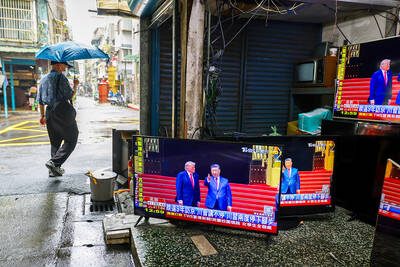
TAIWAN ISSUE: US treasury secretary Scott Bessent said on the first day of meetings that ‘it wouldn’t be a US-China summit without the Taiwan issue coming up’ There were no surprises on the first day of the summit between US President Donald Trump and Chinese President Xi Jinping (習近平), the Mainland Affairs Council (MAC) said yesterday, as the government reiterated that cross-strait stability is crucial to the Asia-Pacific region, as well as the world. As the two presidents met for a highly anticipated summit yesterday, Chinese state media reported that Xi warned Trump that missteps regarding Taiwan could push their two countries into “conflict.” Trump arrived in China with accolades for his host, calling Xi a “great leader” and “friend,” and extending an invitation to visit the White House
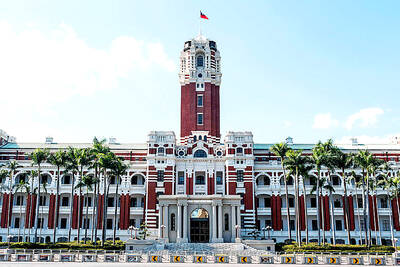
SECURITY: Taipei presses the US for arms supplies, saying the arms sales are not only a reflection of the US security commitment to Taiwan but also serve as a mutual deterrent against regional threats Taiwan is committed to preserving the cross-strait “status quo” and contributing to regional peace and stability, the Presidential Office said yesterday. “It is an undeniable fact that the Republic of China is a sovereign and independent democratic nation,” Presidential Office spokeswoman Karen Kuo (郭雅慧) reiterated, adding that Beijing has no right to claim sovereignty over Taiwan. The statements came after US President Donald Trump warned against Taiwanese independence. Trump wrapped up a state visit to Beijing on Friday, during which Chinese President Xi Jinping (習近平) had pressed him not to support Taiwan. Taiwan depends heavily on US security backing to deter China from carrying


 RSS
RSS